Daniel Bell | Linking knickpoint morphodynamic processes to stratigraphic products of channels
Автор: SEPM Society for Sedimentary Geology
Загружено: 2022-06-19
Просмотров: 218
Описание:
Bouma Virtual Sampler Conference
20-22 April 2022 Day 1 - Flow Processes
Daniel Bell | Linking knickpoint morphodynamic processes to the stratigraphic products of modern and ancient submarine channels
Keywords: knickpoints, submarine channels, repeat bathymetry, morphodynamics
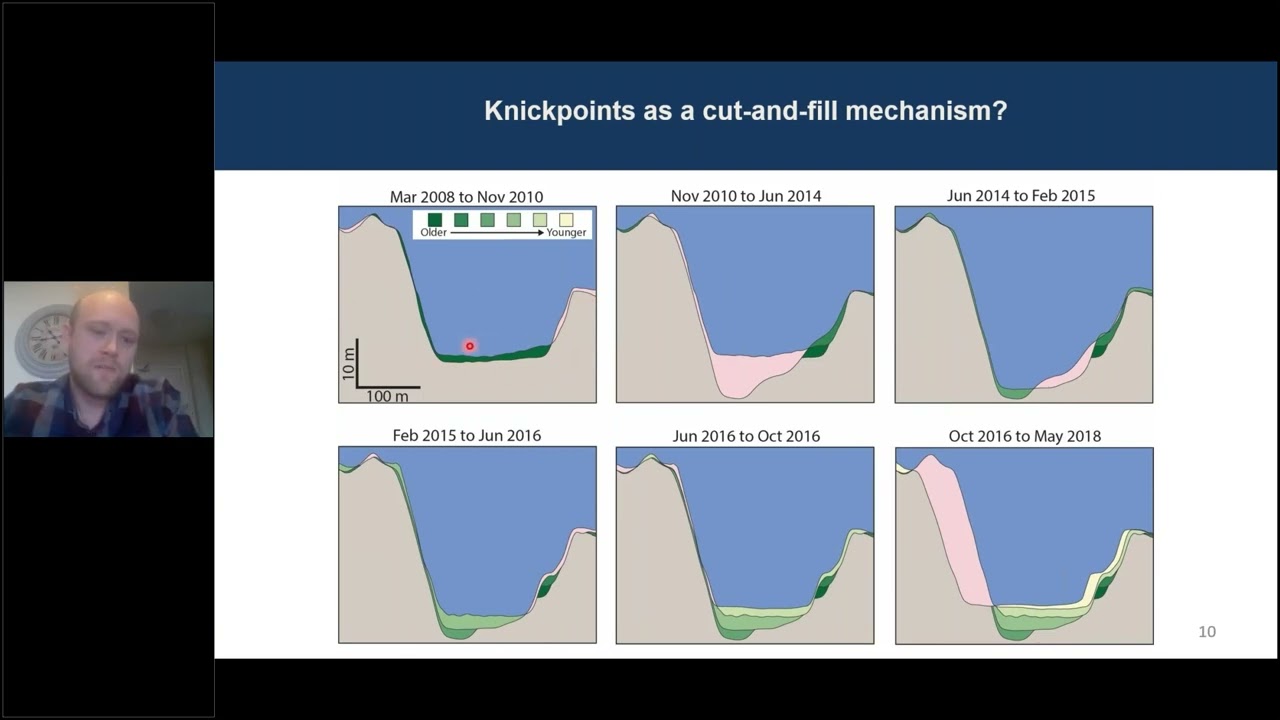
Near-continuous monitoring of rivers through field-observations and remote sensing reveals the lateral migration of barforms is a primary control on their evolution. This produces high aspect ratio channel belts containing laterally accreting sedimentary bodies and couples sedimentary processes to stratigraphic products. Conversely, submarine channels are notoriously challenging to monitor; hence the link between their sedimentary processes and stratigraphic products are comparatively poorly understood. Their planform similarity to rivers means the point-bar model is often applied to submarine channels. However, submarine channel belts exhibit lower aspect ratios, and stratigraphic architectures are dominated by cut-and-fill patterns rather than laterally accreting bodies.
To investigate this disparity, we analyse the depositional geometries of an active submarine channel using repeat bathymetric surveys (Bute Inlet, Canada); and an outcropping example using field mapping and a digital outcrop model (Tres Pasos Fm., Chile). Over decadal timescales, the evolution of the submarine channel in Bute Inlet is dominated by upstream migrating (100s of m/year) knickpoints, with minor lateral migration. Vertical incision is focused in the thalweg at the knickpoint head, whilst deposition occurs downstream of a knickpoint; consequently, successive knickpoints rework the deposits of previous knickpoints. This process produces a repeated cut-and-fill pattern in strike-view, with dip perspectives characterised by discontinuous lenticular-, flute-, and wedge-shaped deposits. These architectures are comparable to those developed in the Tres Pasos Formation over geological timescales, and we suggest that these geometries and lack of obvious lateral accretion in the Tres Pasos Formation channel-fills can be explained by repeated knickpoint migration. We hypothesise that upstream migrating knickpoints are primary morphodynamic agents in submarine channels, comparable in function to point and braid bars in rivers. Accordingly, the role of knickpoints has been previously unappreciated, and may provide an improved channel-fill model prompting re-appraisal of previously studied deep-water depositional systems.
Learn more: https://sepm.org/bouma-conference
Повторяем попытку...
Доступные форматы для скачивания:
Скачать видео
-
Информация по загрузке: