Lenaig Brun | Reworking and deeper sea transfert of cohesive turbiditic deposits
Автор: SEPM Society for Sedimentary Geology
Загружено: 2022-06-19
Просмотров: 111
Описание:
Bouma Virtual Sampler Conference
20-22 April 2022 Day 1 - Flow Processes
Lenaig Brun | Reworking and deeper sea transfert of cohesive turbiditic deposits in the Cassidaigne submarine canyon by internal and regional currents
Keywords: source to sink, canyons, turbidity currents, upwelling
Submarine canyons are common morphological features incising continental slopes. They may start from shallow waters (i.e. submitted to wave action), littoral settings (i.e. submitted to rivers plumes) or even estuaries (i.e. exposed to turbidity maximum). They link continental platforms to the deep sea and are the major pathway for turbidity currents and hence sediment transport. These sediment-laden gravity flows are able to sculpt the continental margins, submarine canyons and eventually produce the large sediment accumulations in the deep-sea together with associated elements as organic carbon, oxygen, nutrients and pollutants.
The study of turbidity flows, much based on their deposits and sediment archives, have been neglecting the interaction with the highly dynamic ocean they are flowing through. The physical investigation of the way gravity-driven flows and oceanic circulation interact is an opening research field. Beside regional contour currents, canyons may locally trap energy and momentum: internal tides, quasi-inertial waves, denser water cascading and upwellings are canyon-specific flows that may modulate the sediment transfer to the deep sea.
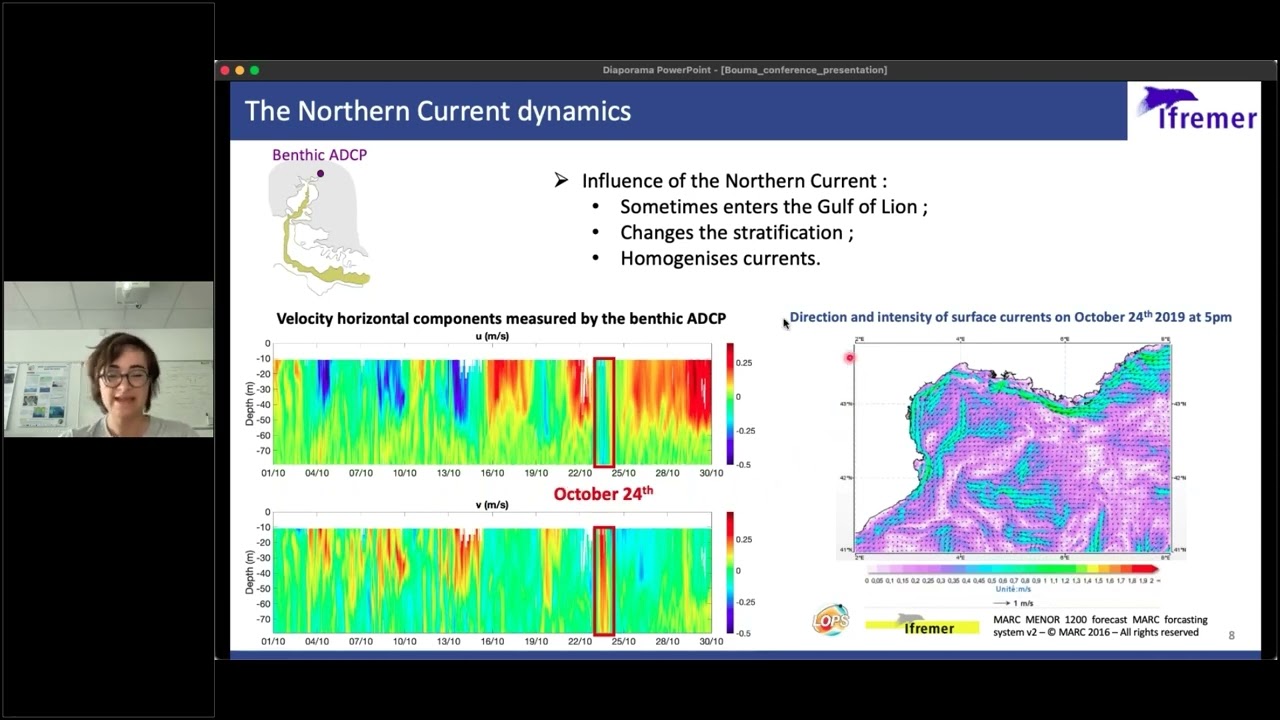
Here, we are presenting monitoring data from the Cassidaigne submarine canyon (Gulf of Lions, French Mediterranean) in order to identify how ocean flows may remobilise sediment previously brought by gravity-driven turbidity currents. The Cassidaigne canyon is used as a field-scale laboratory. From 1967 to 2015, exogenous residual red mud from the industrial treatment of bauxite ore was rejected in the canyon at 320 m of water depth. The estimated 35 mega-tonnes of red mud outflow generated an extended turbiditic system with characteristic deposits.
These red muds are now used as a proxy of how hydrodynamics in a submarine canyon, induced by regional ocean circulation, may eventually affect turbiditic systems and their deposits. Among others, results show that canyon internal energy is able to regenerate turbidity currents from previous deposits and preserve sediment transfer to the deep-sea.
Learn more: https://sepm.org/bouma-conference
Повторяем попытку...
Доступные форматы для скачивания:
Скачать видео
-
Информация по загрузке: