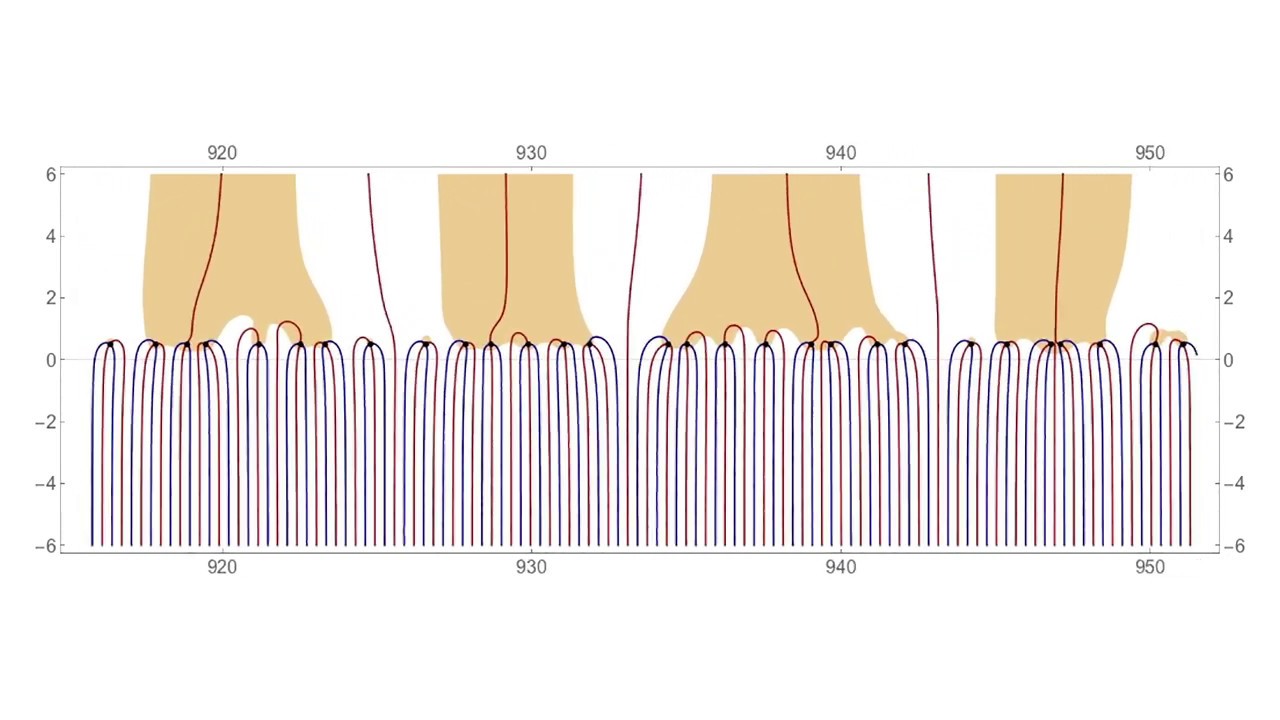
The 4765th Loop of the Riemann Zeta Function Is Itty Bitty
Автор: Infinite Regress
Загружено: 2023-04-07
Просмотров: 50720
Описание:
Any nontrivial zeros that do not lie along the Critical Line of real part = 0.5 must do so in 2 pairs symmetric about both the Critical Line and the Real Line. Therefore, these zeros would necessarily have real part = 0.5 ± some value less than 0.5.
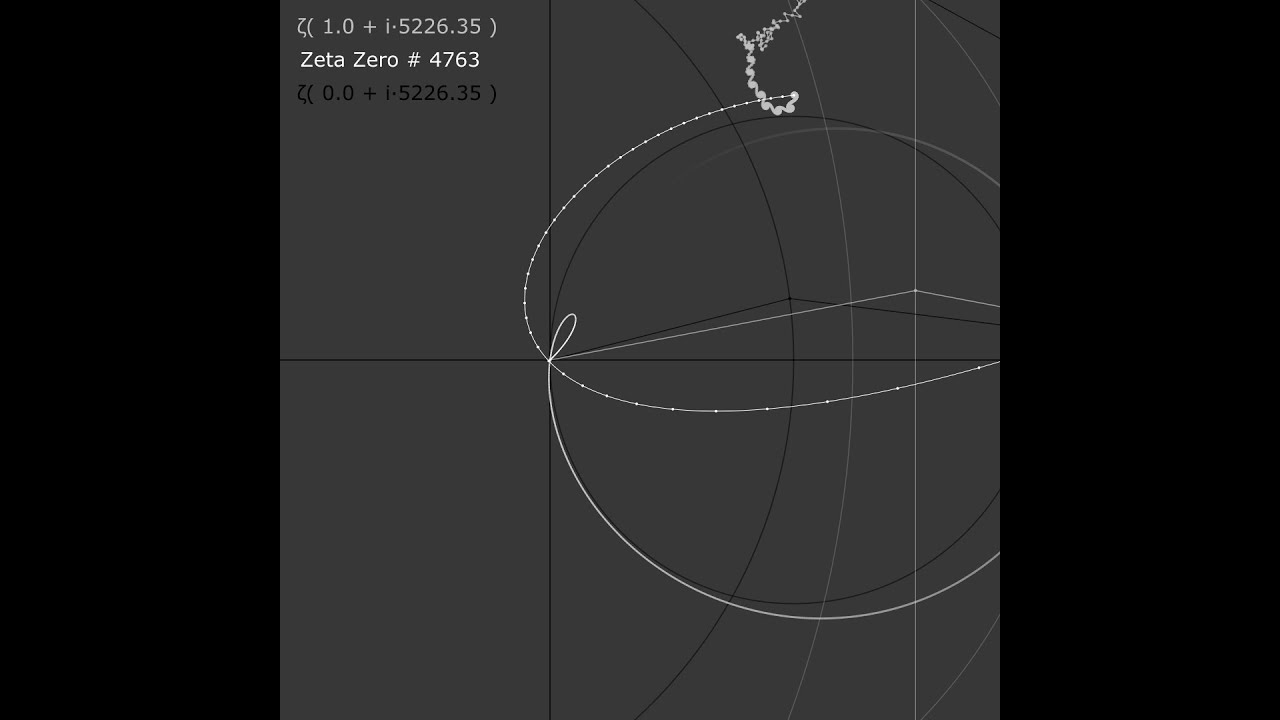
Imagine walking down the Critical Strip and picking up a perpendicular sliver of the strip, from real part = 0 across to 1, then moving it over onto the complex output plane, adjusting its shape and length so that every point mapped according to the Riemann Zeta Function.
For a pair of nontrivial zeros to exist here, this sliver of the Critical Strip would have to satisfy 3 requirements:
• First, it would now have to be intersecting itself, meaning 2 input points mapping to the same output point.
• Second, the overlap would have to be that of 2 points that were originally the same distance in the Critical Strip on either side of the point that had real part = 0.5, (e.g. 0.4 and 0.6).
• Third and finally, this perfectly symmetric coincidence would have to land exactly on the zero of the complex output plane.
This video shows that instances of the first condition do indeed occur when the loops of the Critical Line are sufficiently small.
However, it seems to be the case that the second condition can never be met.
The loop that forms to allow for the self-intersection creates a pinch point that appears always to remain in the right half of the Critical Strip sliver, originally with real part > 0.5 up to 1. Furthermore, the right half of the sliver appears always to be shorter than the left half; so, even though intersection points can exist out into the left half (see between Zeta Zeros 34 and 35 for the first time this occurs), the points from the right half would always start out behind and never be able to catch up to their symmetric left half partner, thus always failing to meet the second condition.
If so, then the Riemann Hypothesis is true.
In fact, in his paper Geometrisches zur Riemannschen Zetafunktion written in 1934, Andreas Speiser showed that, given input from the left half of the Critical Strip, the derivative of the Riemann Zeta Function never producing a zero is equivalent to the Riemann Hypothesis.
~
The Riemann Zeta Function, as the sum of all positive integer reciprocals each raised to the complex input, ( A+i·B ), only converges for input with real part greater than 1.
ζ( A+i·B ) = ( for N = 1 to ∞ ) ∑ { ( 1/N )^( A+i·B ) }, for A > 1
The Dirichlet Eta Function, also known as the Alternating Zeta Function, with every 2nd term subtracted rather than added, however, converges for all input with positive real part.
η( A+i·B ) = ( for N = 1 to ∞ ) ∑ { ( 1/N )^( A+i·B ) · ( –1 )^( N–1 ) }, for A > 0
By taking advantage of the odd-term and even-term subsequences in these functions, it is possible to define the Riemann Zeta Function in terms of the Dirichlet Eta Function, thus extending its definition to the remaining positive real portion of its complex input plane, the Critical Strip.
ζ( A+i·B ) = η( A+i·B ) / ( 1 – 2·( 1/2 )^( A+i·B ) ), for A > 0
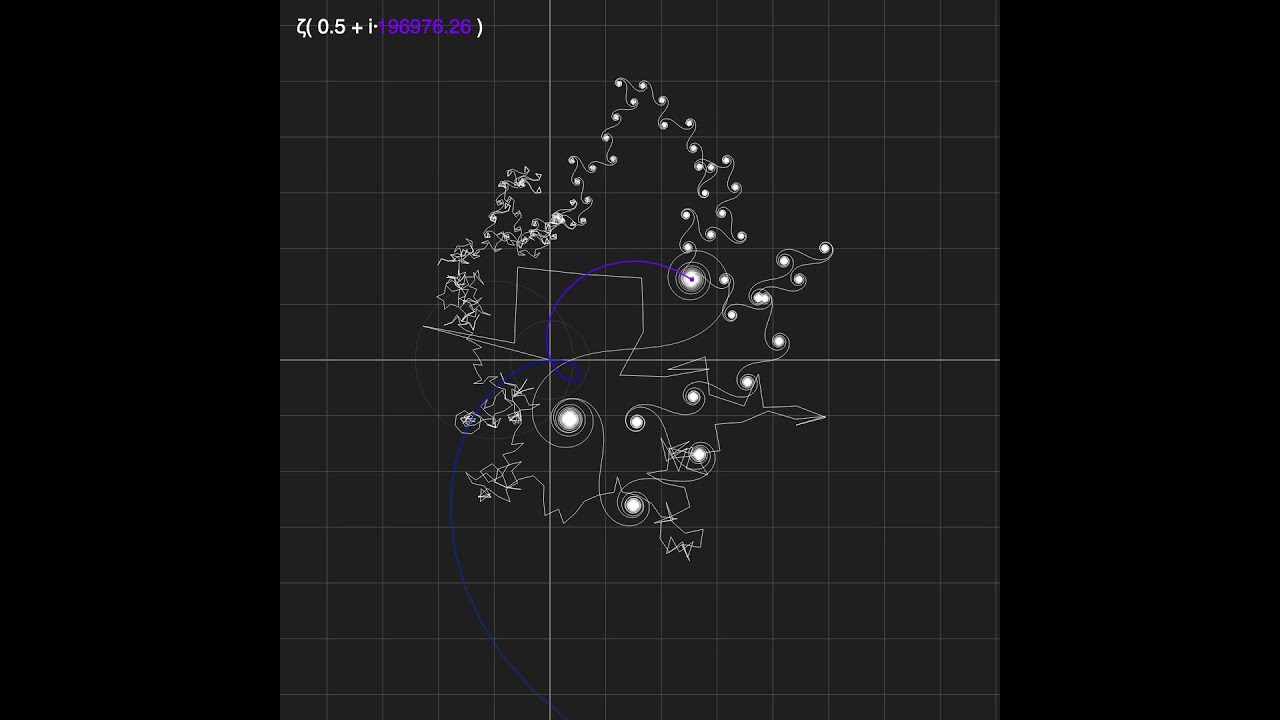
So, this animation depicts not only how discrete paths in the complex output plane taken by this infinite alternating sum––the Eta-defined Zeta Function––converge to specific output values, but also how these paths change and move as the input values (top-left) in the complex input plane move in the positive imaginary direction along the lines of real part A = 0.5+h, with the Critical Strip's minimum and maximum being h = -0.5 and 0.5.
path( ζ( 0.5+h + i·B ) ) = ( for N = 1 to ∞ ) ∑ { ( X – i·Y ) · ( –1 )^( N–1 ) }
X = [ √(2) · cos( B·ln(N/2) ) – ( 2^h ) · cos( B·ln(N) ) ] / [ N^( 0.5+h ) · ( √(8) · cos( B·ln(2) ) - 2^( 1-h ) - 2^h ) ]
Y = [ √(2) · sin( B·ln(N/2) ) – ( 2^h ) · sin( B·ln(N) ) ] / [ N^( 0.5+h ) · ( √(8) · cos( B·ln(2) ) - 2^( 1-h ) - 2^h ) ]
For the animation, the number of steps used for N was 512+floor(B/3) which was enough to reach the final twirl in the path that spirals in toward the actual output value for the Zeta Function.
The animation also depicts the trail for the line of real part = 0.5 from imaginary part = B fading to B-1, along with the full sliver of points with the same imaginary part = B.
Finally, about the path with real part = 0--it does not actually converge to a point given that its steps do not decrease in length. However, it does orbit around the point towards which the rest of its Critical Strip sliver approaches. That being said, being this far along the Critical Strip, it has grown quite large and extends much farther out than the path with real part = 1, thus lying well outside the scale relevant to this video.
For example, ζ(0.5 + i·5229.22) is about 0.00415568 + i·0.00252234 (the itty bitty loop) and ζ(1 + i·5229.22) is about 0.605669 + i·0.200235; meanwhile, ζ(0 + i·5229.22) reaches out to about 13.1889 + i·12.8344.
Повторяем попытку...
Доступные форматы для скачивания:
Скачать видео
-
Информация по загрузке:




![[Visual] The Riemann Zeta Function Visualised](https://imager.clipsaver.ru/GcbML8bGSu8/max.jpg)