The Riemann Zeta Function along the Critical Line around 196560 and 196883
Автор: Infinite Regress
Загружено: 2023-03-21
Просмотров: 32066
Описание:
The Riemann Zeta Function, as the sum of the reciprocals of all positive integers each raised to the complex input, ( A+i·B ), only converges for input with real part greater than 1.
ζ( A+i·B ) = ( for N = 1 to ∞ ) ∑ { ( 1/N )^( A+i·B ) }, for A > 1
The Dirichlet Eta Function, also known as the Alternating Zeta Function, with every 2nd term subtracted rather than added, however, converges for all input with positive real part.
η( A+i·B ) = ( for N = 1 to ∞ ) ∑ { ( 1/N )^( A+i·B ) · ( –1 )^( N–1 ) }, for A > 0
By taking advantage of the odd-term and even-term subsequences in these functions, it is possible to define the Riemann Zeta Function in terms of the Dirichlet Eta Function, thus extending its definition to the remaining positive real portion of its complex input plane, the Critical Strip.
ζ( A+i·B ) = η( A+i·B ) / ( 1 – 2·( 1/2 )^( A+i·B ) ), for A > 0
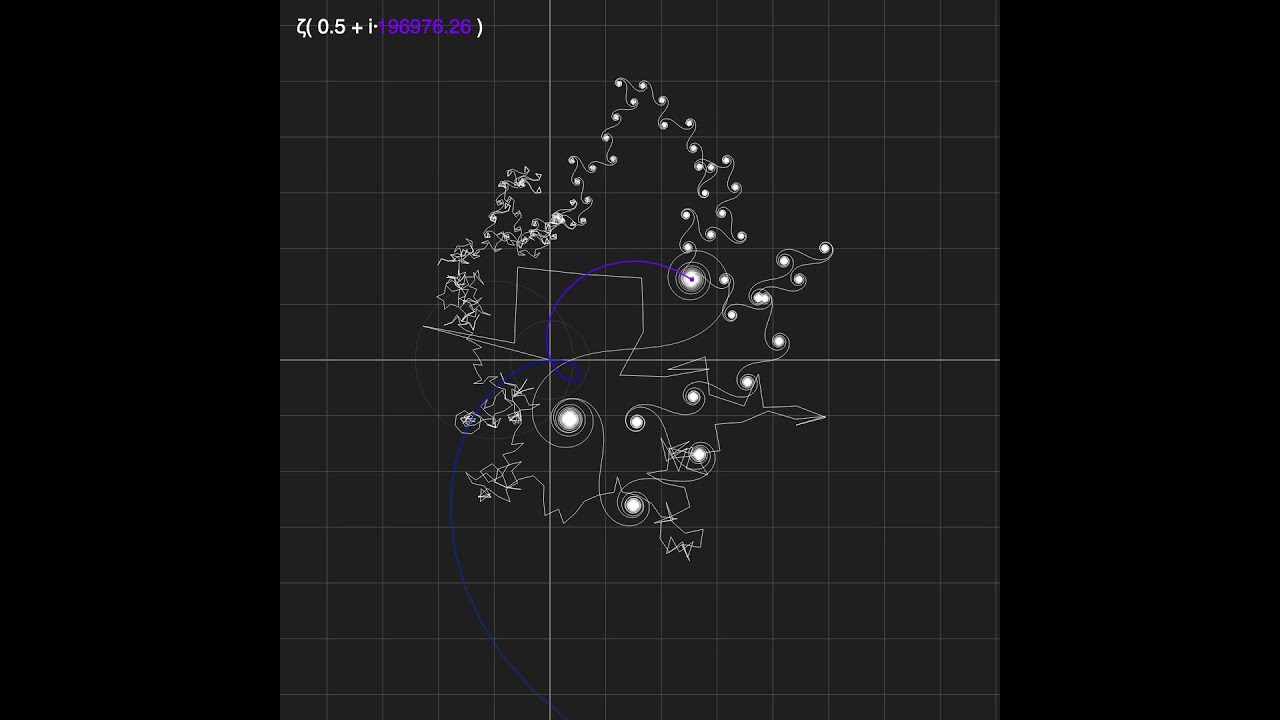
So, this animation depicts not only how the discrete path in the complex output plane taken by this infinite alternating sum––the Eta-defined Zeta Function––converges to a specific output value, but also how that path changes and moves as the input value (top-left) in the complex input plane moves in the positive imaginary direction along the line of real part A = 0.5––the Critical Line.
path( ζ( 0.5+i·B ) ) = ( for N = 1 to ∞ ) ∑ { X – i·Y }
X = ( –1 )^( N–1 ) · [ √(2) · cos( B·ln(N/2) ) – cos( B·ln(N) ) ] / [ √(8·N) · cos( B·ln(2) ) – √(9·N) ]
Y = ( –1 )^( N–1 ) · [ √(2) · sin( B·ln(N/2) ) – sin( B·ln(N) ) ] / [ √(8·N) · cos( B·ln(2) ) – √(9·N) ]
For the animation, the number of steps used for N was 512+floor(B/3) which was enough to reach the final twirl in the path that spirals in toward the actual output value for the Zeta Function.
Повторяем попытку...
Доступные форматы для скачивания:
Скачать видео
-
Информация по загрузке:


![Тестовый вопрос, на который все ответили неверно [Veritasium]](https://image.4k-video.ru/id-video/yP_hDez9wXA)


