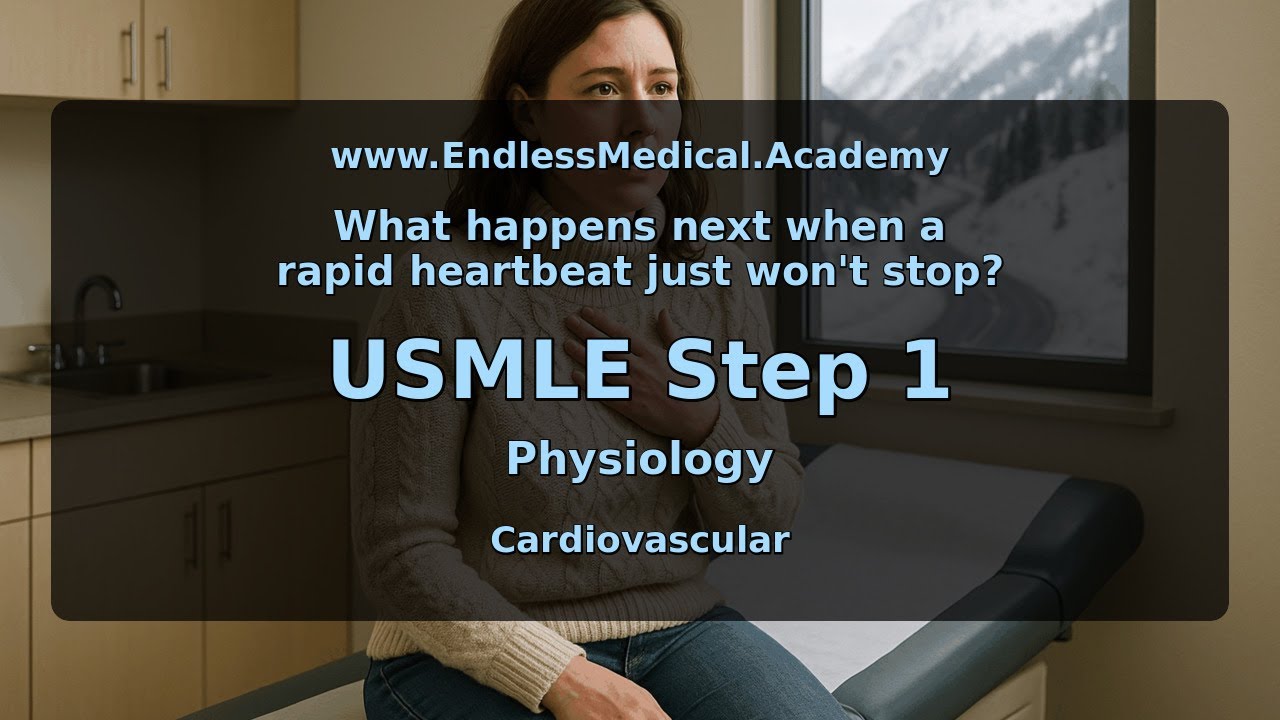
Cardiovascular, Physiology, USMLE Step 1 - Full Vignette with Extended Explanations
Автор: EndlessMedical.Academy
Загружено: 2026-02-21
Просмотров: 7
Описание:
A 57-year-old woman with a history of type 1 diabetes, ulcerative colitis, and IgG4-related disease presents with progressive exertional dyspnea, orthopnea, reduced exercise tolerance, and ankle swelling. Her physical exam shows bibasilar crackles and pitting edema, and labs reveal elevated NT-proBNP with normal troponin. What clinical findings and diagnostic clues should you focus on to identify the condition responsible for her symptoms in this complex patient?
VIDEO INFO
Category: Cardiovascular, Physiology, USMLE Step 1
Difficulty: Hard - Advanced level - Challenges experienced practitioners
Question Type: Diagnosis - Identify conditions based on clinical presentation
Case Type: Routine Visit - Standard clinical encounter in outpatient setting
Explore more ways to learn on this and other topics by going to https://endlessmedical.academy/auth?h...
QUESTION
A 57-year-old woman presents to her primary care clinic for progressive exertional dyspnea, reduced walking distance, and ankle swelling over several months. She works in education and lives independently....
OPTIONS
A. Heart failure with preserved ejection fraction driven by impaired diastolic relaxation and elevated left-sided filling pressures.
B. Primary deconditioning with anxiety-related dyspnea and normal cardiopulmonary reserve.
C. Chronic thromboembolic pulmonary hypertension with segmental perfusion defects on ventilation-perfusion imaging, elevated pulmonary vascular resistance, and progressive right-ventricular dilation.
D. Moderate persistent asthma without airflow obstruction or bronchodilator response.
CORRECT ANSWER
A. Heart failure with preserved ejection fraction driven by impaired diastolic relaxation and elevated left-sided filling pressures.
EXPLANATION
Exertional dyspnea, orthopnea, paroxysmal nocturnal dyspnea, bibasilar crackles, S4, obesity, diabetes, concentric LV hypertrophy, preserved LVEF (60%), enlarged left atrium, elevated E/e (17), and mildly increased pulmonary artery systolic pressure support heart failure with preserved ejection fraction (HFpEF) due to impaired diastolic relaxation and elevated left-sided filling pressures. Resting hypoxemia with exertional desaturation can accompany pulmonary congestion and secondary pulmonary hypertension.
Deconditioning with anxiety would not produce elevated E/e , LA enlargement, pulmonary congestion, or elevated natriuretic peptide. Chronic thromboembolic pulmonary hypertension requires mismatched perfusion defects and progressive RV dilation, which are not present. Moderate persistent asthma would show airflow obstruction or a bronchodilator response, neither of which is seen on spirometry.
In summary, the correct answer is Heart failure with preserved ejection fraction driven by impaired diastolic relaxation and elevated left-sided filling pressures. Echo and clinical findings are diagnostic in aggregate.
Primary teaching point: In HFpEF, preserved EF coexists with elevated filling pressures (eg, E/e greater than 15) and structural heart disease (LVH, LAE), supported by symptoms and natriuretic peptides.
Secondary teaching point: HFpEF commonly features obesity, diabetes, and pulmonary hypertension from chronic elevation of left-sided pressures.
Tertiary teaching point: Normal spirometry argues against asthma; absence of V/Q mismatch and RV changes argues against CTEPH.
Further reading:
Links to sources are provided for optional further reading only. The questions and explanations are independently authored and do not reproduce or adapt any specific third-party text or content.
---------------------------------------------------
Our cases and questions come from the https://EndlessMedical.Academy quiz engine - multi-model platform. Each question and explanation is forged by consensus between multiple top AI models (i.e. Open AI GPT, Claude, Grok, etc.), with automated web searches for the latest research and verified references. Calculations (e.g. eGFR, dosages) are checked via code execution to eliminate errors, and all references are reviewed by several AIs to minimize hallucinations.
Important note: This material is entirely AI-generated and has not been verified by human experts; despite stringent consensus checks, perfect accuracy cannot be guaranteed. Exercise caution - always corroborate the content with trusted references or qualified professionals, and never apply information from this content to patient care or clinical decisions without independent verification.
Clinicians already rely on AI and online tools - myself included - so treat this content as an additional focused aid, not a replacement for proper medical education. Visit https://endlessmedical.academy for more AI-supported resources and cases.
This material can not be treated as medical advice. May contain errors.
---------------------------------------------------
Повторяем попытку...

Доступные форматы для скачивания:
Скачать видео
-
Информация по загрузке: