Cardiovascular, Physiology, USMLE Step 1 - Full Vignette with Extended Explanations
Автор: EndlessMedical.Academy
Загружено: 2026-02-24
Просмотров: 10
Описание:
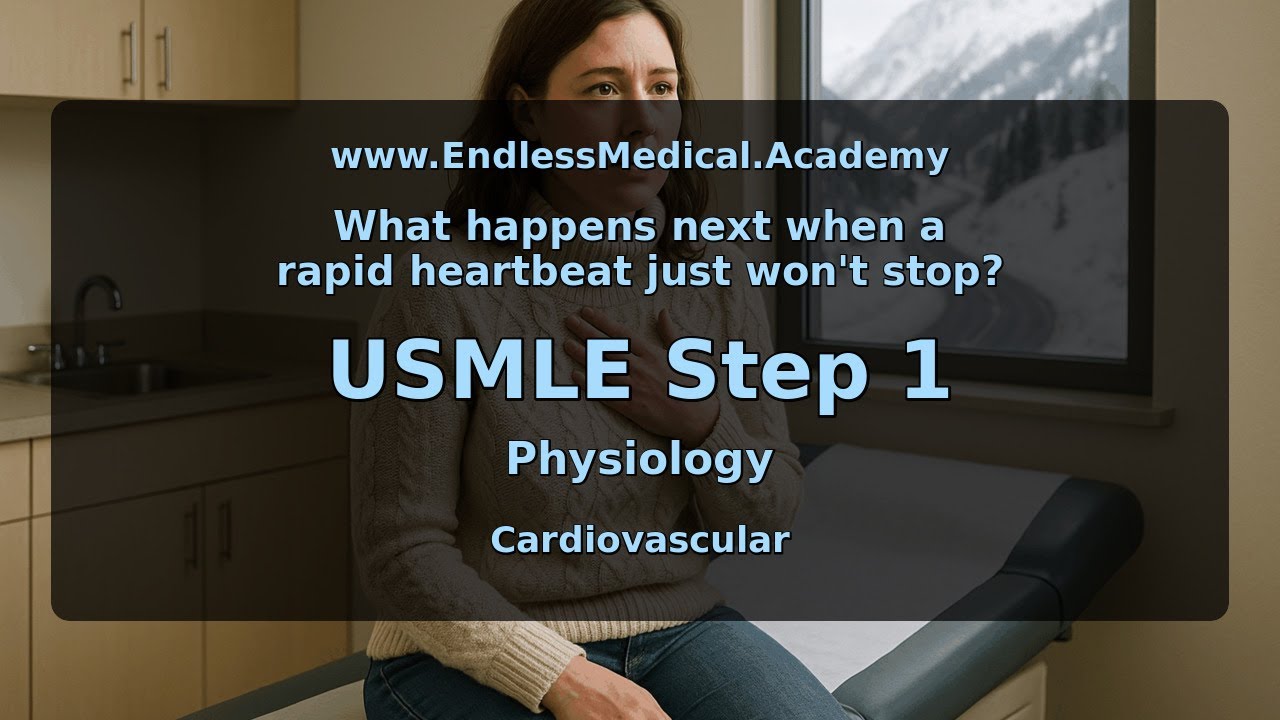
A 30-year-old woman living in a remote area arrives at a small clinic with sudden palpitations, chest fluttering, and lightheadedness while cleaning. Her vital signs reveal a rapid heart rate, oxygen desaturation improved by supplemental oxygen, and a regular narrow-complex tachycardia is seen on rhythm strip. With her medical history and limited access to advanced care, how should her acute symptoms and future risk be assessed?
VIDEO INFO
Category: Cardiovascular, Physiology, USMLE Step 1
Difficulty: Easy - Basic level - Suitable for medical students
Question Type: Natural History
Case Type: Resource Limited
Watch the video for explanation, or see the full explanation at: https://endlessmedical.academy/auth?h...
QUESTION
A 30-year-old woman living in a remote valley presents to a small clinic with sudden palpitations, chest fluttering, and lightheadedness that began while cleaning. Vitals: T 37.6 degreesC, pulse 218-224/min, RR 18/min, BP 146/11 mm Hg, SpO2 90% on room air improving to 95% with 2 L/min oxygen. The rhythm strip shows a regular narrow-complex tachycardia near 220/min without visible P waves. She describes two prior episodes in the past year that started and stopped abruptly....
OPTIONS
A. Paroxysmal AV-node-dependent supraventricular tachycardia tends to recur with sudden onset and offset in structurally normal hearts; short-term mortality is low, but recurrent episodes can impair quality of life and infrequently cause tachycardia-induced cardiomyopathy, making recurrence more lik...
B. Most adults with paroxysmal supraventricular tachycardia experience spontaneous permanent cure within weeks without therapy, so recurrence in the next 6 months is uncommon even without ablation.
C. Untreated paroxysmal supraventricular tachycardia commonly evolves into sustained monomorphic ventricular tachycardia with high near-term sudden death risk despite a structurally normal heart.
D. Paroxysmal supraventricular tachycardia invariably progresses to severe systolic heart failure within a few weeks unless ablation is performed emergently during the index episode.
Further reading:
Links to sources are provided for optional further reading only. The questions and explanations are independently authored and do not reproduce or adapt any specific third-party text or content.
---------------------------------------------------
Our cases and questions come from the https://EndlessMedical.Academy quiz engine - multi-model platform. Each question and explanation is forged by consensus between multiple top AI models (i.e. Open AI GPT, Claude, Grok, etc.), with automated web searches for the latest research and verified references. Calculations (e.g. eGFR, dosages) are checked via code execution to eliminate errors, and all references are reviewed by several AIs to minimize hallucinations.
Important note: This material is entirely AI-generated and has not been verified by human experts; despite stringent consensus checks, perfect accuracy cannot be guaranteed. Exercise caution - always corroborate the content with trusted references or qualified professionals, and never apply information from this content to patient care or clinical decisions without independent verification.
Clinicians already rely on AI and online tools - myself included - so treat this content as an additional focused aid, not a replacement for proper medical education. Visit https://endlessmedical.academy for more AI-supported resources and cases.
This material can not be treated as medical advice. May contain errors.
---------------------------------------------------
Повторяем попытку...
Доступные форматы для скачивания:
Скачать видео
-
Информация по загрузке: