Gastrointestinal, Physiology, USMLE Step 1 - Full Vignette with Extended Explanations
Автор: EndlessMedical.Academy
Загружено: 2026-02-22
Просмотров: 7
Описание:
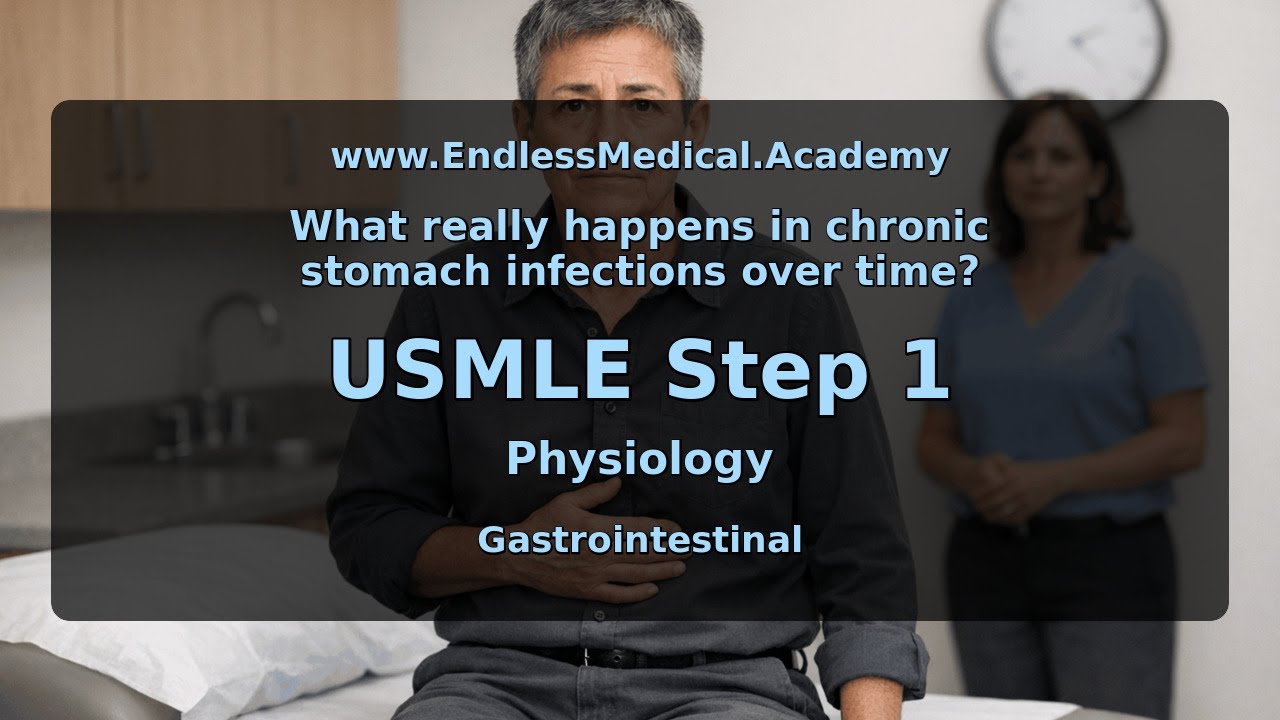
A 30-year-old woman has been experiencing burning epigastric discomfort, early satiety, and intermittent nausea for several months, with a normal exam and initial non-revealing laboratory and imaging results. With persistent symptoms despite proton pump inhibitor therapy and negative Helicobacter pylori serology, what is the most effective next diagnostic approach to consider when investigating ongoing upper gastrointestinal complaints?
VIDEO INFO
Category: Gastrointestinal, Physiology, USMLE Step 1
Difficulty: Moderate - Intermediate level - Requires solid foundational knowledge
Question Type: Diagnostic Failure
Case Type: Tricky Findings
Explore more ways to learn on this and other topics by going to https://endlessmedical.academy/auth?h...
QUESTION
A 30-year-old woman presents with 4 months of burning epigastric discomfort, early satiety, and intermittent nausea. She denies hematemesis or melena and has no NSAID use. Medical history includes multiple sclerosis treated with glatiramer, chronic spontaneous urticaria for which she uses cetirizine as needed, and a remote repaired myelomeningocele. She rarely drinks alcohol and has been abstinent from heroin for several years. She has an egg allergy that causes pruritic rash....
OPTIONS
A. Stop PPI for 2 weeks and perform a urea breath test to diagnose active Helicobacter pylori
B. Perform a urea breath test now while continuing the current PPI dose without interruption
C. Repeat serum H. pylori IgG ELISA as the preferred diagnostic approach for active infection
D. Start 14 days of clarithromycin triple therapy empirically without further testing confirmation
CORRECT ANSWER
A. Stop PPI for 2 weeks and perform a urea breath test to diagnose active Helicobacter pylori
EXPLANATION
Stopping proton pump inhibitors before noninvasive tests increases diagnostic yield for active Helicobacter pylori. PPIs suppress bacterial urease activity and reduce organism load, causing false-negative urea breath tests and stool antigen tests. Per the ACG 2024 guideline and NICE QS96, PPIs should be withheld for about 2 weeks before testing. This patient remains symptomatic despite PPI therapy, had negative serology (which cannot distinguish past from active infection), and has not had endoscopy; thus, holding the PPI for 2 weeks and then performing a urea breath test best balances accuracy and noninvasiveness.
Performing a urea breath test while continuing PPIs risks a false negative. Repeating serum IgG ELISA is inappropriate because serology detects exposure, not active infection, and lingers positive after eradication; sensitivity/specificity are inferior for active disease. Empiric clarithromycin triple therapy without confirmation is discouraged in the United States due to high and variable clarithromycin resistance and because best practice is test-and-treat with confirmation of active infection.
In summary, the correct answer is Stop PPI for 2 weeks and perform a urea breath test to diagnose active Helicobacter pylori, because a 2-week washout improves sensitivity and avoids unnecessary procedures while ensuring accurate noninvasive diagnosis.
Primary teaching point: PPIs should be stopped for ~2 weeks before urea breath or stool antigen testing to limit false negatives.
Secondary teaching point: H. pylori serology (IgG) does not distinguish active from past infection and should not be used to diagnose active disease.
Tertiary teaching point: Avoid empiric clarithromycin triple therapy without confirmation due to resistance and guideline-recommended test-and-treat strategies.
Further reading:
Links to sources are provided for optional further reading only. The questions and explanations are independently authored and do not reproduce or adapt any specific third-party text or content.
---------------------------------------------------
Our cases and questions come from the https://EndlessMedical.Academy quiz engine - multi-model platform. Each question and explanation is forged by consensus between multiple top AI models (i.e. Open AI GPT, Claude, Grok, etc.), with automated web searches for the latest research and verified references. Calculations (e.g. eGFR, dosages) are checked via code execution to eliminate errors, and all references are reviewed by several AIs to minimize hallucinations.
Important note: This material is entirely AI-generated and has not been verified by human experts; despite stringent consensus checks, perfect accuracy cannot be guaranteed. Exercise caution - always corroborate the content with trusted references or qualified professionals, and never apply information from this content to patient care or clinical decisions without independent verification.
Clinicians already rely on AI and online tools - myself included - so treat this content as an additional focused aid, not a replacement for proper medical education. Visit https://endlessmedical.academy for more AI-supported resources and cases.
This material ...
Повторяем попытку...

Доступные форматы для скачивания:
Скачать видео
-
Информация по загрузке: