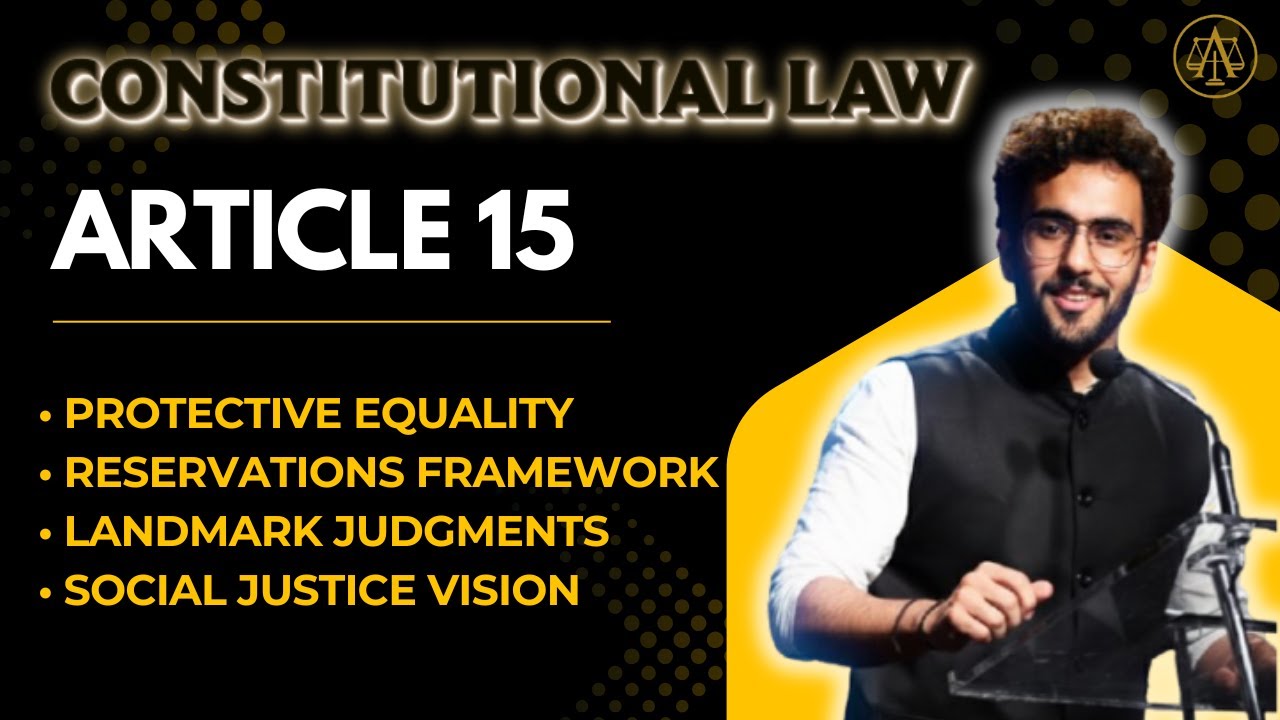
Article 15 – Prohibition of Discrimination, Protective Equality & Key Judgments | UPSC & CLAT PG
Автор: LexMentor | Adv. Aditya Sharma
Загружено: 2025-11-23
Просмотров: 29
Описание:
In this lecture, we examine Article 15, one of the core equality provisions under the Indian Constitution. Article 15 operationalises the broader guarantee of equality under Article 14 by expressly prohibiting the State from discriminating on specific grounds, while simultaneously empowering it to take affirmative measures for socially and educationally disadvantaged classes.
This topic is indispensable for UPSC Law Optional, CLAT PG, Judiciary, UGC-NET Law and university-level constitutional examinations due to its unique blend of negative prohibitions and positive commitments to substantive equality.
🧭 What You’ll Learn
1️⃣ Article 15 – Text, Meaning & Constitutional Objective
Meaning of discrimination on prohibited grounds such as religion, race, caste, sex, and place of birth.
Understanding Articles 15(1) and 15(2) as the foundational anti-discrimination guarantees.
Relationship between individual rights and State obligations in preventing both direct and indirect discrimination.
2️⃣ Protective Discrimination under Article 15(3), 15(4) & 15(5)
Constitutional validity of special provisions for women and children under Article 15(3).
The emergence of affirmative action for socially and educationally backward classes through Article 15(4).
Scope of reservations in educational institutions, including private unaided institutions (except minority institutions), under Article 15(5).
Role of Article 15(6) in permitting reservations for economically weaker sections (EWS).
3️⃣ Landmark Supreme Court Judgments
State of Madras v. Champakam Dorairajan (origin of 15(4))
M.R. Balaji v. State of Mysore (interpretation of backwardness)
Indra Sawhney v. Union of India (limits on reservations—though primarily Article 16, foundational for 15(4) and 15(5))
T.M.A. Pai Foundation, P.A. Inamdar and Ashoka Kumar Thakur (educational institutions & reservation policy)
Navtej Singh Johar v. Union of India (equality and non-discrimination jurisprudence)
Janhit Abhiyan v. Union of India (EWS reservation constitutionality)
4️⃣ What Article 15 Does NOT Permit
No discrimination solely based on the specified grounds.
No reverse discrimination without constitutional backing.
No arbitrary classifications disguised as affirmative action.
5️⃣ Importance of Article 15
Promotes substantive equality and social justice.
Forms the constitutional basis for India’s reservation framework.
Widely tested in exams through theory, case-law analysis and policy-based questions.
👨⚖️ LinkedIn:
/ advocate-adityasharma
Повторяем попытку...
Доступные форматы для скачивания:
Скачать видео
-
Информация по загрузке: