Difference between Inductive Effect and Resonance Effect | Cogitavers
Автор: CogitaVerse-Urdu Hindi
Загружено: 2026-01-08
Просмотров: 13
Описание:
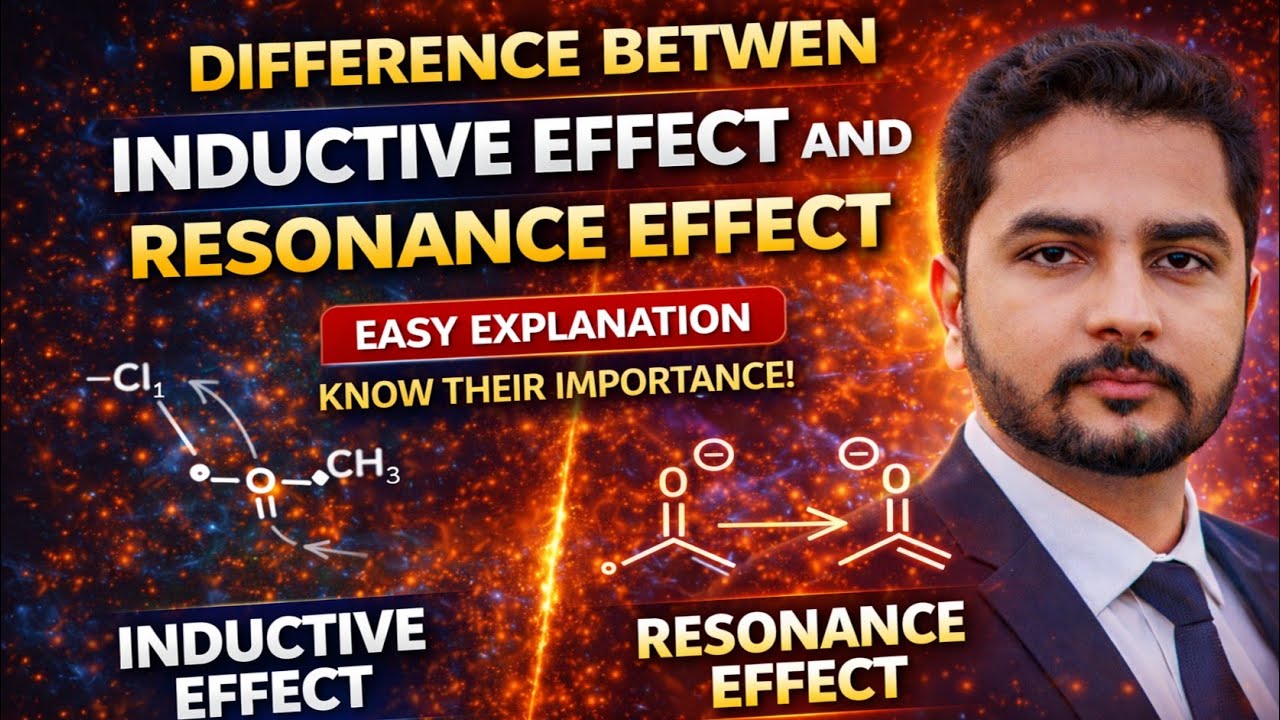
Understanding how electrons shift within organic molecules is foundational for mastering reaction mechanisms, predicting product stability, and confidently navigating GOC. In this detailed Cogitavers lecture-style description, we delve deep into the conceptual and practical distinctions between the Inductive Effect and the Resonance Effect, two pillars of electronic interpretation in organic chemistry. This video is designed to provide you with an academically rich yet intuitive grasp of how these electronic influences dictate reactivity, acidity–basicity, functional group behavior, and overall molecular dynamics across a wide range of reactions.
This explanation begins by front-loading the core SEO concepts—stability, reactivity, mechanism, and GOC interpretation—ensuring learners immediately contextualize the theoretical frameworks within real reaction behavior. Cogitavers guides you through how the Inductive Effect arises from σ-bond electron withdrawal or donation mediated through electronegativity differences. This effect, inherently distance-dependent and rapidly diminishing along the carbon chain, critically shapes acidity, conjugate base stabilization, nucleophilicity, and the behavior of electron-withdrawing and electron-donating substituents in aliphatic systems.
We then contrast this with the Resonance Effect, a phenomenon governed by π-electron delocalization within conjugated frameworks. Resonance contributes profoundly to structural stabilization by distributing electron density across multiple atoms, influencing aromatic substitution patterns, conjugate stability, and the very identity of reactive intermediates. Unlike the inductive effect, resonance operates through overlapping p-orbitals, making it direction-specific, structural-specific, and often dominant in determining chemical behavior when conjugation is present.
Cogitavers emphasizes the practical distinctions: Inductive Effect is permanent, operational in all σ-bonded frameworks, and primarily concerns electronegativity gradients; Meanwhile, the Resonance Effect is structural, dependent on extended orbital overlap, and often overrides inductive influence when conjugation pathways exist. The video explains why electron-withdrawing groups such as –NO₂ exert strong –M effects, how donating groups like –OH and –OR stabilize carbocations via +M effects, and where inductive withdrawal may conflict with resonance donation—as seen in halogens attached to aromatic rings.
To ensure full conceptual mastery, Cogitavers walks you through real-world examples, comparing effects in substituted benzoic acids, evaluating electron flow in carbocations vs carbanions, analyzing EAS directing groups, and examining resonance–inductive interplay in conjugated acids, bases, and intermediates. This long-format academic explanation is crafted for deep comprehension, enabling learners to confidently apply these principles in advanced GOC, reaction prediction, and competitive exam problem-solving.
Cogitavers integrates these insights into a cohesive narrative, making this lecture not only an essential resource for organic chemistry foundations but also a high-value SEO-optimized content module that enhances clarity, retention, and exam-oriented thinking. As always, Cogitavers maintains precision, academic depth, structured reasoning, and exam relevance, ensuring an authoritative understanding of how electronic effects define organic reactivity.
🌐 Website: CogitaVerse.com
📘 Facebook: Facebook.com/cogitaverse
📸 Instagram: Instagram.com/cogita_verse
Повторяем попытку...
Доступные форматы для скачивания:
Скачать видео
-
Информация по загрузке: