Black Ögyen Chenrézigs ~ Oṃ Āḥ Hūṃ Vajra Guru Padma Siddhi Hrīḥ ~ Guru Rinpoche/ Chenrezig Yab Yum
Автор: Om Vajrapani Hum
Загружено: 2026-01-29
Просмотров: 184
Описание:
In the Aro gTér (a Nyingma lineage), Ögyen Chenrézigs is a particularly vibrant and central figure. This form represents the "indivisibility" of the Guru (Padmasambhava) and the Buddha of Compassion (Avalokiteshvara).
When depicted in yab-yum (consort union), the imagery moves beyond simple "gods" and functions as a sophisticated map of the enlightened mind.
The Symbolism of the Union
In the Aro tradition, iconography is rarely just "art"; it’s a description of how reality functions.
The Yab (Male - Ögyen Chenrézigs): He represents skilful means and the "form" aspect of reality. He is the energy that reaches out into the world with compassion.
The Yum (Female - Sang-gyé Tso / Yeshé Tsogyel): She represents emptiness (shunyata) and the spacious, limitless quality of the mind.
The Union: The yab-yum posture isn't about physical romance; it symbolizes that spaciousness and appearance are one. You cannot have the "dance" without the "space" to dance in.
Distinctive Aro Features
Ögyen Chenrézigs
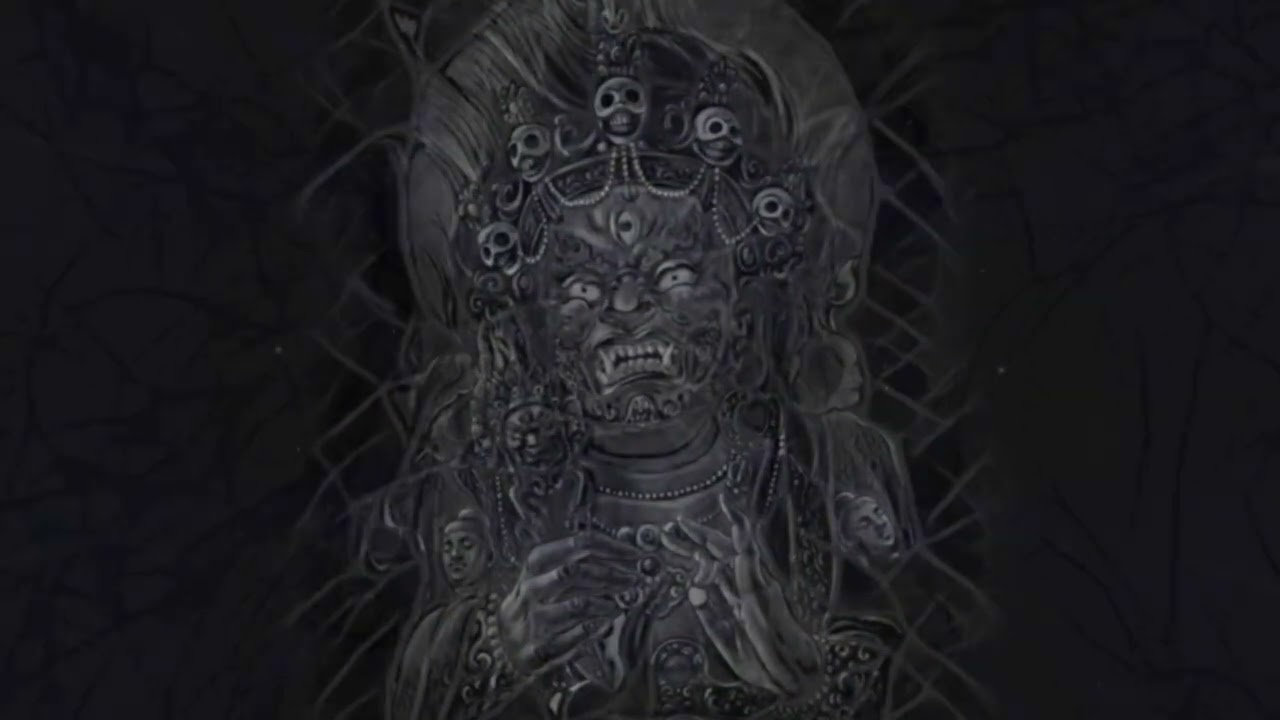
four-armed black Chenrézigs yab-yum
In the Aro gTér all yidams are depicted as manifestations of Padmasambhava and Yeshé Tsogyel. In this form—as Ögyen Chenrézigs—Padmasambhava wears the white hat of Guru Ngangsrid Zilgnön, which again is particular to the Aro gTér. The red and white of the hat reflects the symbology of male and female.
Ögyen Chenrézigs Yab-yum (o rGyan sPyan ras gZigs nak po yab yum) is a form of Padmasambhava and Yeshé Tsogyel in union manifesting as the yidam of compassion. They each hold a conch. They hold crystal teng’ars in their right hands, and green lotuses bearing crystal tsé-gu dorjes. He is black and wears emerald-green robes. A raven flies above his head. She is black with flame-coloured hair. She wears lapis lazuli ornaments and sings with a voice like a shang.
Ögyen Chenrézigs and Yeshé Tsogyel each hold a dorje (rDo rJe – vajra). The dorjes are depicted on a lotus blossom rather than being held. This is an iconographic method of depiction that is used in thangka painting when the mudra being performed by the yidam(s) is not one for holding an implement. The yidams are not performing a vajra-holding type of mudra, so the lotus allows the vajra to emerge. Ögyen Chenrézigs and Yeshé Tsogyel are performing the touching mudra which is related to their being the Buddhas of compassion.
Above the head of Ögyen Chenrezigs flies a raven (cha-rog). Ravens and crows with glossy feathers and a blue-green radiance, are symbolically connected with the presence of the Dharma protectors (chö-kyong and srungma), and particularly with Mahakala and Mahakali.
Crows and ravens are accorded great respect by Tibetans because these birds cry out the sound of ‘A’ – the primordial syllable. Cha-rog are regarded as holders of the non-dual teachings, hence the Tibetan proverb that says it is a worse deed to kill one raven than five hundred monks. ‘A’ – the simplest sound a human being can make – is a symbol of the natural state.
The conch shell has many symbolic meanings. The sound of the conch when it is blown as an instrument is said to be the sound of liberation, and earrings of conch are a symbol of ‘liberation through wearing’. The conch shell is a symbol of wisdom. The spiral form of a conch shell symbolizes form arising from emptiness, and the non-duality of emptiness and form.
Rainbows ending in tiglés and syllables emanate from the conch, which are an expression of rTsal – externally manifested energy which radiates.
The Aro tradition often emphasizes a "human-scale" or "heroic" aesthetic. Unlike some traditions that portray deities as distant, celestial beings, the Aro gTér style often depicts them with a raw, vivid energy that feels more accessible to practitioners living everyday lives.
Embodiment: The union emphasizes that compassion isn't just a quiet feeling—it is a powerful, creative, and "procreative" force in the universe.
The Mantra
The mantra associated with this deity in the Aro tradition combines the essence of the Vajra Guru mantra with the seed syllable of compassion.
Oṃ Āḥ Hūṃ Vajra Guru Padma Siddhi Hrīḥ
Oṃ Āḥ Hūṃ: The seeds of enlightened Body, Speech, and Mind.
Vajra Guru Padma Siddhi: The standard "Vajra Guru" mantra calling upon Padmasambhava.
Hrīḥ: The "heart syllable" of Chenrézig. It is the sound of compassion vibrating from the heart center.
[!NOTE] In some specific Aro practices, the mantra may be shortened or extended depending on the specific "terma" (treasure) text being used, but the version above is the most standard for general practice.
Why "Ögyen"?
The name Ögyen refers to Oddiyana, the birthplace of Padmasambhava. By calling him Ögyen Chenrézig, the tradition is reminding you that your own teacher (the Guru) and the cosmic principle of compassion (Chenrézig) are not two separate things. It’s a bit like saying "the artist and the art are one."
~
For the benefit of all.
Повторяем попытку...

Доступные форматы для скачивания:
Скачать видео
-
Информация по загрузке: