Asteraceae (revised) - UK wildflowers - Five-minute families
Автор: Five-minute families
Загружено: 2025-12-29
Просмотров: 179
Описание:
Five-minute families is on Patreon! If you're interested in supporting what I do, head over to / fiveminutefamilies
Today we’re going to look at the Asteraceae, also known as the daisy family. This is one of the largest plant families in the world, with around 25,000 species of annual, biennial and perennial herbaceous plants, as well as shrubs and a few trees and vines. Members of this family are found pretty much everywhere in the world except Antarctica and the middle of Greenland. The Asteraceae is sometimes still called Compositae, an older name referring to the plants’ flowers, which we’ll get to soon.
Many Asteraceae species are familiar as ornamental plants...
In the UK, Asteraceae is the largest family with several hundred species. They are mostly herbaceous annual, biennial and perennial plants, though there are shrubs too. They include Bellis perennis, Daisy, Solidago virgaurea, Goldenrod, Hypochaeris radicata, Cat’s Ear, Jacobaea vulgaris, Common Ragwort, Gnaphalium uliginosum, Marsh Cudweed, Cirsium arvense, Creeping Thistle, and the Taraxacum species aggregate, Dandelions.
Several of these last are often regarded as weeds, but give them a break: they are part of our natural flora, they are good for pollinating insects and a lot of them are attractive. I defy you not to be at least a little bit cheered to see your first yellow Dandelion in spring.
The main identifying feature of this family are its inflorescences: the distinctive, often large, daisy-like flowerheads. Anything that looks like a daisy is almost certainly in the Asteraceae. These flowerheads are actually made up of dozens of tiny flowers called florets, all arranged on a base called the receptacle. These compound inflorescences are known as capitula, capitulum in the singular.
The florets can be bisexual, female or male. Most species are either hermaphrodite or gynomonoecious, meaning they have both hermaphrodite and female flowers. A few species have separate male and female flowers. Each tiny hermaphrodite floret has five petals, five stamens and a style in the middle, but here’s where it gets interesting.
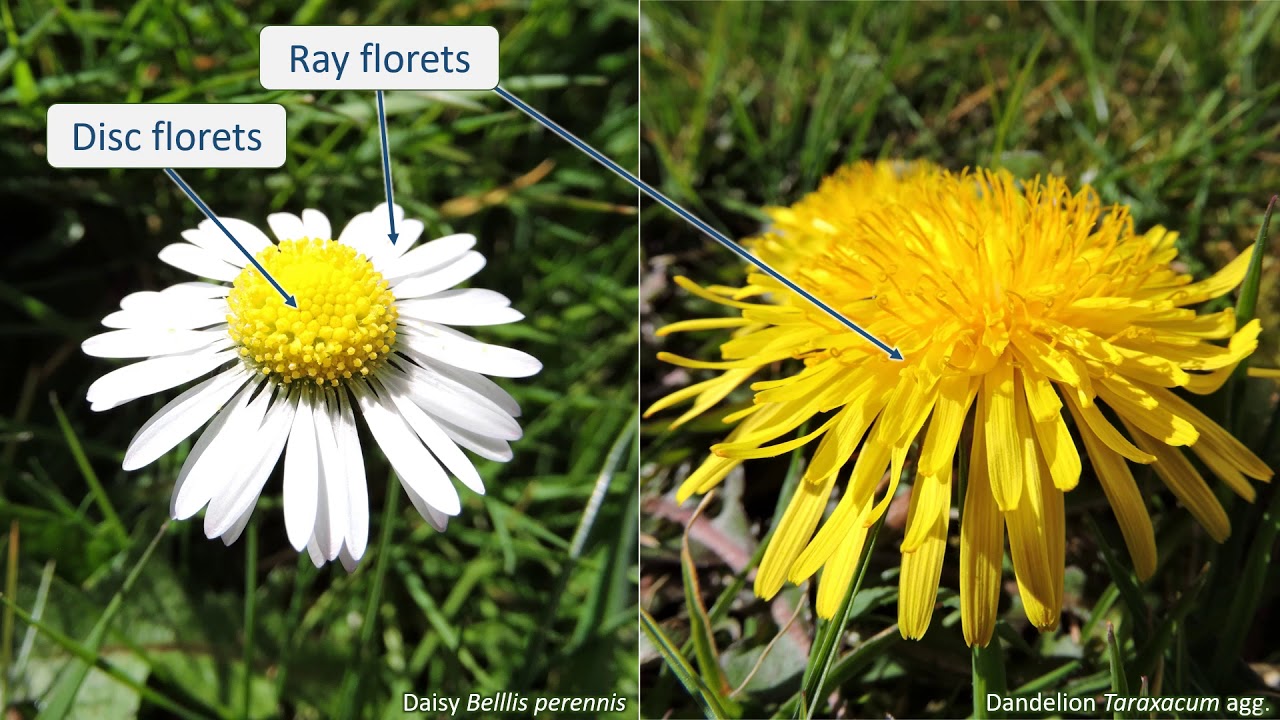
Asteraceae flowers come in different forms, known as disc florets and ray florets. Disc florets are actinomorphic in symmetry. Ray florets are zygomorphic, much showier than disc florets and serve to attract pollinators (the majority of Asteraceae species are insect-pollinated). In disc florets, the petals are equal and fused into a tube with five lobes. In ray florets, the petals are also fused, however, they are fused into a strap shape on one side of the floret. This makes them look as through they have only have single petal, but if you look closely at the tip of this you will see several tiny ‘teeth’; these are the tips of the fused petals.
Which type of floret is present depends on the species. Some, like Tanacetum parthenium, Feverfew, have both disc and ray florets: the disc florets are the yellow ones packed into the middle and the ray florets are the white ‘petals’ around the outside. Other species have only ray florets, like Taraxacum, or only disc florets, like Matricaria discoides, Pineappleweed. The capitula come in a wide range of colours, though they are frequently yellow.
The stamens are attached to the fused petals. The anthers of the stamens are joined into a tube around the style, which branches in two. The stigmas are on these branches. The capitulum is surrounded by protective bracts, called phyllaries, known collectively as the involucre. The number, position and appearance of these phyllaries is often important for identifying individual species.
The ovary of the florets is inferior, and each ripens into a dry one-seeded fruit called an achene or cypsela.
You might be wondering what has happened to the calyx, the whorl of sepals around the floret, in all this. Well, the calyx may be absent but is frequently modified to form a ring of hairs or bristles attached to the fruit, called a pappus. This pappus enables the seeds to be dispersed by the wind; it’s what makes the parachutes in Dandelion clocks and the fluff in thistle heads.
The leaves of Asteraceae are very variable, but are usually either arranged alternately up the stems or in a basal rosette; a few are opposite. They are often simple, (undivided), sometimes pinnate (divided into leaflets), and may have entire or lobed margins, sometimes deeply lobed.
So, remember, if a plant has a capitulum flowerhead with many tiny florets, with or without a long fused petal, stamens with anthers joined into a tube, a style with two branches, and the capitulum has an involucre of protective bracts beneath it, you have yourself an Asteraceae.
Keep an eye out for these three species in your garden or your street:
• Bellis perennis, Daisy
• Senecio vulgaris, Groundsel
• Cirsium arvense, Creeping Thistle
Повторяем попытку...

Доступные форматы для скачивания:
Скачать видео
-
Информация по загрузке: