TGfU SIG 40th Anniversary Conference- Sanmuga Nathan
Автор: TGfU SIG
Загружено: 2024-10-02
Просмотров: 33
Описание:
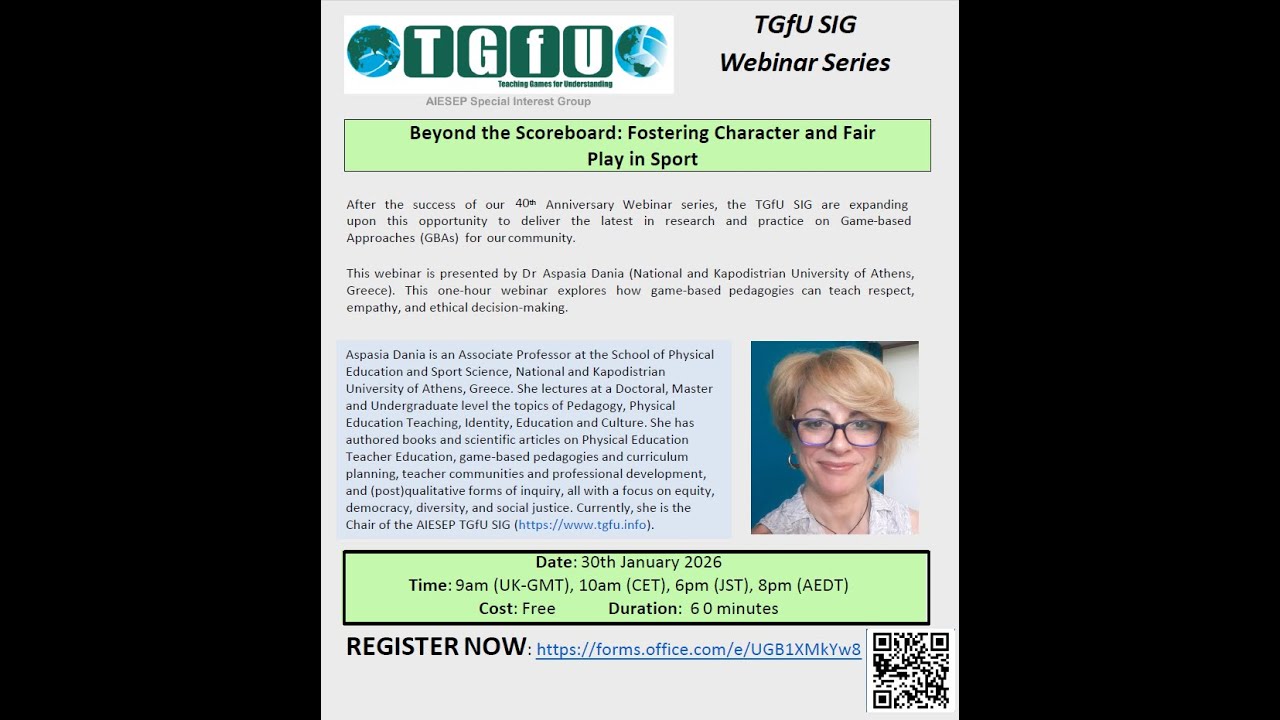
TGfU SIG 40th Anniversary Conference:
The effects of TGfU, NP and Skilled-based approaches in badminton learning process among Malaysian secondary school students
Author: Sanmuga Nathan
Sultan Idris Education University of Malaysia
Abstract:
Introduction: Numerous studies have been conducted to elicit the efficacy of TGfU as game-based approach as well as Nonlinear pedagogy (NP), and skilled-based models in terms of game performance outcome (Nathan, 2016; Chow, David, Burton, Shuttleworth, Renshaw & Arujo, 2007). Namely these studies investigated game performance outcome such as skill execution, tactical decision making and enjoyment attributes in Physical Education (PE). However, not many studies have been carried out about student engagement in learning process that takes place in PE or coaching environment. Especially in terms of student’s engagement in learning process of warming-up content activities, general class management, technical or skill practice, tactical decision making in small sided game play and full game play which directly influence the game outcome often being neglected.
The purpose of this study was to investigate the effectiveness of TGfU, NP and skilled-based approaches in learning and teaching process behaviours of Malaysian school secondary students in Badminton PE lessons. The effectiveness of these pedagogical models in terms of learning process engagement were investigated in terms of warming-up activities, general class management, technical skill practice, tactical decision making in small sided game play (SSG), and full game play activities.
Method and data: This study employed quasi experimental time series design to investigate three different pedagogical interventions of TGfU, NP and skilled-based to elicit badminton learning process among Malaysian students in badminton PE class. The learning process of dependent variables includes warming-up content activities, general class management, technical skill practice, tactical decision making in small sided game play (SSG), and full game play activities. Each badminton lesson interventions adapted from Malaysian Standard Based school PE curriculum. As for participants, three intact classes (10 students from each class) of form one male students aged 13 years old were chosen and observed their learning process via intact sampling technique. As for interventions, TGfU badminton lessons were dwelled based on TGfU original model, while NP lessons were organised adjusting areas, equipment based on Constraints-led theory. Meanwhile skilled-based approach badminton lessons centred around teacher with skill demonstration, skill drills and full game at end of the lesson. As for learning process measurement each lesson of three different pedagogical approaches were videotaped and analyses at three different point of time viz post-test one (1), post-test two (2) and post-test three (3). The dependent variables were analysed using SOTG-PE instrument by Robert and Fairclough (2011). Data were collected three times, post-test 1, post-test 2 and post-test 3 immediately after each teaching intervention of TGfU, NP and skilled-based through video recording and coded quantitively by three teachers. The teachers and coders were trained to upheld the fidelity of the experiment. The elicited data were analysed descriptively, inferentially using ANOVA repeated measures.
Summary of findings: As for warm-up content related activities, TGfU indicated significant improvement, F (2,27) =66.636, p=0.01. As for technical or skill practice, NP followed by TGfU indicated significant improvement, F(2,27)=35.730, p=0.01. While for small-sided game play, NP followed by TGfU indicated significant improvement F(2,27)=86.74, p=0.01. In contrast as for full game play, skill-based showed significant improvement compared to the other models, F(2,27)=41.74, p=0.01.
Conclusion: The present findings encourage teacher to adopt GBA such as TGfU and NP for students to engagement actively in learning process of badminton. However, to support the present research future research may replicate this study for other games. As well as future study can undertake other dependent variables such verbal technical and tactical action in game learning process.
For more information visit http://www.tgfu.info/
Повторяем попытку...

Доступные форматы для скачивания:
Скачать видео
-
Информация по загрузке: