Tuk tuks, Matatus & Shared Minibuses: How Africa and Asia Move Millions Every Day - C1M2E2
Автор: UrbanHistory
Загружено: 2025-12-23
Просмотров: 53
Описание:
1️⃣ Why These Vehicles Exist Everywhere — The True Backstory
Before we compare tuk-tuks, matatus, and minibuses, we need to understand why informal transport dominates in so many developing countries.
The reasons are simple:
Formal transit systems grow too slowly
Road networks expand faster than rail networks
Urban sprawl makes fixed routes expensive
Governments often can’t subsidize large bus fleets
Demand is unpredictable, surging and shifting hour by hour
Informal operators respond instantly
These modes thrive because they’re cheap, flexible, and everywhere.
2️⃣ Nairobi’s Matatus — The Wild, Colorful, Musical Transportation Marvel
🎨 What They Look Like
Nairobi’s matatus are privately owned minibuses or vans, decorated with:
LED lights
Airbrushed murals
Cartoon characters
Politicians
Bible verses
Rappers
Marvel superheroes
Step inside, and you’ll get:
Music at 200% volume
Bright lights
A conductor shouting “Tao! Tao!”
Riders boarding and leaving while the bus is still moving
A matatu doesn’t stop — it briefly reduces speed to consider stopping.
Matatus carry over 60% of all daily trips in Nairobi.
Around 20,000 matatus operate in the metro area.
They generate hundreds of thousands of jobs.
Routes are semi-structured
Prices fluctuate depending on weather, time, and mood
Operators compete aggressively for passengers
Drivers earn per passenger, not per hour
This creates energy… but also chaos.
3️⃣ Egypt’s Shared Microbuses — The Backbone of Urban Mobility in Cairo
Now let’s fly north to Cairo, a megacity of almost 22 million people.
Shared microbuses — known abstractly as “servees,” “micro,” or “white microbuses” — are extremely common throughout Egypt.
Most are:
14-seat white minibuses
Often Hyundai, Ford Transit, or Chinese models
With sliding doors that… sometimes work
Cairo’s microbuses operate on thousands of unofficial routes across Greater Cairo.
Cairo’s metro is efficient — but it covers only a limited part of the city.The microbus picks up the rest.
They carry over 40% of daily commuter trips in Cairo.
Estimated 80,000–100,000 microbuses operate in Greater Cairo.
They serve over 8 million passenger trips per day.
4️⃣ Southeast Asia — Tuk-Tuks, Motorcycle Taxis & Minibuses
Asia is the spiritual homeland of the tuk-tuk — but it’s far more diverse than that.
🇹🇭 Thailand — Tuk-Tuks & Songthaews
🚖 1. Tuk-Tuks
The three-wheeled, open-air taxi known as “tuk-tuk” is iconic in Bangkok, Chiang Mai, and tourist towns.
Tuk-tuks are:
Loud
Fast
Agile
🚚 2. Songthaews
These are pickup trucks with benches in the back — the REAL mass mobility tool in many Thai towns.They operate:
On semi-fixed routes
With flexible stops
Carrying 8–20 passengers
At extremely low cost
🇻🇳 Vietnam — The Motorcycle Taxi (Xe Ôm)
Vietnam is the world capital of two-wheeled mobility.
Ho Chi Minh City and Hanoi have:
Millions of motorbikes
Dozens of informal motorcycle taxi hubs
Gigantic swarms of scooters that move like a liquid
📱 Moto-Taxis Go Digital
Apps like GrabBike and Gojek turned informal motorcycle taxis into semi-formal, app-based services:
Real-time pricing
GPS
Safety ratings
Digital payments
🇮🇩 Indonesia — The Angkot & Ojek
🚐 1. Angkot
In Bandung, Bogor, and many cities, the “angkot” minibus system is essential.
Characteristics:
10–14 seats
Fixed but numerous routes
Loud music
Hyper-competitive drivers
Cheap fares
🛵 2. Ojek
The motorcycle taxi — “ojek” — is legendary.
Today, Gojek (based on ojek culture) is Southeast Asia’s biggest mobility and delivery platform, handling:
Rides
Deliveries
Payments
Logistics
5️⃣ Comparing African & Asian Informal Systems
Let’s compare key characteristics across regions.
A. Vehicle Types
B. Organization Structure
C. Technology Integration
D. Cultural Characteristics
6️⃣ The Strengths of These Systems
Despite chaos, these systems are brilliant in many ways:
1. They Scale Instantly
2. They Reach Everywhere
3. They Are Affordable
4. They Create Jobs
5. They Adapt to Traffic
7️⃣ The Key Challenges
1. Safety
2. Over-Competition
3. Emissions
4. Unpredictability
5. Governance Conflicts
8️⃣ Modernizing Informal Transport (Without Killing It)
Cities across Africa & Asia are trying to modernize paratransit — not eliminate it.
Approaches include:
Fleet modernization programs
Digital fare integration
GPS route mapping
Cooperatives with better management
Electrification (e-tuk-tuks, e-motorbikes, e-minibuses)
Priority lanes for high-volume routes
Hybrid systems integrating BRT + paratransit
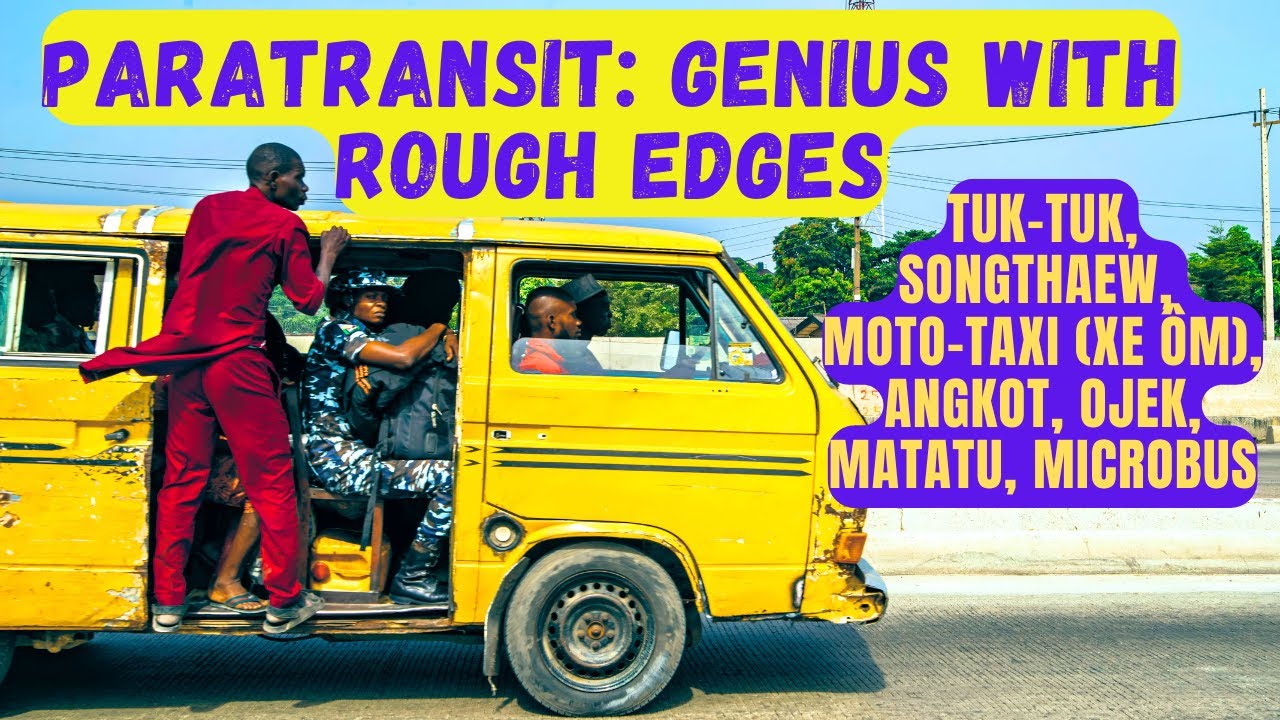
9️⃣ Final Message — These Systems Are Not “Chaos.” They Are Genius with Rough Edges.
Tuk-tuks, matatus, microbuses, ojeks — they’re not temporary solutions.They’re permanent pillars of mobility.
They move:
the majority of commuters
through the biggest megacities
at the lowest cost
with the highest flexibility
#paratransit #urbanhistory #urbanplanning #publictransport #developingcountries #sustainablemobility #matatu #nairobi #tuktuk #bangkok #southeastasia #hanoi #jakarta #indonesia #cairo #microbus
Повторяем попытку...
Доступные форматы для скачивания:
Скачать видео
-
Информация по загрузке: