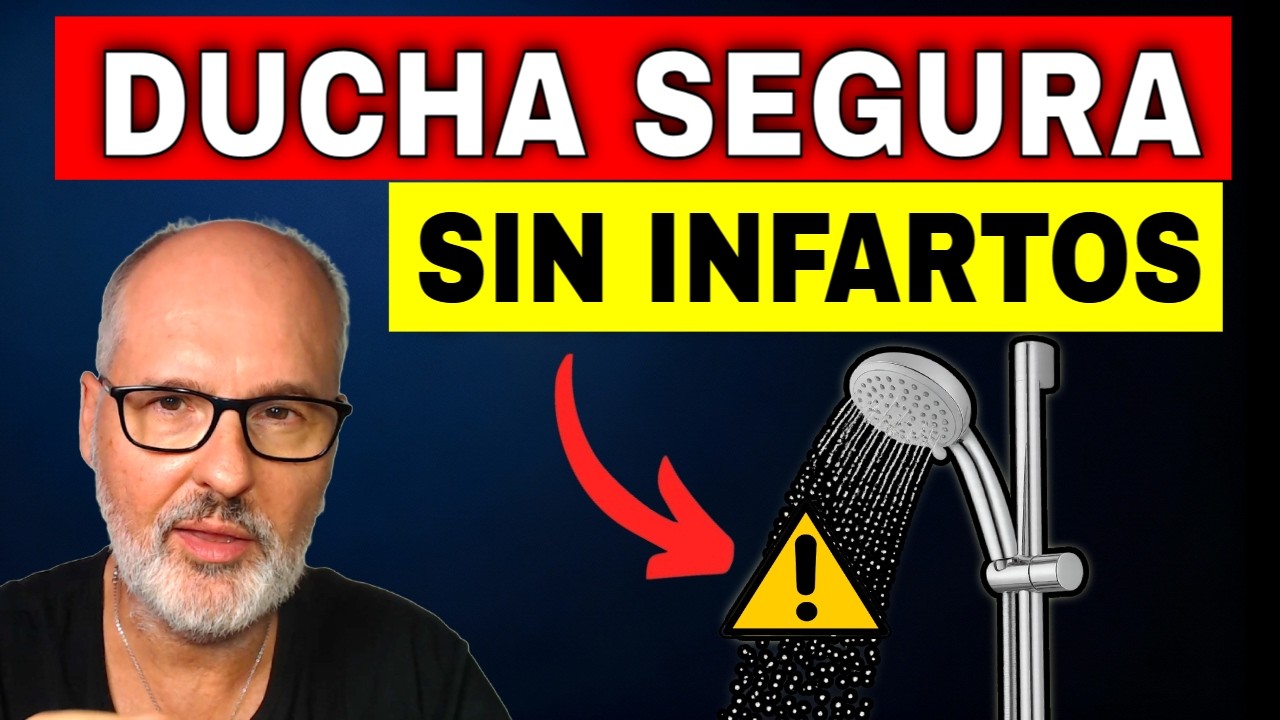
ESTE Hábito en la Ducha NO Causa Infartos NI Derrames (La Verdad Médica)
Автор: Dr. Alberto Sanagustín
Загружено: 2025-10-29
Просмотров: 70136
Описание:
Ducharte después de los 60 no debería ser un riesgo. En este vídeo entenderás por qué algunas personas mayores se marean o se sienten débiles al ducharse, qué temperatura y duración son seguras, y cómo prevenir caídas o desvanecimientos con simples hábitos médicos comprobados.
0:00 El mito del infarto al ducharse
1:15 ¿Puede la ducha provocar un infarto o un ACV?
4:52 Por qué algunos mayores se marean al ducharse
8:25 Temperatura y duración seguras de la ducha
11:44 Cómo influye la hora del día
14:06 Señales de alarma que no debes ignorar
16:31 Plan médico práctico para ducharte con seguridad
19:11 Cuándo consultar por tus medicamentos
20:03 Prudencia con el agua fría
20:53 Qué hacer si te sientes mal a mitad de la ducha
21:47 Las tres reglas de oro para una ducha segura
22:10 Reflexión final
22:58 Vídeo recomendado
Dr. Alberto Sanagustín
★ Referencias:
1. Stevens JA, Rudd RA. Circumstances and contributing causes of fall deaths among persons aged 65 and older: United States, 2010. J Am Geriatr Soc. 2014;62(3):470-5.
2. Mion LC, Chandler AM, Waters TM, et al. Is it possible to identify risks for injurious falls in hospitalized patients? Jt Comm J Qual Patient Saf. 2012;38(9):408-13.
3. Freeman R, Wieling W, Axelrod FB, et al. Consensus statement on the definition of orthostatic hypotension, neurally mediated syncope and the postural tachycardia syndrome. Clin Auton Res. 2011;21(2):69-72.
4. Low PA. Prevalence of orthostatic hypotension. Clin Auton Res. 2008;18 Suppl 1:8-13.
5. Ricci F, De Caterina R, Fedorowski A. Orthostatic hypotension: epidemiology, prognosis, and treatment. J Am Coll Cardiol. 2015;66(7):848-60.
6. Shibao C, Lipsitz LA, Biaggioni I. ASH position paper: evaluation and treatment of orthostatic hypotension. J Clin Hypertens (Greenwich). 2013;15(3):147-53.
7. Figueroa JJ, Basford JR, Low PA. Preventing and treating orthostatic hypotension: As easy as A, B, C. Cleve Clin J Med. 2010;77(5):298-306.
8. Finucane C, O'Connell MD, Fan CW, et al. Age-related normative changes in phasic orthostatic blood pressure in a large population study: findings from The Irish Longitudinal Study on Ageing (TILDA). Circulation. 2014;130(20):1780-9.
9. Lipsitz LA, Hayano J, Sakata S, et al. Complex demodulation of cardiorespiratory dynamics preceding vasovagal syncope. Circulation. 1998;98(10):977-83.
10. Grubb BP. Clinical practice. Neurocardiogenic syncope. N Engl J Med. 2005;352(10):1004-10.
11. Naschitz JE, Rosner I. Orthostatic hypotension: framework of the syndrome. Postgrad Med J. 2007;83(983):568-74.
12. Juraschek SP, Appel LJ, Mitchell CM, et al. Comparison of supine and seated orthostatic hypotension assessments and their association with falls and orthostatic symptoms. J Am Geriatr Soc. 2022;70(8):2310-9.
★ Los vídeos de este canal son solo divulgativos. De ningún modo pretenden sustituir el consejo médico directo. Si tienes o crees tener alguna síntoma, signo o enfermedad descrito en estos vídeos, siempre debes consultar a tu médico de referencia. Nada puede sustituir la relación directa médico-paciente.
Повторяем попытку...
Доступные форматы для скачивания:
Скачать видео
-
Информация по загрузке: