Grand Canyon Railway 4960 Steam Locomotive
Автор: Yard Limit
Загружено: 2019-04-27
Просмотров: 6783
Описание:
http://www.yardlimit.com
The Grand Canyon is a heritage railroad which carries passengers between Williams, Arizona, and the South Rim of Grand Canyon National Park.
The 64-mile railroad, built by the Atchison, Topeka and Santa Fe Railway, was completed on September 17, 1901. The arrival of trains led increased tourism to the area, and the railway company was instrumental in the creation of the Grand Canyon Village to serve guests.
Declining ridership due to the popularity of the automobile led the Atchison, Topeka and Santa Fe Railway to cease passenger service of the Grand Canyon Railway in July 1968 and freight service on the line ended in 1974.
The railway chugged back to life in the late 1980s, after private investors purchased the line in 1988, restored the facilities, and passenger trains started running again on September 17, 1989.
The railroad carries hundreds of passengers to and from the canyon every day, totaling about 225,000 people per year.
The restored Santa Fe Railway Station in Williams serves as the southern terminus for the Grand Canyon Railway and the Grand Canyon Depot, owned by the National Park Service, is the northern terminus for passengers of the line.
Most trains are pulled by the Railway's fleet of F40FH diesel locomotives. Steam locomotives pull trains on special holidays and the first Saturday of the peak travel season (March through October). The Grand Canyon Railway's fleet of historic ALCO FA diesel locomotives also see occasional use.
Passengers ride to and from the Grand Canyon in 1950s era climate-controlled coaches. During the peak travel season, 1920s era Pullman Harriman style coaches with open windows are also available.
The railroad adds to the Old West experience by having actors dressed as bandits stage a mock train robbery during the return trip from the Grand Canyon to Williams.
The Grand Canyon Railway offers at least one daily round trip of its Williams Flyer train between Williams and the Grand Canyon every day except on Christmas Day, December 25. During peak demand periods a second train departure is added.
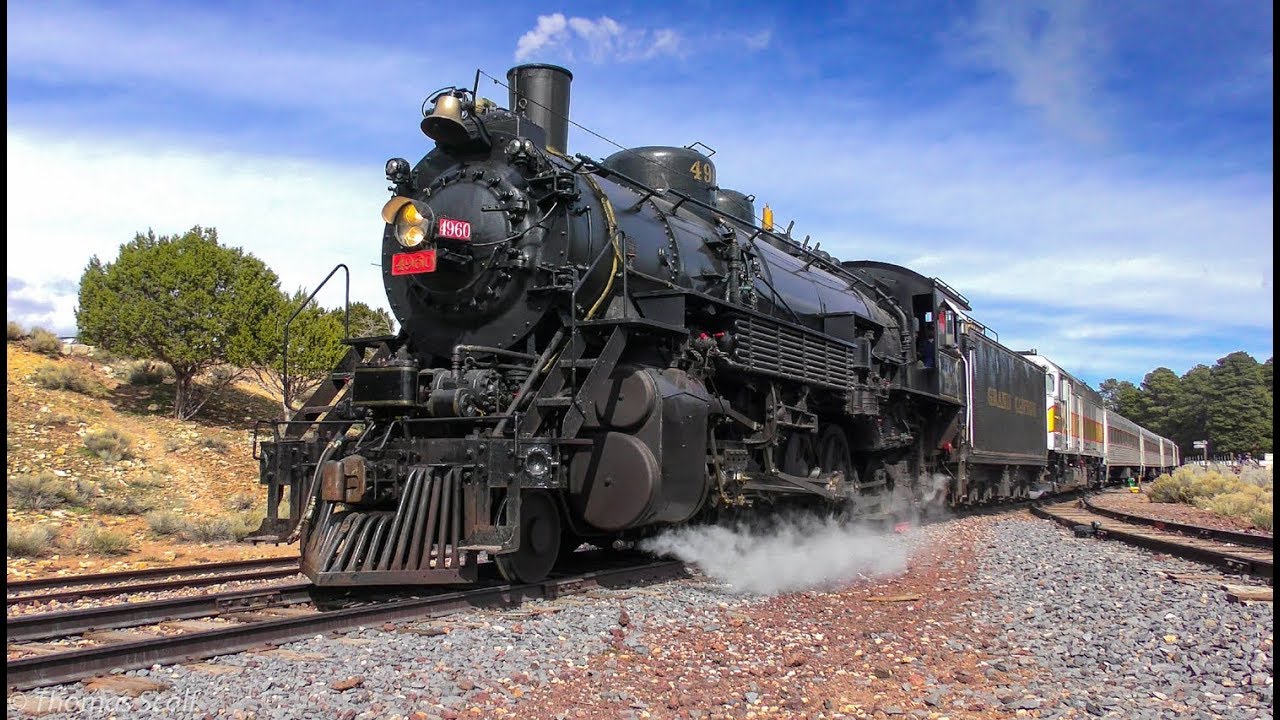
The Grand Canyon Railway has two operable steam locomotives that have been restored to like-new working condition. Locomotive No. 4960 was built in 1923 by Baldwin Locomotive Works in Philadelphia. It operated a freight- and coal-hauling service for the Midwestern Chicago, Burlington & Quincy railroad until the late 1950s and made its first official run on the Grand Canyon line in 1996. Locomotive No. 29 was restored in 2004 at a cost of more than $1 million and 26,000 man-hours of labor. An SC-3 class locomotive, Locomotive No. 29 was built in 1906 by ALCO in Pittsburgh and weighs 185 tons.
Hopi House is located on the South Rim of the Grand Canyon. Built in 1904, it is the first of eight projects at the Grand Canyon that were designed by architect Mary Colter. Hopi House was built by the Fred Harvey Company as a market for Native American crafts, made by artisans on the site. The Hopi, as the historic inhabitants of the area, were chosen as the featured artisans, and the building was designed to closely resemble a traditional Hopi pueblo. Hopi House opened on January 1, 1905, two weeks before the El Tovar Hotel.
The El Tovar Hotel is a former Harvey House hotel situated directly on the south rim of the Grand Canyon.
The hotel was designed by Charles Whittlesey, Chief Architect for the Atchison, Topeka, and Santa Fe Railway and was opened in 1905 as one of a chain of hotels and restaurants owned and operated by the Fred Harvey Company in conjunction with the Santa Fe.
The hotel is one of only a handful of Harvey House facilities that are still in operation, and is an early example of the style that would evolve into National Park Service Rustic architecture.
The El Tovar was built from local limestone and Oregon pine. The lower portions of the building are mainly of log construction, yielding to lighter, smoother framed construction sheathed with planking for the upper levels. The roof is covered in shingles. The lobby, behind a broad entry veranda, extends to four stories topped with a turret with a pyramidal roof. The guest room wings extend from this central section at a shallow angle, with their top floors extending only partway, creating roof decks. The hotel's entrance is on the side of the building with the canyon to the left, at a right angle to the railroad terminal directly across the street.
#grandcanyon #Railway
Повторяем попытку...
Доступные форматы для скачивания:
Скачать видео
-
Информация по загрузке: