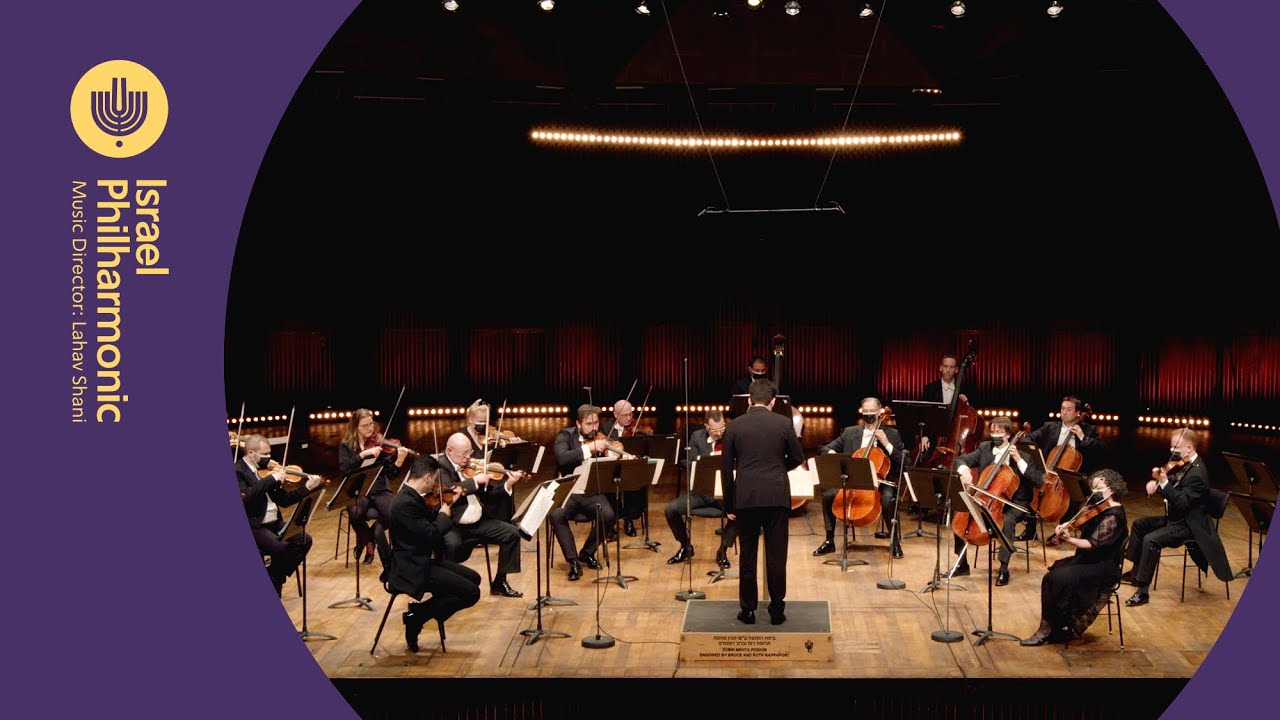
Ödön Pártos: Psalms, for String Orchestra - Lahav Shani, conductor
Автор: Israel Philharmonic - הפילהרמונית הישראלית
Загружено: 2022-05-04
Просмотров: 1832
Описание:
Curator: Assaf Shelleg
Command of the Hebrew language was critical for emigrating composers. Those who had command of the language could set modern Hebrew poetry to music or even write operas or oratorios based on literary texts or Jewish religious sources. In so doing they could take an active part in shaping modern Hebrew culture. Those whose command of the language was at a higher level could also write critical articles. Such was, for example, Alexander Uriah Boskovich was one such example; he began publishing articles on Israeli art music in the 1950s, alongside numerous musical reviews he produced as the music critic of Haaretz between 1956 and 1964. Another composer, Josef Tal, wrote numerous reviews (in Hebrew) of the compositional approaches in Israel from the 1950s to the late 1990s; and in 1944 he published one of the first music theory books in Hebrew.
But Ödön Pártos never mastered Hebrew. In his manuscripts from the 1940s and 1950s, the Hebrew titles he copied often looked like forms that were slowly and hesitatingly written. While Partos arranged liturgical music and even wrote a Cantata on a text by Bialik, he was otherwise rather linguistically and thus culturally limited. His first Viola Concerto (1949), titled Song of Praise, was indeed a song of praise to the newly founded State of Israel, but it was no coincidence that it was a song without words. This was also the case of Visions, for flute, string orchestra and piano (1957), and Psalms (1960).
Lacking command of the language, Partos focused on the shared qualities of modern compositional techniques and the musical properties of Eastern Musics. In the early 1960s he opted for twelve-tone music and through it sought to simulate biblical tropes as short motifs whose variants proliferate continuously both rhythmically and melodically.
Given his lack of command of Hebrew, Partos sought the melodic properties that were common to what he imagined as biblical tropes in addition to what he learned from Bartok’s music, all while employing Schoenberg’s compositional technique from the 1920s. This resulted in a highly rhetorically and emotionally charged work, which in many ways renders Psalms the modern Hebrew Partos could speak.
Since the IPO is now performing Partos’ Psalm for String orchestra, it is only fitting that we should mention his role as Principal Viola of the Palestine Orchestra (later the Israel Philharmonic). Partos was invited to fill this position by Bronislaw Huberman and held it until 1956, all while expanding the orchestral repertoire for viola with four concerti and other orchestral and chamber works.
Text: Assaf Shelleg
0:00 I. Adagio
9:21 II. Lento, Calmo
16:56 III. Allegro, Molto Vivace
First Violin:
Dumitru Pocitari, Alexander Stark, Adelina Grodsky, Nitzan Canetty, Gilad Rivkin, Drorit Valk
Second Violin:
Ari Vilhjálmsson, Shmuel Glazer, Avital Steiner Tuneh, Hadar Cohen
Viola:
Miriam Hartman, Amir van der Hal, Vladislav Krasnov, Gili Radian-Sade
Cello:
Emanuele Silvestri, Enrique Maltz, Iakov Kashin
Bass:
Nir Comforty, Omri Weinberger
/ israel_philharmonic
/ israel.philharmonic
-------------------
Video Director: Yoel Culiner
Director of Photography: Dror Heller
Sound: Rafi Eshel, Yaron Aldema - Eshel Sound Studios
Creative Director: Elizabeth Culiner
Light Designer: Dani Rogovin
Production: Liz Fisher
Animation: Gavriel Izaky
#ArtMusicInIsrael #Bows #ÖdönPártos
Повторяем попытку...
Доступные форматы для скачивания:
Скачать видео
-
Информация по загрузке: