Research Forum Presentation - Mohamad Adams Brooks, PhD
Автор: Silberman School of Social Work at Hunter College
Загружено: 2026-01-05
Просмотров: 14
Описание:
Title: "Engaging Refugees and Asylum-Seekers in Mental Health Treatment: Exploring the Role of Cultural Brokers"
Background & Purpose: Refugees and asylum-seekers face high rates of psychological distress as a result of their difficult migration journey and stressors adjusting to the United States (U.S.) They are, however, less likely to engage with mental health treatment compared to the general population. Our study explored “cultural brokers” – individuals who shares both mainstream culture (i.e. U.S. culture) and various sub-cultures (i.e. refugee culture) – and their distinct roles in helping refugees and asylum-seekers engage in mental health treatment.
Methods: We interviewed adult refugee mental health service providers who self-identified as cultural brokers (N=10) as well as key stakeholders (i.e. community leaders, refugee mental health managers, and field experts) (N=5) who have lived in the U.S. for at least five years. Participants were recruited via posted flyers and emails sent through a refugee behavioral health and refugee resettlement agency located in a Northeastern city in the U.S. In-depth interviews were completed via Zoom between July-Aug 2024. Topics discussed included refugee mental health, barriers and facilitators to treatment, and the role of cultural brokers in facilitating care. Multiple coders analyzed the interview data using line-by-line open coding and grounded theory coding techniques (e.g., constant comparison).
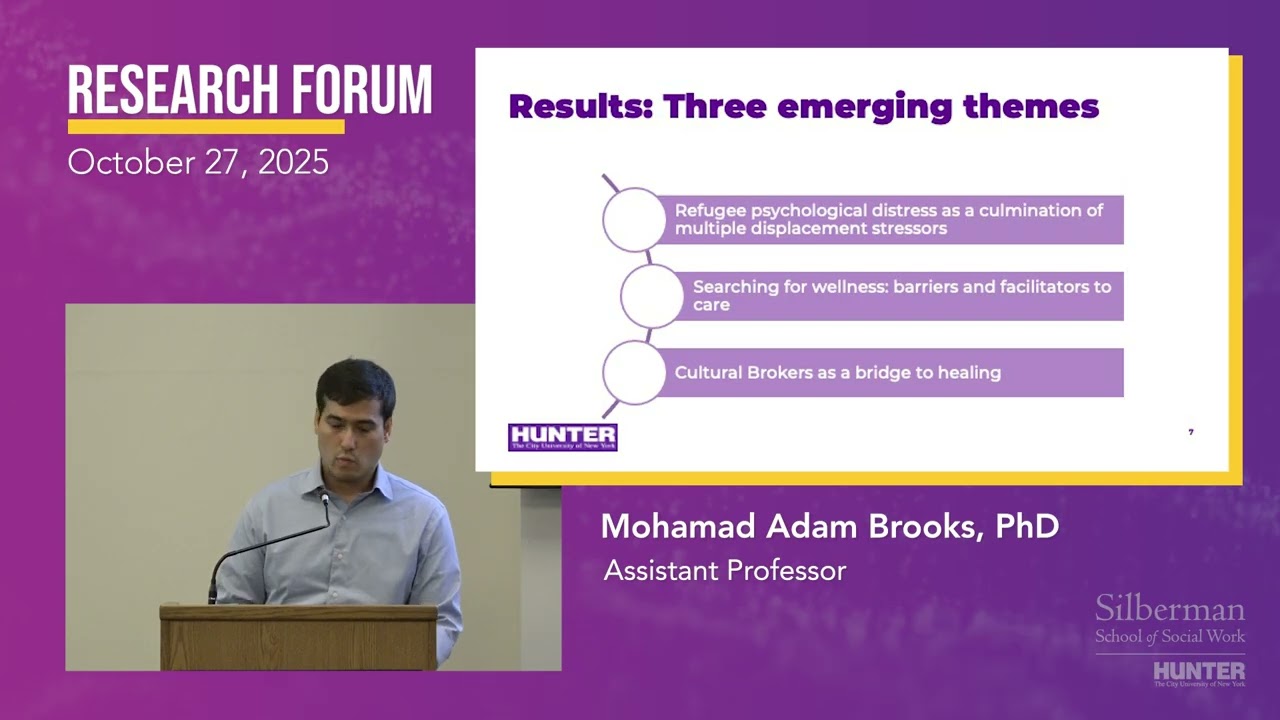
Results: Participants interviewed were from Bhutan, Somalia, North Africa, Iraq, Sudan, Congo, Haiti, and Rwanda. Participants, on average, served as a behavioral health provider or were a key stakeholder for 11.3 years (Range 1-30, SD=6.8). Three major themes emerged: 1) psychological distress as an accumulation of multiple displacement stressors, 2) overcoming barriers in search of mental health care, and 3) cultural brokers as a bridge to healing.
Participants reported refugees and asylum-seekers experienced a range of mental health symptoms (anxiety-, trauma-, depression-, somatic-, and psychosis-like symptoms) that were associated with the accumulation of multiple pre- and post-migration stressors. Pre-migration stressors included exposure to violence, persecution, marginalization, as well as extreme life stressors such as food, financial, and employment insecurity prior to arriving to the U.S. Post-migration stressors included culture shock, having to learn English, employment, financial and housing instability, as well as navigating changing family dynamics.
While in search of mental health care, refugees and asylum-seekers reported multiple barriers to care that include mental health stigma, unfamiliarity with the mental health system, lack of culturally appropriate service providers, transportation and language barriers, as well as fear and mistrust of service providers. Despite barriers to mental health care, participants reported that cultural brokers helped refugees and asylum-seekers engage in mental health treatment by connecting them to appropriate resources, navigating the mental health system, advocating and supporting language and cultural gaps between providers, expanding social networks, mitigating mental health stigma, and providing insight into their mental health symptoms.
Conclusions & Implications: Displacement is a traumatic/stressful event that is associated with psychological distress. Although refugees and asylum-seekers resettled in the U.S. face a myriad of barriers in search of mental health treatment, cultural brokers can support treatment-seeking. Insight into cultural brokers can provide a vital role in bridging the mental health treatment gap among refugees and asylum-seekers.
Повторяем попытку...
Доступные форматы для скачивания:
Скачать видео
-
Информация по загрузке: