Swahili Grammar lesson[NGELI YA M-MI [U-I]
Автор: Kiswahili With Abdulkarim
Загружено: 2021-02-17
Просмотров: 6488
Описание:
SWAHILI GRAMMER LESSON
************ SARUFI
3).M-MI noun class [Ngeli ya M-MI] {U-I}
This noun class has the following nouns: a). Majina ya miti na mimea (names of trees and plants) b). Baadhi ya sehemu za mwili [Some of the body parts]
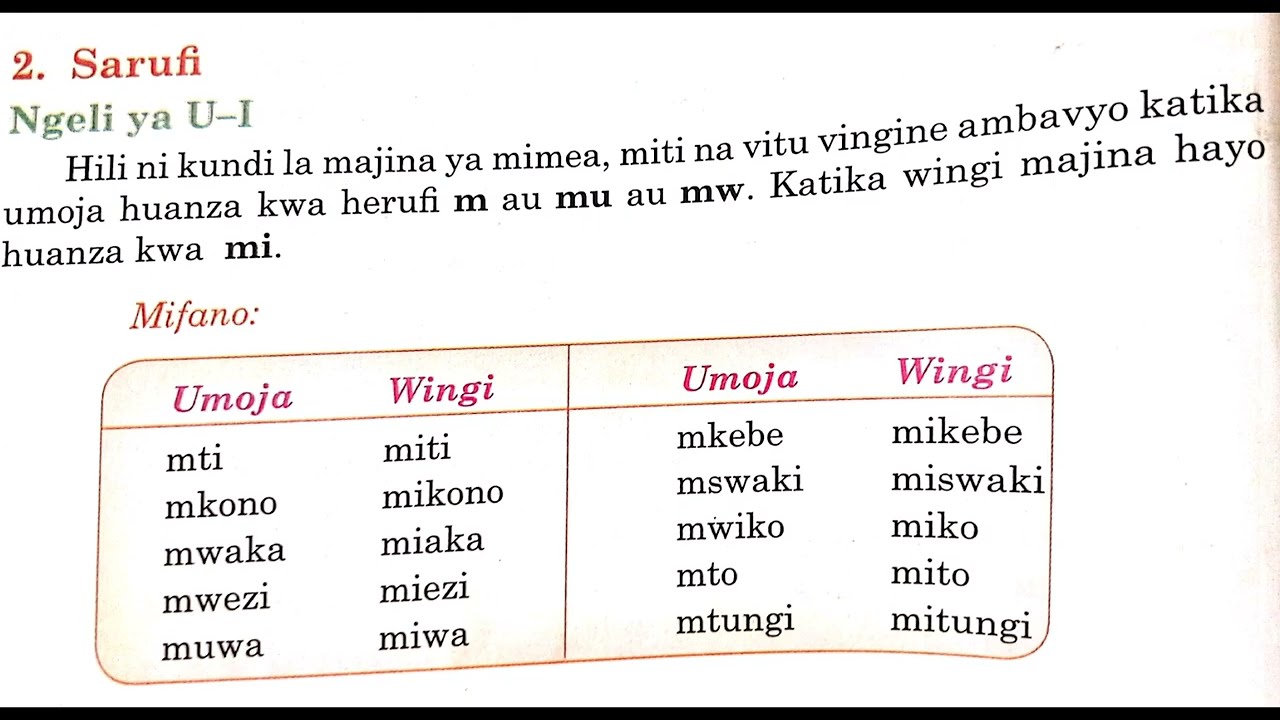
★Generally nouns in this category starts with either the markers {“M-” or “Mu-” or “Mw-”} in singular forms or the marker “Mi-" in plural forms.
a).Majina ya miti na mimea(Names of trees and plants)
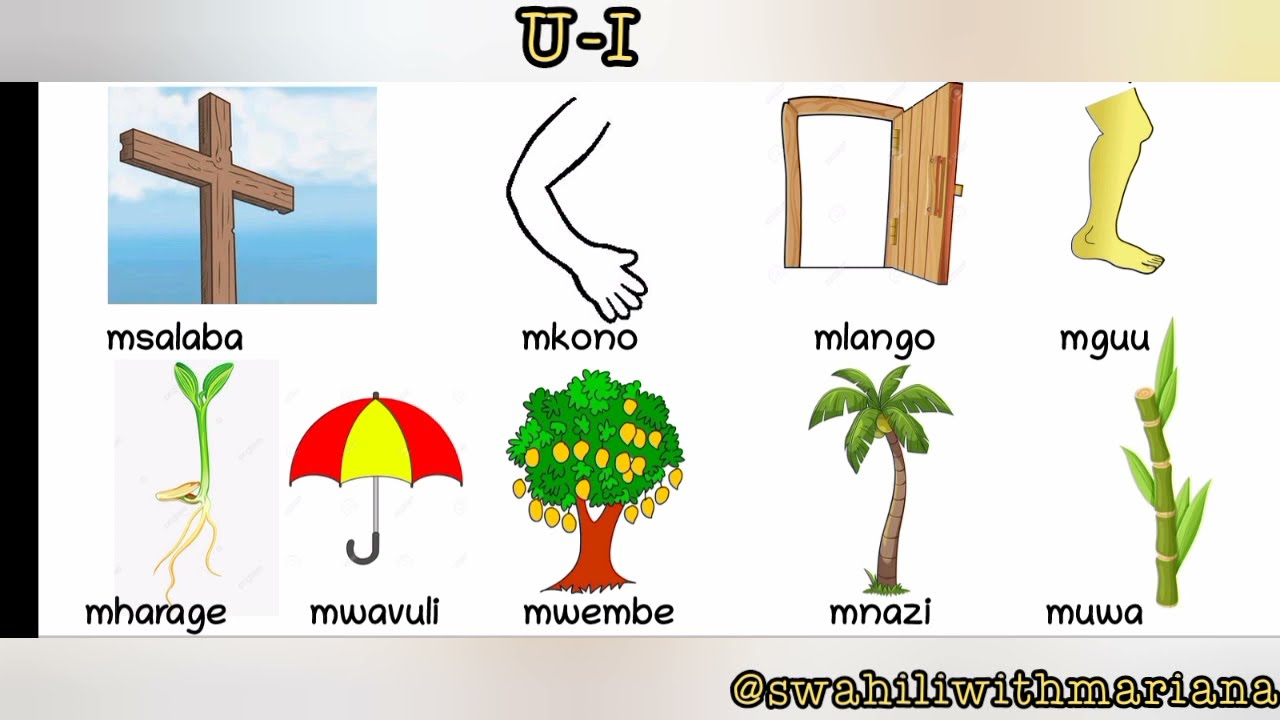
mti/miti (tree/trees) mnazi/minazi (coconut tree/coconut trees) mchungwa/michungwa (orange tree/orange trees) mwembe/miembe (mango tree/mango trees) mtofaa/mitofaa /(apple tree/apple trees
b).Some names of body parts[baadhi ya majina ya sehemu za mwili]
mdomo/midomo [mouth/mouths] mkono/mikono [hand/hands] mguu/miguu [leg/legs] mfupa/mifupa [bone/bones] mgongo/migongo [back/backs] moyo/mioyo [heart/hearts] mwili/miili [body/bodies]
mfupa / mifupa [bone / bones]
CLASS AGREEMENT
1. AGREEMENT WITH VERBS
Nouns in this class agrees with the marker “u-" in singular form and “i-" in plural form on the verb.eg.
Panda…climb/to plant
Pandwa..be clmbed/planted
Mti umepandwa (a tree has been planted/climbed).
Miti imepandwa(Trees have been planted/climbed)
Mwezi umepita (a month has passed)
Miezi imepita (Months have passed)
Zoezi A
1. Mto ….mesimama( the river has stopped)
2.
2. AGREEMENT WITH POSSESSIVES
Swahili possessives roots include
-angu( my/mine)
-ako(your/yours)
-ake(his/her/hers)
-etu(our/ours)
-enu(your/yours)[plural]
-ao (their/thiers)
These roots are incomplete and need to be added prefixes to make them complete.
This class of nouns M-MI [U-I] takes the prefix “w-" in the singular form and “y-" in plural form. eg.
1a.Mti wangu (my tree)
b. Miti yangu (my trees).
c. Mti wetu(our tree)
d. Miti yetu(our trees)
2a.Mwavuli wako (Your umbrella)
b.Miavuli yako(your umbrellas)
3a.Mpira wake (His/her ball)
b.Mipira yake(His/her balls).
c.mpira wao(their ball)
d.mipira yao[their balls]
Zoezi B
1. Mguu …..angu …uma(my leg is hurting)
2. Change sentence 1 into plural.
3. Change sentence 1 into the third person singular
4. AGREEMENT WITH DEMONSTARTIVES
“VIASHIRIA”
Demonstrative for this class are:
Huu (This)
Hii (These)
Huo (That)
Hiyo (Those) [a little bit far]
Ule (That one) [very far]
Ile (Those ones) [very far].
Examples:
1a.Mti huu (This tree)
b.Miti hii (These trees).
2a.Mlima huo (That Mountain)
b.Milima hiyo (Those Mountains).
3a.Mkono ule (That hand) {very far}
b.Mikono ile (Those hands){very far}.
ZOEZI CH
1.Mnazi ….(this coconut tree)
2. Minazi ….( these coconut trees)
3. Mguu ….angu ni ….(my leg is this]
4.Mgomba … …vunjika(This coconut tree broke]
5.Mdomo … …..pendeza(that mouth is attractive]
4. AGREEMENT WITH ADJECTIVES
With adjectives, this class of nouns agrees with the prefix “m-" in the singular form and “mi-" in the plural form. eg.
-zuri(good)
-kubwa(big)
-dogo (small)
-refu (tall)
-fupi ( short)
-nene (fat) [used with human beings]..nenepa umenenepa
-nono (fat) [used with animals]…nona mbuzi huyu amenona
1a.Mti mkubwa (a big tree)
b.Miti mikubwa (big trees).
2a.Mkate mtamu (Sweet bread)
bMikate mitamu (Sweet breads).
3a.Mwaka mrefu (long year)
b.Miaka mirefu (long years).
zoezi D
A.Translate into Swahili [email protected]
1. This is a big tree
2. That is a small leg
3. These are my plants
B.Translate into ENGLISH
1.Huu ni mchungwa wako
2.Ule ni mgongo wa Rihanah
3.Hii ni miaka mizuri
Mti wa ABDUL….MTI WAKE
Miti ya Abdul… miti yake
5. AGREEMENT WITH RELATIVE CLAUSES
A relative clause is called kirejeshi in Swahili. It implies “the one who…”or “the one which…” there are two types in Swahili i.e. kirejeshi amba- and kirejeshi –o (you can choose any of the two, but you should not mix)
1. Kirejeshi amba- agrees with the M-MI[U-I] as follows:
In singular form it takes the suffix -o while in the plural form it takes the suffix –yo
Examples:
1a). Mti ambao utapandwa (The tree that will be planted/climbed)
b) Miti ambayo itapandwa(The trees that will be planted)
c). Mkate ambao ni mtamu (The bread that is sweet)
d).Mikate ambayo ni mitamu (The breads that are sweet)
b). Kirejeshi –o- agrees as follows:
It takes the prefix o in the singular form and yo in plural form. These prefixes are conjugated within the verb phrase
Mifano:
1a.Mkate ulionunuliwa (the bread that was bought)
b.Mikate iliyonunuliwa (the breads that were bought).
ZOEZI E
Jaza pengo
1. Mchungwa amba... …katwa ni ….[The orange tree that was cut is this]
2. Mji …. Unapendeza( this city is attractive)
3. Change sentence (2) into plural form.
4. Mwavuli uli…nunuliwa ni …(the umbrella that was bought is this)
★Some nouns that may start with “mi-" are taken to be in this category in the plural form. They will also agree with other parts of speech as if they are in plural form of this class.For instance,Mizani(weight),miraa(khat),Miwani (eye glasses)
Example in a sentence:
Miwani yangu imepotea (my glasses are lost)
Повторяем попытку...
![Swahili Grammar lesson[NGELI YA M-MI [U-I]](https://imager.clipsaver.ru/uBhtUSYVTq8/max.jpg)
Доступные форматы для скачивания:
Скачать видео
-
Информация по загрузке:
![SWAHILI GRAMMER [NGELI YA KI-VI]](https://imager.clipsaver.ru/F5inWEzJplU/max.jpg)






![Swahili Grammar N-N Noun class [nGELI YA I-ZI] Part 2](https://imager.clipsaver.ru/WNptQDLQXzg/max.jpg)