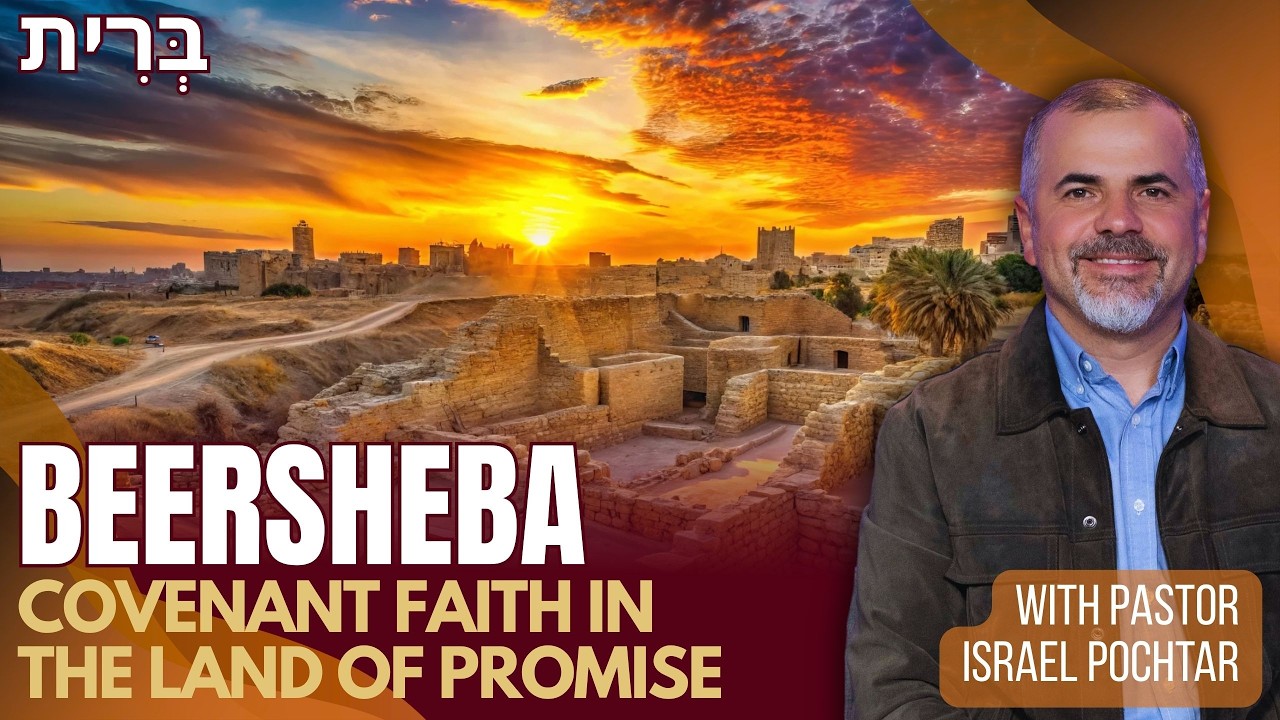
Beersheba: Covenant Faith in the Land of Promise
Автор: Beit Hallel Israel
Загружено: 2026-02-19
Просмотров: 81
Описание:
A few weeks ago I was in Beersheba, and the time there has stayed with me. Beersheba is not just another southern city in Israel. In Scripture it becomes one of the markers of the whole land. When the Bible later says “from Dan to Beersheba,” it is describing the full span of Israel. Standing there, you feel that you are at the edge of something — the meeting point between settled land and open desert, between what feels established and what still feels wild.
When we follow Abraham’s story in Genesis, we see a man who spent much of his life moving. He left Ur, passed through Haran, entered Canaan, and built altars along the way. He lived in tents for years. His obedience often came long before he saw fulfillment. He walked with God while still waiting for the promise to take visible shape.
But by Genesis 21, something deeply personal has changed. Isaac has been born. The son of promise is no longer just a word spoken by God — he is a child Abraham can hold. The covenant is no longer abstract. It has become flesh and blood in his own family.
After resolving the conflict over the wells with Abimelech, Abraham settles in Beersheba. In that world, wells were not small details. They meant long-term presence. To dig and secure a well was to say, “We are staying here.” Genesis tells us that Abraham planted a tamarisk tree and called on the name of the Lord, El Olam — the Everlasting God. A tree grows slowly. It assumes tomorrow. For a man who had spent so many years in tents, planting a tree speaks of quiet confidence that God’s promise would endure beyond him.
It is from that place of settlement and visible blessing that Genesis 22 unfolds. God calls Abraham to go to the land of Moriah and offer Isaac. The timing is important. The greatest test did not come when Abraham was still waiting for a son. It came after the promise had already arrived. Isaac represented joy, future, legacy — everything God had spoken about.
To surrender Isaac would seem to threaten the very promise God had given.
Yet Abraham obeyed. And his obedience was not impulsive or blind. By this time he had decades of history with God. He had stood under the night sky and heard God speak of descendants as numerous as the stars. He had received the covenant sign. He had heard God name Isaac specifically as the covenant son. Hebrews 11 tells us that Abraham believed God could even raise Isaac from the dead. That is not emotional faith; that is deep, settled trust. Abraham understood that the covenant rests on God’s faithfulness, not on his ability to protect the promise.
On Mount Moriah, God provided the ram. The son was spared, the substitute was given, and the covenant was reaffirmed. That same location would later become associated with Jerusalem and the Temple Mount. What felt like the place of greatest tension would become central in Israel’s worship and in the unfolding story of redemption. God was already working on a larger canvas than Abraham could see.
What touches me most is what happens afterward. Genesis 22:19 simply says that Abraham returned to Beersheba and dwelt there. He did not stay on the mountain. He went back to daily life — back to the wells, back to ordinary covenant living.
That detail speaks to us. Spiritual life is not sustained only in dramatic moments. It continues in returning — returning to faithfulness, returning to worship, returning to steady obedience in the place God has given us.
Beersheba continues to appear in the next generations. In Genesis 26, Isaac returns there during famine and conflict. God appears to him and repeats the covenant promises. Isaac builds an altar and digs wells again. Later, in Genesis 46, Jacob comes to Beersheba before going down to Egypt. There he offers sacrifices, and God reassures him that even this descent is part of the covenant plan. Through famine, fear, relocation, and uncertainty, the covenant holds.
When we look at the broader picture, we see continuity. Abraham planted. Isaac rebuilt. Jacob worshiped. Different seasons, different challenges, but the same faithful God.
For us today, the lesson is not about the physical location of Beersheba. It is about how we live inside God’s promises. There are seasons when He establishes us and confirms His faithfulness in visible ways. There are seasons when He tests whether our trust rests in the gift or in the Giver. And there are seasons when, after a profound encounter, we must simply return to quiet, steady obedience.
May the God of Abraham, Isaac, and Jacob establish you firmly in His covenant purposes.
https://www.beithallel-israel.org
#pastorisraelpochtar
#beithallelashdod
#prayforisrael
#istandwithisrael
#messianicjudaism
#yeshua
Повторяем попытку...
Доступные форматы для скачивания:
Скачать видео
-
Информация по загрузке: