Exoskeleton | ecdysis or Moulting | class 12
Автор: Visible Science
Загружено: 2023-06-21
Просмотров: 6240
Описание:
Aslam o alikum
I am Hassam ur Rahman and I am teaching Fsc biology since 2014 .I am always trying to improve myself and provide best lecture to students.i am taking content for the lecture from authentic and relevant sources but human errors are possible . you are requested to please highlight the mistakes.My lectures are equally reliable for Fsc and mdcat students
#visiblescience #mdcatbiology #alevelbiology #neetbiology #exoskeleton
This lecture is about
Exoskeleton
An exoskeleton is hardened outer covering to which internal muscles are attached. The exoskeleton
is inert and non-living. It is secreted by the ectoderm in animal cells. It is composed of two layers.
The epicuticle is the outer most layer. Because it is made up of waxy lipoprotein, it is impermeable
to water and serves as a barrier to microorganisms in insects. The bulk of exoskeleton is below the
epicuticle and is called the procuticle.Procuticle consists of an outerlayer exocuticle and inner layer
of endocuticle. The procuticle is composed of chitin, tough, leathery, polysaccharide and several
kinds of protein. It is further hardened by sclerotization and sometimes by impregnation with
calcium carbonate.
The simplest example of an exoskeleton is the shell of mollusca, which generally consists of just
one or two pieces. Some marine bivalvia and snail have shell composed of crystals of calcium
carbonate. The shell of land snail generally lacks the hard minerals and are much lighter. Molluscan
shell can grow as the animal grows and growth rings are apparent on the shell. The soft parts of the
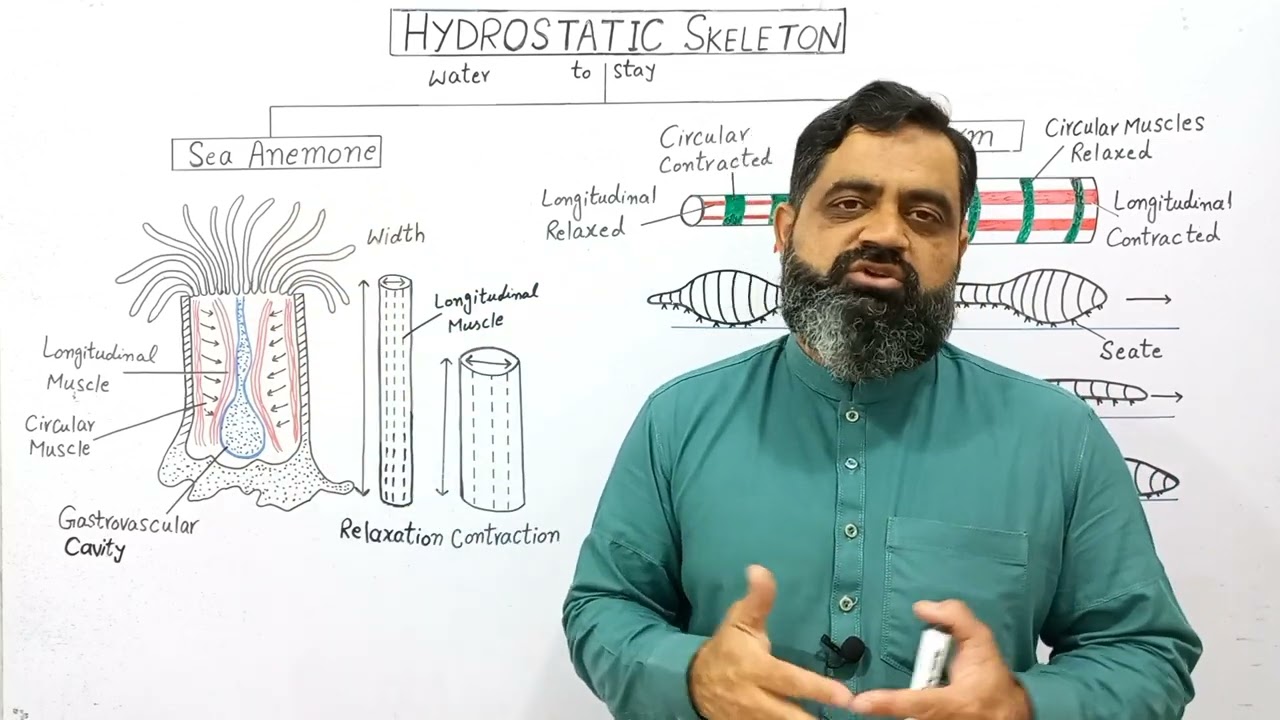
molluscan body have a hydrostatic skeleton as well.
The most complex exoskeleton is found among the arthropods. The arthropods have made a
variety of adaptations to allow them to live and grow within their exoskeleton. The invagination of
exoskeleton forms firm ridges and bars for muscle attachment. Another modification of exoskeleton
is the formation of joints. The exoskeleton are thin, soft and flexible at joints, consequently joint
move very easily. Other modifications of exoskeleton include sensory receptors called sensilla that
are in the form of bristles, and lenses and the modification of the exoskeleton that permits gaseous
exchange.
The exoskeleton in arthropoda protects the animals against their enemies and rough environment.
It also protects them from drying.
However, it has one disadvantage and that is animals cannot grow larger. The animal, therefore,
needs to shed its exoskeleton periodically and replace it with one of the larger size. This process is
known as “ecdysis or moulting.”
Ecdysis is divided into four stages:
1. Enzymes, secreted from hypodermal glands, begin digesting the old endocuticle. This digestion
separates hypodermis and the exoskeleton.
2. The old exoskeleton is split and pores are formed.
3. The digestion of endocuticle is followed by secretion of new procuticle and epicuticle.
4. Finally, the new exoskeleton is hardened by deposition of calcium carbonate. During the
hardening process, the arthropod is vulnerable to predators and remains hidden. All these
changes are controlled by the nervous system and the hormone ecdysone.
Повторяем попытку...

Доступные форматы для скачивания:
Скачать видео
-
Информация по загрузке: