Renal and Electrolyte Disorders, Hospital Medicine (for Hospitalists) - Full Vignette with Extended
Автор: EndlessMedical.Academy
Загружено: 2026-02-05
Просмотров: 3
Описание:
A 5-year-old boy is admitted with several weeks of progressive edema and dark, foamy urine, accompanied by laboratory evidence of nephrotic-range proteinuria, dysmorphic red blood cells in urine, and a complex coagulation profile. How should you approach the procedural bleeding risk before a planned percutaneous renal biopsy in a child with multisystem findings? What clinical and laboratory factors must be carefully evaluated to ensure patient safety during kidney biopsy in pediatric nephrotic syndrome?
VIDEO INFO
Category: Renal and Electrolyte Disorders, Hospital Medicine (for Hospitalists)
Difficulty: Hard - Advanced level - Challenges experienced practitioners
Question Type: Contraindications
Case Type: Typical Presentation
Explore more ways to learn on this and other topics by going to https://endlessmedical.academy/auth?h...
QUESTION
A 5-year-old boy is admitted to a general pediatric ward in a U.S. community hospital for progressive edema and dark, foamy urine noted by his parents over 3 weeks. On triage, an oxygen saturation of 89% on room air is immediately repeated on a well-perfused probe and reads 98%. Blood pressure measured with a pediatric cuff is 104/64 mmHg. He has focal epilepsy diagnosed at age 3 years, seizure-free for 18 months on valproate syrup and levetiracetam solution....
OPTIONS
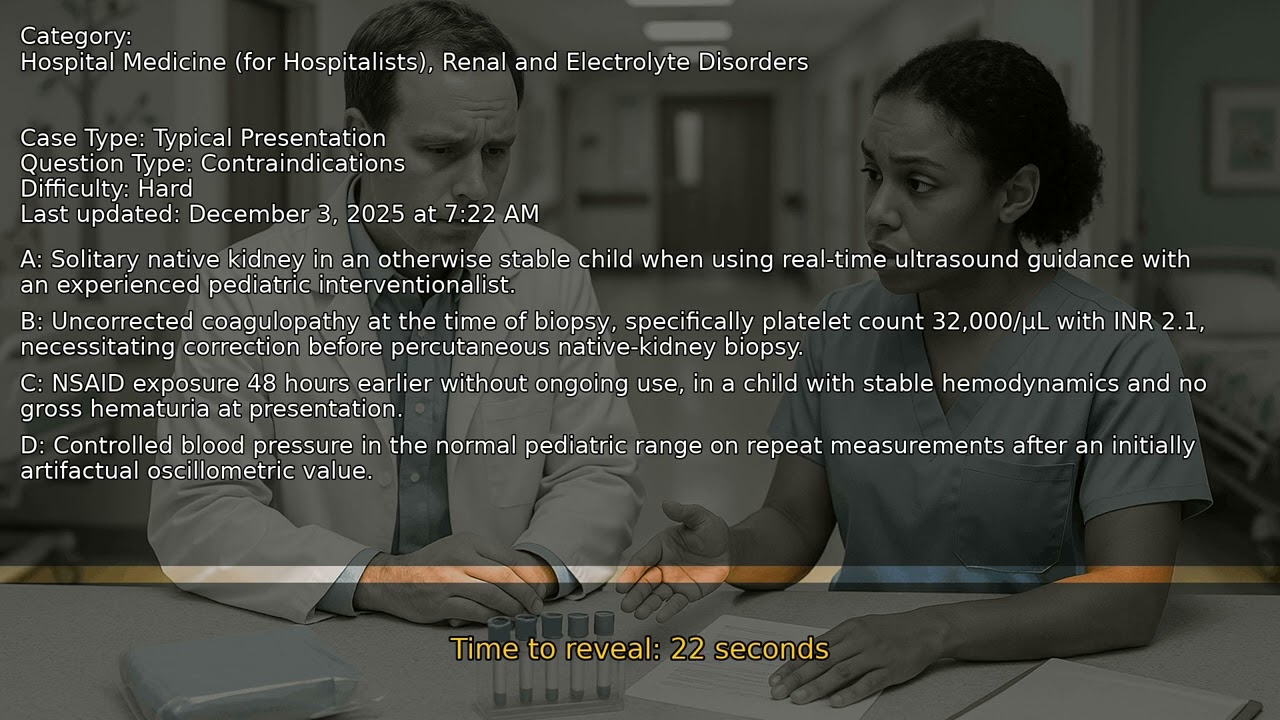
A. Uncorrected coagulopathy at the time of biopsy, specifically platelet count 32,000/muL with INR 2.1, necessitating correction before percutaneous native-kidney biopsy.
B. Solitary native kidney in an otherwise stable child when using real-time ultrasound guidance with an experienced pediatric interventionalist.
C. Controlled blood pressure in the normal pediatric range on repeat measurements after an initially artifactual oscillometric value.
D. NSAID exposure 48 hours earlier without ongoing use, in a child with stable hemodynamics and no gross hematuria at presentation.
CORRECT ANSWER
A. Uncorrected coagulopathy at the time of biopsy, specifically platelet count 32,000/muL with INR 2.1, necessitating correction before percutaneous native-kidney biopsy.
EXPLANATION
The child s bleeding profile is the single decisive issue. Percutaneous native-kidney biopsy is a high-bleeding-risk procedure, and active, uncorrected coagulopathy markedly increases the chance of hematoma, gross hematuria, transfusion, or intervention. This patient s platelet count is 32,000/muL with an INR of 2.1, both well outside standard safety targets for biopsy. Before proceeding, the team should correct coagulation parameters (for example, platelet transfusion to achieve at least a procedural threshold, vitamin K and/or plasma to normalize INR) and then reassess. This aligns with interventional radiology consensus that mandates correction of significant thrombocytopenia and coagulopathy before high-risk image-guided procedures.
By contrast, the other checklist items do not constitute absolute contraindications in this specific scenario. A solitary native kidney is no longer considered an absolute bar to biopsy when performed by an experienced operator under real-time ultrasound; it is a relative consideration that increases the need for expertise and post-biopsy monitoring. Controlled blood pressure in the pediatric reference range is appropriate for biopsy; the initially low oxygen saturation and artifact blood pressure were promptly clarified and are not relevant barriers....
Further reading:
Links to sources are provided for optional further reading only. The questions and explanations are independently authored and do not reproduce or adapt any specific third-party text or content.
---------------------------------------------------
Our cases and questions come from the https://EndlessMedical.Academy quiz engine - multi-model platform. Each question and explanation is forged by consensus between multiple top AI models (i.e. Open AI GPT, Claude, Grok, etc.), with automated web searches for the latest research and verified references. Calculations (e.g. eGFR, dosages) are checked via code execution to eliminate errors, and all references are reviewed by several AIs to minimize hallucinations.
Important note: This material is entirely AI-generated and has not been verified by human experts; despite stringent consensus checks, perfect accuracy cannot be guaranteed. Exercise caution - always corroborate the content with trusted references or qualified professionals, and never apply information from this content to patient care or clinical decisions without independent verification.
Clinicians already rely on AI and online tools - myself included - so treat this content as an additional focused aid, not a replacement for proper medical education. Visit https://endlessmedical.academy for more AI-supported resources and cases.
This material can not be treated as medical advice. May contain errors.
---------------------------------------------------
Повторяем попытку...
Доступные форматы для скачивания:
Скачать видео
-
Информация по загрузке:



![WYDAŁEM 12 TYSIĘCY NA NOWE FUTURE STARS! - FC26 Ultimate Team [#131]](https://imager.clipsaver.ru/PI-sWdCuUCM/max.jpg)