Vascular Anatomy, Human Anatomy, USMLE Step 1 - Full Vignette with Extended Explanations
Автор: EndlessMedical.Academy
Загружено: 2026-02-07
Просмотров: 7
Описание:
A 44-year-old endurance runner with a history of chronic fatigue, NSAID-sensitive asthma, prior right tibial osteomyelitis, and recent angioplasty for popliteal stenosis presents with recurrent exertional left calf pain and visible calf enlargement. Despite initial improvement, her symptoms now occur after brief uphill walking, with provocative maneuvers altering distal pulses and duplex velocities. What clinical and diagnostic features should you consider to identify the cause of persistent symptoms and guide further evaluation?
VIDEO INFO
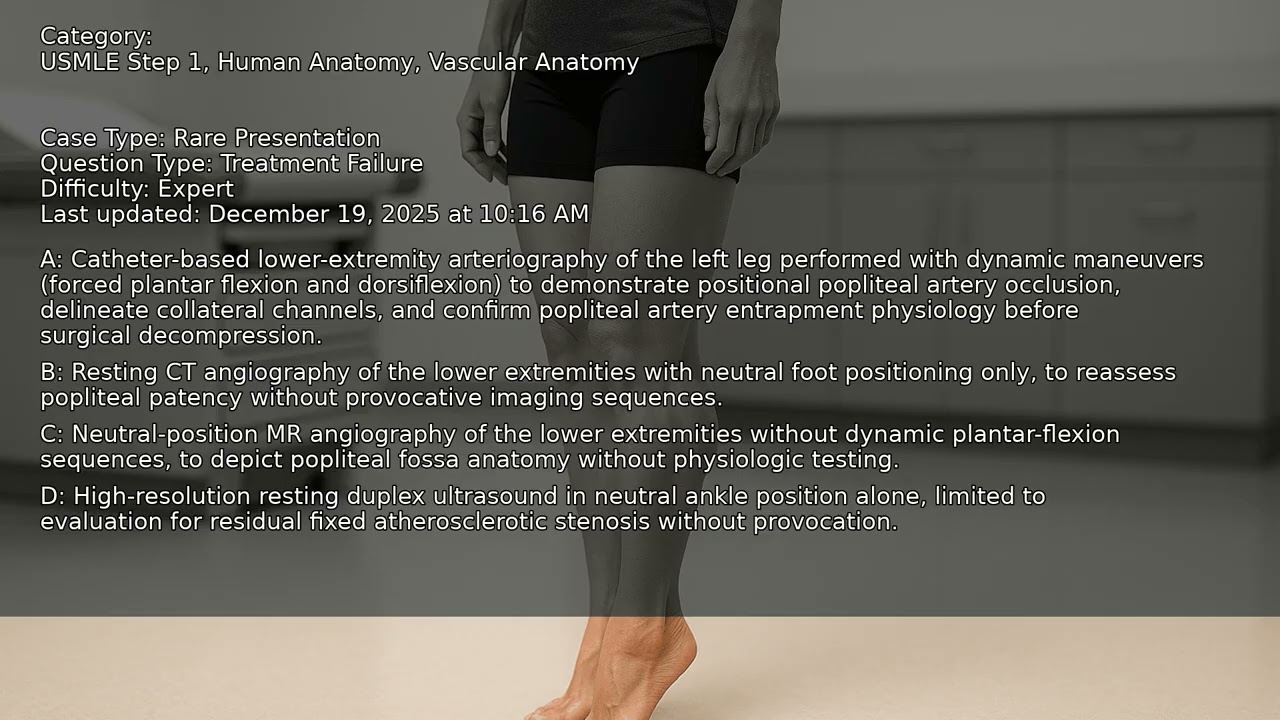
Category: Vascular Anatomy, Human Anatomy, USMLE Step 1
Difficulty: Expert - Expert level - For those seeking deep understanding
Question Type: Treatment Failure
Case Type: Rare Presentation
Explore more ways to learn on this and other topics by going to https://endlessmedical.academy/auth?h...
QUESTION
A 44-year-old endurance runner with chronic fatigue syndrome, asthma (NSAID-sensitive), remote osteomyelitis of the right tibia (15 years ago), and basal cell carcinoma excised from the left cheek (3 years ago) presents to a vascular clinic for recurrent exertional left calf pain 8 months after a balloon angioplasty performed elsewhere for a high-grade popliteal stenosis. She has never had diabetes; last month hemoglobin A1c was 5.3%....
OPTIONS
A. Catheter-based lower-extremity arteriography of the left leg performed with dynamic maneuvers (forced plantar flexion and dorsiflexion) to demonstrate positional popliteal artery occlusion, delineate collateral channels, and confirm popliteal artery entrapment physiology before surgical decompres...
B. Resting CT angiography of the lower extremities with neutral foot positioning only, to reassess popliteal patency without provocative imaging sequences.
C. High-resolution resting duplex ultrasound in neutral ankle position alone, limited to evaluation for residual fixed atherosclerotic stenosis without provocation.
D. Neutral-position MR angiography of the lower extremities without dynamic plantar-flexion sequences, to depict popliteal fossa anatomy without physiologic testing.
CORRECT ANSWER
A. Catheter-based lower-extremity arteriography of the left leg performed with dynamic maneuvers (forced plantar flexion and dorsiflexion) to demonstrate positional popliteal artery occlusion, delineate collateral channels, and confirm popliteal artery entrapment physiology before surgical decompression.
EXPLANATION
The patient s reproducible exertional calf pain with rapid relief, side-to-side calf hypertrophy, loss of dorsalis pedis pulse and appearance of a popliteal bruit during forced plantar flexion, post-exercise ABI drop to 0.66, and dynamic duplex showing a velocity ratio of about 2.24 with transient flow cessation strongly suggest popliteal artery entrapment physiology rather than fixed atherosclerotic restenosis. Neutral-position CTA and MRA were previously normal, which is typical when dynamic compression is not provoked during imaging. The best next study is catheter-based arteriography performed with active maneuvers (forced plantar flexion and dorsiflexion) to demonstrate positional occlusion, map collaterals, and confirm the entrapment mechanism to guide definitive surgical decompression.
Resting CTA, resting duplex limited to neutral ankle position, or neutral-position MRA would likely repeat prior false-negatives by failing to reproduce the provocative limb position....
Further reading:
Links to sources are provided for optional further reading only. The questions and explanations are independently authored and do not reproduce or adapt any specific third-party text or content.
---------------------------------------------------
Our cases and questions come from the https://EndlessMedical.Academy quiz engine - multi-model platform. Each question and explanation is forged by consensus between multiple top AI models (i.e. Open AI GPT, Claude, Grok, etc.), with automated web searches for the latest research and verified references. Calculations (e.g. eGFR, dosages) are checked via code execution to eliminate errors, and all references are reviewed by several AIs to minimize hallucinations.
Important note: This material is entirely AI-generated and has not been verified by human experts; despite stringent consensus checks, perfect accuracy cannot be guaranteed. Exercise caution - always corroborate the content with trusted references or qualified professionals, and never apply information from this content to patient care or clinical decisions without independent verification.
Clinicians already rely on AI and online tools - myself included - so treat this content as an additional focused aid, not a replacement for proper medical education. Visit https://endlessmedical.academy for more AI-supported resources and cases.
This material can not be treated as medical advice. May contain errors.
---------------------------------------------------
Повторяем попытку...
Доступные форматы для скачивания:
Скачать видео
-
Информация по загрузке: