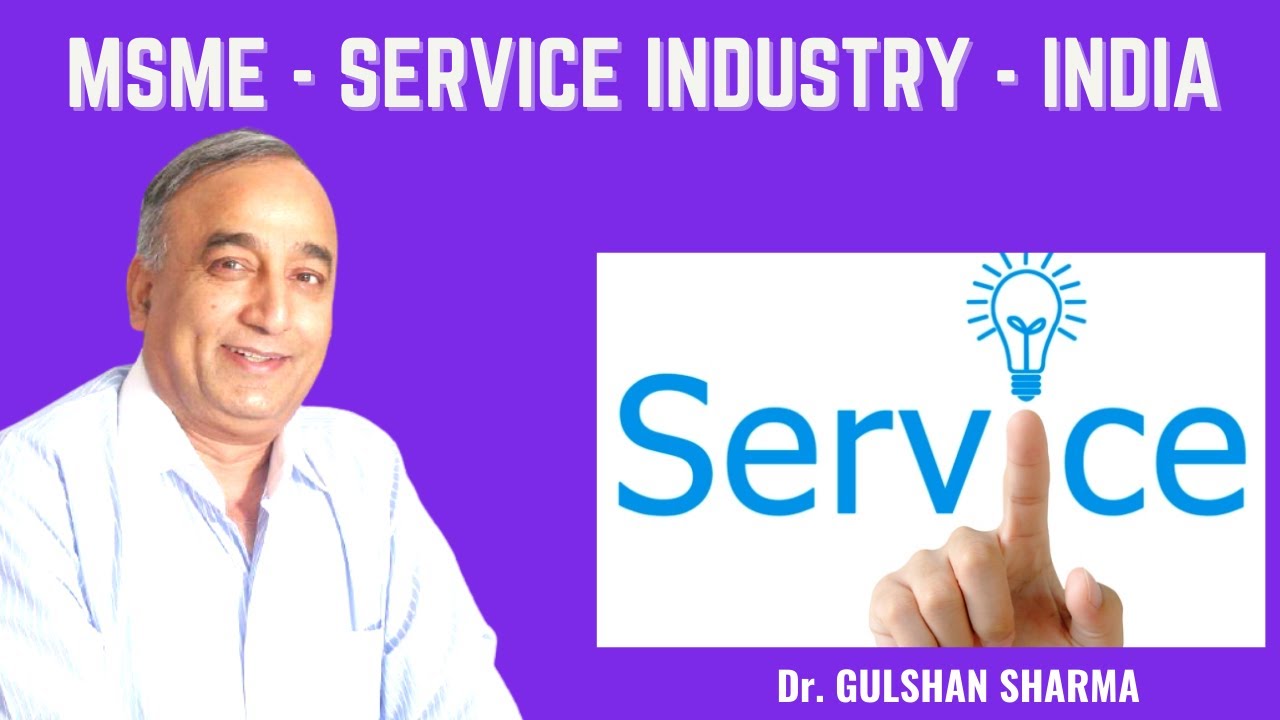
MSME - SERVICE INDUSTRY - INDIA | Making Education Relevant | 16 July, 2021
Автор: Chamber for Service Industry
Загружено: 2021-07-16
Просмотров: 1290
Описание:
MSME - SERVICE INDUSTRY - INDIA | Making Education Relevant | 16 July, 2021
ICSI – int. Chamber for Service Industry is thankful to Prime Minister and the Finance Minister of India to announce that now the services sector will be at par with manufacturing sector in the MSME domain from 13th May 2020 onwards and new definition for the MSME based on our recommendations for continuously three years to GoI.Today during Covid 19, nearly 9 in every 10 countries tracked by the International Monetary Fund (IMF) contracted in 2020, making COVID-19 the biggest economic shock since the Great Depression of 1929. India was no exception as its economy too contracted for the first time in four decades. Government enforced lockdowns and self-isolation measures resulted in a near freeze of supply chains and most businesses found themselves amidst a very real existential crisis. A closer look at the business performance data reveals that the pandemic has had a disproportionate impact on the Micro, Small and Medium Enterprises (MSMEs).
Recognising this, the government and the RBI have been undertaking a host of measures. In the Union Budget, the government proposed more than double the allocation for the MSME sector to Rs 157 bn in FY22 from Rs 56.6 bn in FY21. The allocation of Rs 100 bn (64% of total allocation to MSMEs) for Guarantee Emergency Credit Line (GECL) facility will help MSMEs meet their operational liabilities and restart their businesses in the post pandemic world.
Despite the measures taken by the government to ease the credit constraints of MSMEs, the outstanding value of MSME loans from commercial banks as a percentage of GDP stands at 6.4% in India. The current level of supply chain financing stand at less than 1% in India. Improving this penetration can help MSMEs borrow funds at ease as well as at an interest rate that is effectively the same as for a large company. Besides, providing equity funding to MSMEs through government Venture Capital funds and making a robust Intellectual property (IP) finance ecosystem for innovative MSMEs should be considered.
Further, the budget has taken measures in two core areas – access to finance and ease of doing business – to support the MSME sector. However, much more needs to be done to make MSMEs truly competitive in the post COVID-19 era. The government and private sector have a collective responsibility of activating three growth levers for MSMEs – access to finance, digital transformation, and access to markets. The pandemic is expected to have a lasting impact on companies in terms of the way they conduct their business. While COVID-19 has accelerated digital transformation of businesses by several years, Indian MSMEs haven’t yet leveraged digital technology to a full extent. The percentage of e-commerce sales to total retail sales stands at 2% in India, compared to around 14% globally.
Business information portals can play a huge role in expanding market access for firms by mitigating the problems of information asymmetry and reducing the sunk cost of entering new markets. Hence, the government and export promotion agencies need to incentivize MSMEs to use business information portals to improve their access to markets.
The Technology and Services industry has become the backbone for other industries, driving growth, transformation, and innovation in those sectors. COVID-19 will continue to impact the technology and services value chain across different levels.COVID-19 is expected introduce novel methods to the service sector, such as untact service, telecommuting, alternative work arrangements, job crafting, and new work skills, digital technology is becoming more important than ever before. The use of virtual collaboration tools has skyrocketed, not just for personal use but for workplace communication, but challenges of bandwidth have led to uneven experiences in two-way communication. Enterprises will be compelled to redesign their supply chain networks, making them hyper local. Remote learning, automation, and the rise of the gig and sharing economies are some new disruptions COVID-19 will introduce to the workplace. Firms will shift their business models to everything-as-a-service. Legitimate concerns over privacy due to increased surveillance will push firms to develop robust cyber defense mechanisms
Like me at / gsmotivator
Follow me at / gsmotivator
Tweet me at / gsmotivator
Visit us at www.icsiindia.in
Write to us at [email protected]
Whats App for joining as panelist in our webinars or to send any suggestions or to book our speaker at [email protected]
@gsmotivator
@DrGulshanSharma
@MakingEducationRelevant
#MakingEducationRelevant
#DrGulshanSharma
#gsmotivator
https://www.blogger.com/blog/posts/57...
https://www.blogger.com/blog/post/edi...
Thank you for Watching !
Повторяем попытку...
Доступные форматы для скачивания:
Скачать видео
-
Информация по загрузке: