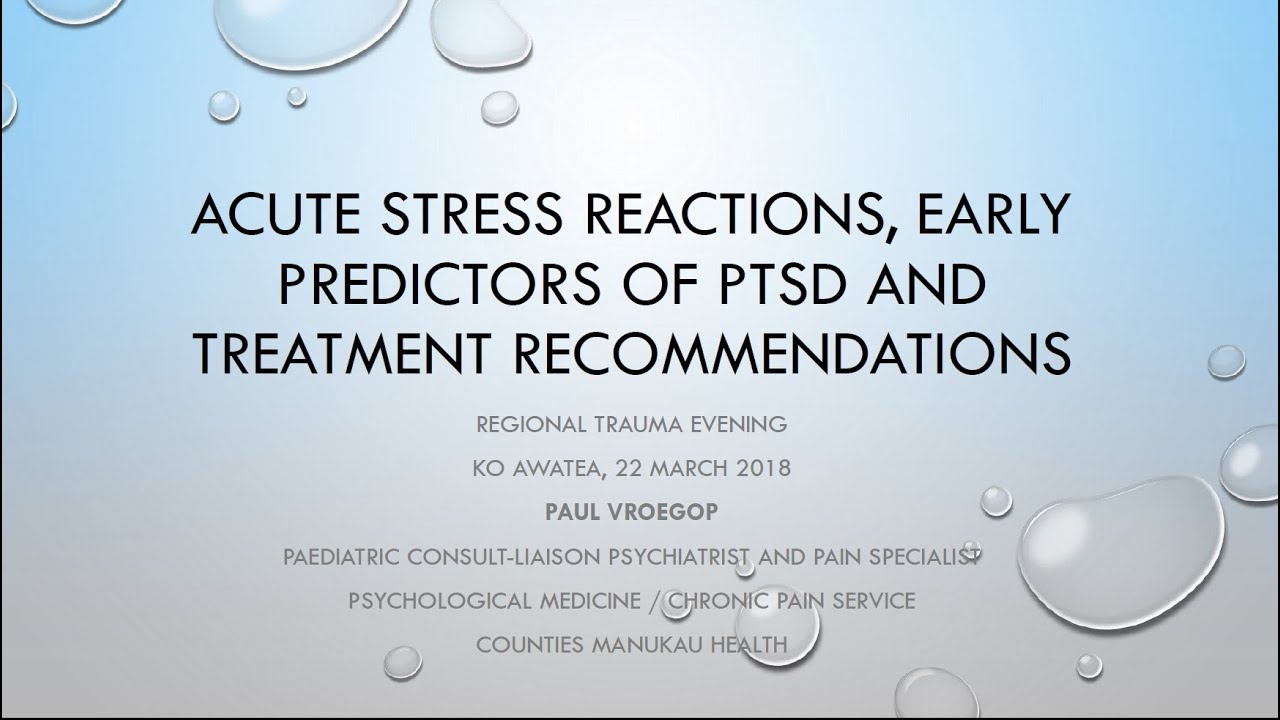
Acute stress reactions
Автор: Vijay Bhatia
Загружено: 2020-03-10
Просмотров: 582
Описание:
Mind disorders is a channel for short videos on mental disorders and the symptoms of mental disorder. Dr Vijay Bhatia has been working in mental health for last 30 years and has experience in diagnosing and treating mental health disorders. These videos are designed to understand mental illness and identify symptoms in mental disorders. Acute stress reaction. A transient disorder that develops in an individual without any other apparent mental disorder in response to exceptional physical and mental stress, and which usually subsides within hours or days.
Individual vulnerability and coping capacity play a role in the occurrence and severity of acute stress reactions. The symptoms show a typically mixed and changing picture, and include an initial state of “daze” with some constriction of the field of consciousness and narrowing of attention, inability to comprehend stimuli and disorientation.
This state may be followed either by further withdrawal from the surrounding situation (to the extend of dissociative stupor (F44.2), or by agitation and overactivity (flight reaction or fugue).
Autonomic signs of anxiety (tachycardia, sweating, flushing) are commonly present.
The symptoms usually appear within minutes of the impact of the stressful stimulus or event, and disappear within 2-3 days (often within hours).
Partial or complete amnesia (F44.0) for the episode may be present.
If the symptoms persist, a change in diagnosis should be considered.
Acute crisis reaction
Acute reaction to stress
Combat fatigue
Crisis state
Psychic shock. The patient must have been exposed to an exceptional mental or physical stressor.
Exposure to the stressor is followed by an immediate onset of symptoms (within 1 hour).
Criteria
Withdrawal from expected social interaction
Narrowing of attention
Apparent disorientation
Anger or verbal aggression
Despair or hopelessness
Inappropriate or purposeless overactivity
Uncontrollable and excessive grief (judged by local cultural standards)
If the stressor is transient or can be relieved, the symptoms must begin to diminish after not more than 8 hours.
If exposure to the stressor continues, the symptoms must begin to diminish after not more than 48 hours.
Most commonly used exclusion clause. The reaction must occur in the absence of any other concurrent mental or behavioural disorder except Generalised anxiety disorder and personality disorders. And not more than 3 months of the end of an episode of any other mental or behavioural disorder.
Повторяем попытку...
Доступные форматы для скачивания:
Скачать видео
-
Информация по загрузке:



![Роберт Сапольски — Депрессия [Vert Dider]](https://imager.clipsaver.ru/_UtA0dwGoUQ/max.jpg)







![The Best of Ludovico Einaudi | Greatest Hits 2024 | [2 HOURS]](https://imager.clipsaver.ru/NwM4ajjPrzI/max.jpg)