Strain Gauge Working Principle | Types of pressure gauge
Автор: Raj Kanabar
Загружено: 2024-02-02
Просмотров: 25509
Описание:
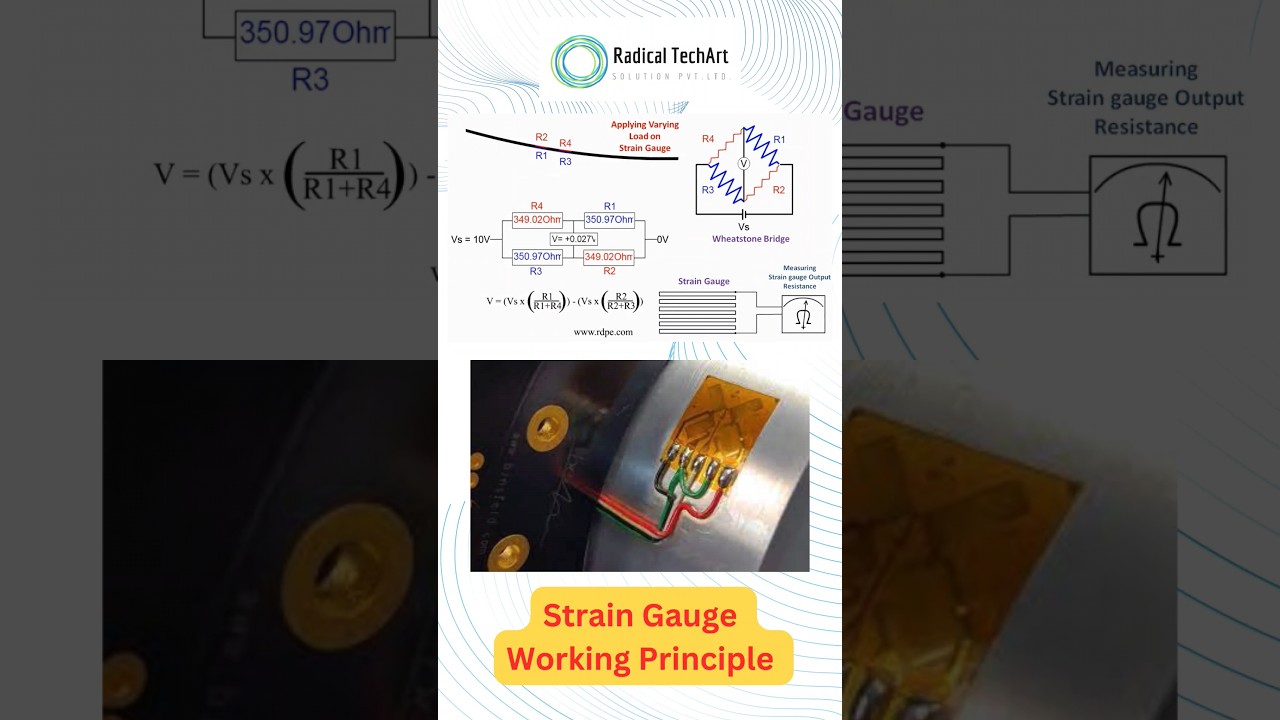
A strain gauge is a sensor used to measure the amount of deformation or strain in an object. It works on the principle that the electrical resistance of a wire or a foil changes when it undergoes mechanical strain. Strain gauges are commonly used in applications such as stress analysis, structural monitoring, and load measurements. Here's an overview of the working principle of a strain gauge:
1. *Material and Construction:*
Strain gauges are typically made of a thin, flexible material, such as metal foil or wire.
The most common material used is a metal, like constantan or nickel-chromium alloy, due to its stable electrical properties.
2. *Attachment to the Surface:*
The strain gauge is bonded or attached to the surface of the object (structure) where strain measurement is desired.
The adhesive used for bonding is crucial, as it should allow for good mechanical coupling and efficient transfer of strain.
3. *Deformation of the Object:*
When the object experiences mechanical strain or deformation, the strain gauge deforms along with it.
4. *Change in Electrical Resistance:*
The deformation causes a change in the length and/or cross-sectional area of the strain gauge material.
Due to the inherent properties of the material, this change in dimensions leads to a change in electrical resistance.
5. *Wheatstone Bridge Configuration:*
Strain gauges are often arranged in a Wheatstone bridge configuration for improved sensitivity and accuracy.
A Wheatstone bridge consists of four resistive arms, with the strain gauge forming one or more of these arms.
6. *Bridge Output:*
The Wheatstone bridge is connected to an electrical circuit.
As the strain causes a change in resistance in the strain gauge, the bridge becomes unbalanced, leading to an output voltage proportional to the applied strain.
7. *Signal Conditioning:*
The output signal from the Wheatstone bridge is typically very small.
Signal conditioning devices, such as amplifiers, are used to amplify and process the signal for further measurement or recording.
8. *Measurement and Calibration:*
The output voltage is then measured and calibrated to determine the amount of strain experienced by the object.
Key Considerations:
*Gauge Factor:* The gauge factor is a dimensionless constant that defines the sensitivity of the strain gauge. It represents the fractional change in electrical resistance per unit strain.
*Temperature Compensation:* Strain gauges are sensitive to temperature changes, and proper compensation mechanisms or temperature compensation techniques are often employed.
Strain gauges are widely used in various industries to monitor and measure the deformation of structures and materials under different conditions, providing valuable information for design, testing, and quality control purposes.
👍 If you found this video helpful, don't forget to give it a thumbs up, subscribe to our channel, and hit the notification bell to stay updated on our latest industrial solutions.
Connect with us:
🌐 Website: https://www.radicaltechmart.com/
📧 Email: [email protected]
Повторяем попытку...
Доступные форматы для скачивания:
Скачать видео
-
Информация по загрузке: