Washington Irving References in Easy Rider | Video Essay | Film Analysis
Автор: Cinema Sensationalist
Загружено: 2025-09-23
Просмотров: 24
Описание:
The landmark film Easy Rider, although it is more commonly associated with the 1960s counterculture, and the movies of New Hollywood, it is also associated with the literature of the American Romantic movement of the early 19th century, through references and thematic connections to Washington Irving’s works of historical fiction.
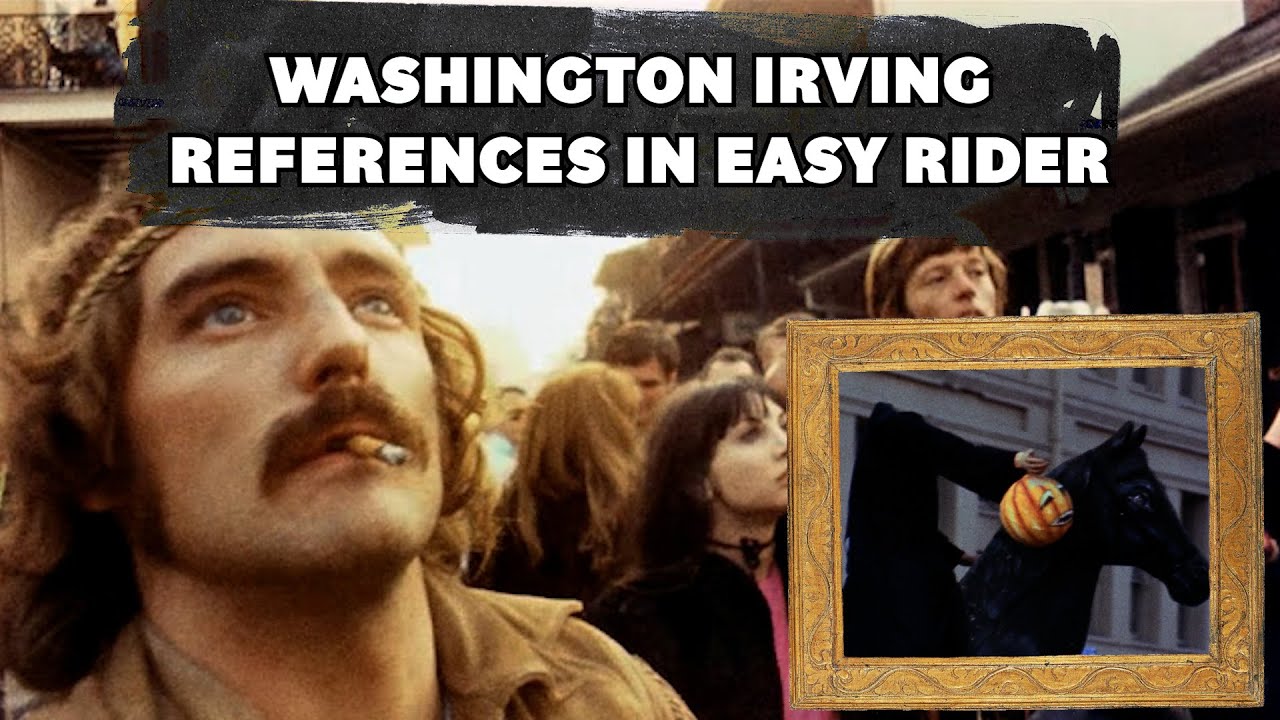
When Fonda and Hopper’s characters attend the Marti Gras celebrations, in the parade there is a float depicting a headless horseman. This is a direct reference to Washington Irving’s story: The Legend of Sleepy Hollow, where the mythical figure officially entered the canon of American superstitions.
Additionally, in the parade, we see a float depicting a pirate ship travelling past a building called The Roosevelt, a hotel in New Orleans. Irving’s work would often insinuate a connection between the wealth of America’s actually existing richest families, and the country’s colonial era buccaneering. This is conveyed most explicitly in Tom Walker and The Devil. This image from Easy Rider makes the same insinuation, made all the more apparent through the more direct reference to the headless horseman alongside it. When using fiction to historicise, and denigrate, the fortunes of America’s elite families, Irving’s focus would often be directed towards the descendants of certain Dutch colonists of New Amsterdam. These families, in reality and in Irving’s fiction, would go on to become the socialites and industrial barons that formed the upper crust of New York’s elite society. The Roosevelts, who trace their lineage to a 17th century Dutch immigrant to New Amsterdam named van Rosenvelt, are typical of the sort of family Irving was targeting in his stories.
The parade also includes masked figures who represent the Native people who inhabited the country before European settlers arrived. Almost every one of Irving’s stories reminds the reader of their presence.
Also, Rip Van Winkle’s story deals with the conflict between a rigid, hard-working life and a carefree life of ease. Easy Rider deals with this theme too. Their journey commences with Peter Fonda’s character discarding his watch, which symbolises an abandonment of both temporality and the Protestant work ethic – two things that Rip Van Winkle abandoned, or that abandoned him, perhaps.
Easy Rider, like Irving’s work, is concerned with America’s national character.
This is most obviously apparent in the two main characters’ costume.
Fonda is wearing an American flag on his jacket, and Hopper is dressed like a frontiersman – the sort of pioneering figure who continues to define America’s perception of itself.
#movievideoessay#videoessay #filmstudies #sceneanalysis #filmtheory #filmreview #filmanalysis #cinemaanalysis #cinema #filmvideoessay #filmcoding #deepdivefilmanalysis #deepdivemediatheory #filmanalysis #allegoryinfilm #filmallegory #filmsymbolism #symbolisminfilm #scenebreakdown
#washingtonirving #easyrider #easyrider1969 #fonda #sleepyhollow #ripvanwinkle #filmanalysis #symbolicimagery #literatureanalysis #americanfiction
Washington Irving and Dennis Hopper both present an intensely superstitious nation.
Like Ichabod Crane, The Easy Riders, have terrifying visions as they pass through the graveyard, with the added help of LSD in place of a copy of Cotton Mather’s History of New England Witchcraft. Like Ichabod Crane, The Easy Riders are chased out of a small town for disrupting the delicate social order of its unwelcoming, backwards inhabitants, who appear to be stuck in time. Like Ichabod Crane in The Legend of Sleepy Hollow, Fonda and Hopper’s characters are embodiments of a particular cultural geography.
Both The Easy Riders and Ichabod Crane are figures representing Yankeedom.
In American Nations: A History of the Eleven Rival Regional Cultures of North America, Collin Woodard explores how American history has been shaped by the migratory pattern of its different settler histories. Even minute cultural, culinary, and linguistic differences can be linked to the history of which European settlers colonised the area most successfully. Woodard is developing a pre-existing thesis.
Easy Rider, while advancing the modern counterculture, was drawing from America’s Romantic literary traditions. In doing so, Hopper and Fonda demonstrated, with great wisdom, that the New America was just like the Old America despite its superficial changes. Like Ichabod Crane, The Hippies of the counterculture could not escape the internalised framework of their culture. A culture forged at the meeting houses, witch trials, and Indian battles of 17th century Massachusetts by the passengers of The Mayflower, their descendants, and those who came to join them later.
Повторяем попытку...
Доступные форматы для скачивания:
Скачать видео
-
Информация по загрузке:


![«ФАНТОМАС»🎭😃Как создавали Легендарный фильм с Луи де Фюнесом [Съемки Факты Интересности]](https://image.4k-video.ru/id-video/IHSXCZ6uiTg)