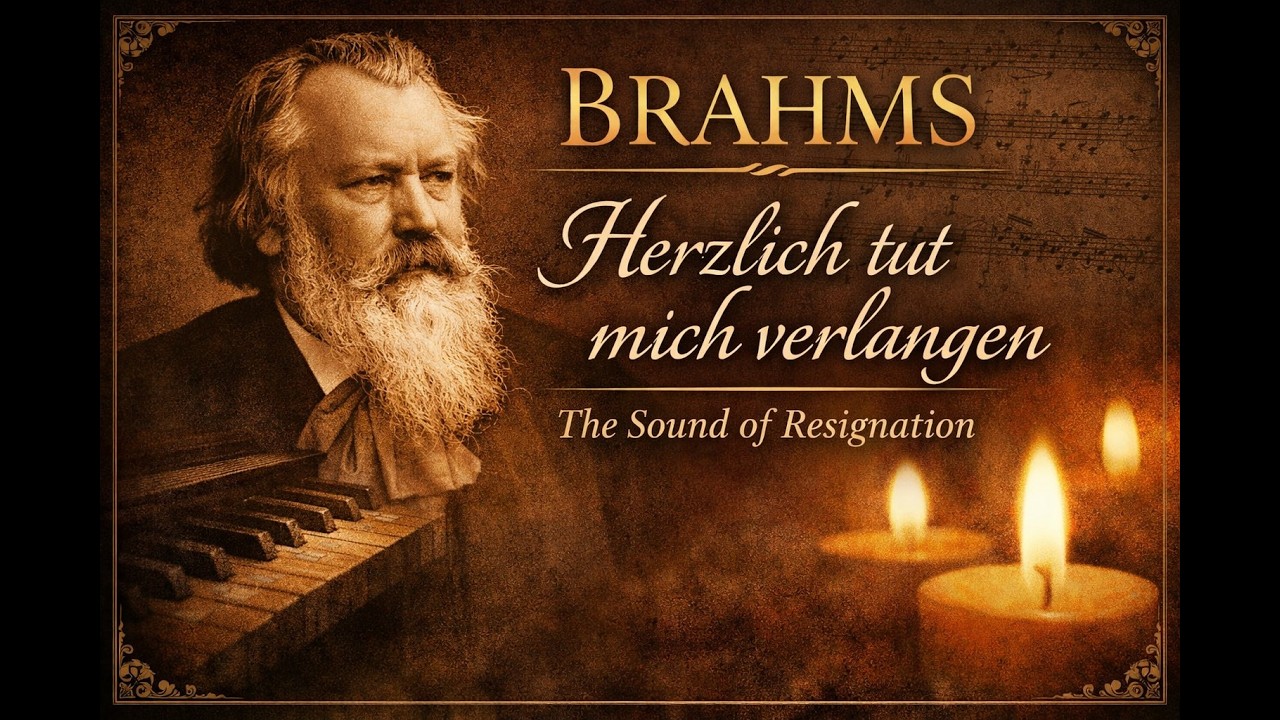
Brahms: Herzlich tut mich verlangen -- The Sound of Resignation | Renaissance Organ
Автор: The Singing Organist
Загружено: 2026-03-09
Просмотров: 33
Описание:
Part of the series “The Sound of Grief: A Musical Journey Toward Transcendence.”
Johannes Brahms’ Herzlich tut mich verlangen (Op. 122 No. 10) represents the third stage in this journey: resignation. After the inward contemplation of Frescobaldi and the dramatic struggle of Bruhns, Brahms transforms the ancient musical “sigh” into something quieter and more human — a steady heartbeat beneath the music.
Johannes Brahms (1833–1897)
Herzlich tut mich verlangen — Op. 122 No. 10
Prologue — Frescobaldi: Toccata cromatica per l’Elevatione
Struggle — Bruhns: Praeludium in E minor
Resignation — Brahms: Herzlich tut mich verlangen
Brahms composed the Eleven Chorale Preludes, Op. 122 during the final year of his life in 1896. Published posthumously, they are often understood as his spiritual testament. Many of the chosen chorales reflect on mortality, longing for rest, and the hope of redemption.
The melody Herzlich tut mich verlangen (“my heart yearns”) originates in the Phrygian mode, whose distinctive half-step above the final gives the tune its ancient, plaintive color. By Brahms’s time it was most widely associated with Paul Gerhardt’s Passion text “O Haupt voll Blut und Wunden,” familiar from J.S. Bach’s St. Matthew Passion.
In this setting Brahms softens the stark modal austerity of the melody by casting the prelude in A minor. The Phrygian inflections remain, but they are absorbed into the warmer tonal language of the nineteenth century, preserving the chorale’s ancient gravity while tempering it with Romantic tenderness.
Throughout the piece Brahms maintains a persistent throbbing bass pulse, which I hear as a heartbeat — a musical embodiment of the longing expressed in the text itself. Above this pulse, gentle hemiolas and sighing gestures weave through the manuals while chromatic descents echo the lament figures heard earlier in the series.
Only at the end does the music finally settle. The bass pulse slows, harmonic tensions dissolve, and the earlier struggle disappears into a Picardy third (in this performance), giving the work its sense of quiet resignation.
For this recording I used a sampled organ by AVO based on the instrument once played by Franz Liszt. The manual accompaniment is registered with warm 8′ strings and flutes, while the chorale melody in the pedals is played on an 8′ Fugara with tremulant to highlight its expressive character — continuing the use of undulating solo colors heard in the earlier recordings of this series.
Some performance choices further shape the interpretation. When canonic voices appear in the manuals, they are allowed to linger slightly longer than notated, and a flexible use of rubato helps emphasize the music’s inward, breathing quality.
Unlike the turbulent anguish heard earlier in this program’s narrative, the sorrow here is restrained and contemplative. The chorale unfolds with simplicity while the surrounding voices breathe their quiet sighs or sustain the steady heartbeat beneath.
In this way the lament rhetoric heard earlier in Frescobaldi and Bruhns returns here in transformed form — no longer anguished, but inward and accepting.
Chapters — Brahms: Herzlich tut mich verlangen
00:00 Brahms: The Heartbeat Begins
00:25 The Chorale Appears
01:26 The Plaint Repeats
02:14 The Sound of Resignation
02:48 The Chromatic Descent
02:57 Longing and Final Breath
03:53 The Picardy Third
Part of the series “The Sound of Grief — A Musical Journey Toward Transcendence.” -- • The Sound of Grief: A Musical Journey Towa...
This series began with these two prior uploads:
Part 1: Frescobaldi: The Sound of Consolation -- • Frescobaldi: Toccata Cromatica — The Sound...
Part 2: Bruhns: The Sound of Struggle -- • Bruhns: Praeludium in E Minor — The Sound ...
#Brahms
#OrganMusic
#PipeOrgan
#BrahmsOp122
#ChoralePrelude
#SoundOfGrief
#TheSingingOrganist
Повторяем попытку...
Доступные форматы для скачивания:
Скачать видео
-
Информация по загрузке: