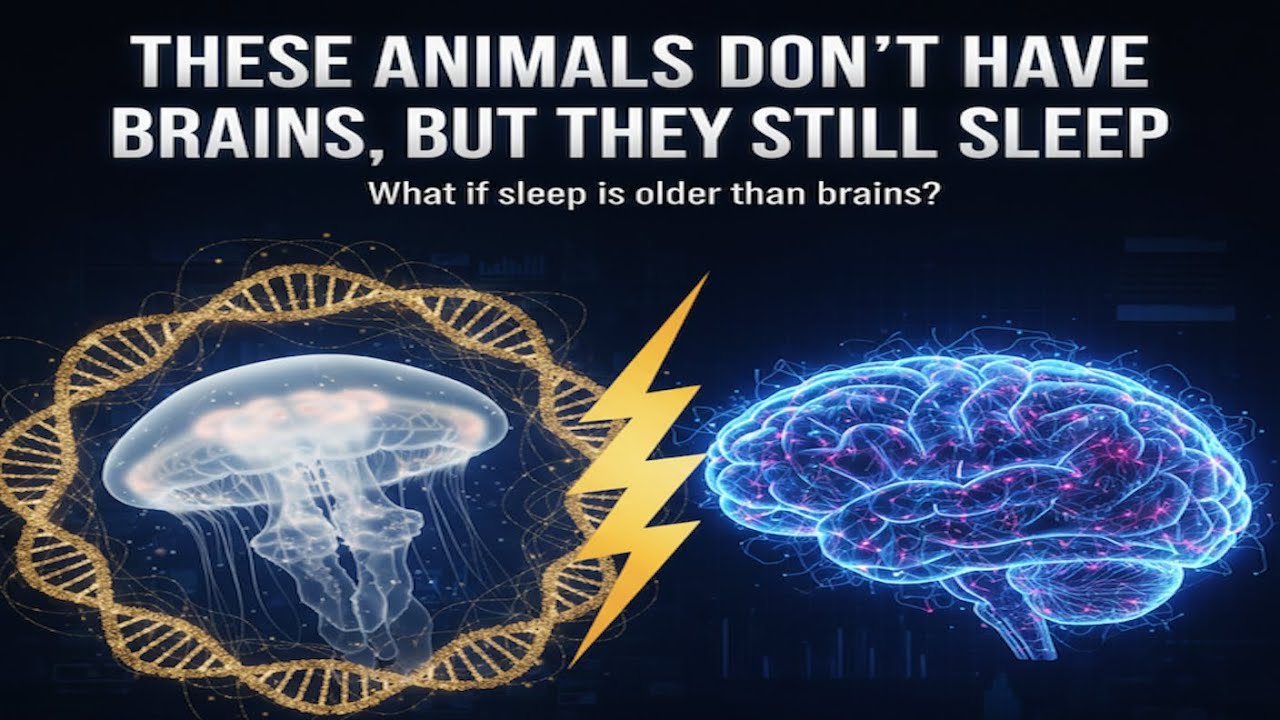
These Animals Don't Have Brains, But They Still Sleep: What if sleep is older than brains?
Автор: alpha 137
Загружено: 2026-02-04
Просмотров: 17
Описание:
Nature Communications(2026), DOI: https://doi.org/10.1038/s41467-025-67... (https://www.nature.com/articles/s4146...)
1. THE IMPOSSIBLE REPUTATION
Imagine a creature with no heart, no blood, and not even a brain.It doesn’t think. It doesn’t plan.It just pulses.
By every definition we have, it’s one of the simplest animals on Earth.
And yet…if you keep it awake too long,it shows signs of the same biological exhaustion you do.
What if sleep is older than brains?Older than dinosaurs. Older than trees.
Scientists have discovered that animals with no central control center at all still enter a genuine sleep-like state.Not just “rest.”Not just “slow down.”A regulated, essential shutdown.
And what happens during those quiet hours may explain why you can’t survive without sleep either.
2. SLEEP WITHOUT BRAINS
When we think of sleep, we think of the brain.Dreams. Memory. REM cycles.
But the upside-down jellyfish (Cassiopea) and the starlet sea anemone (Nematostella) don’t have brains.They have a nerve net — a loose web of neurons spread throughout their bodies.More like a living internet than a central computer.
Researchers tracked these animals continuously and found something remarkable.
Both spend about one-third of their day in a reversible state of inactivity.Their pulsing slows.Their responsiveness drops.
But here’s the real test:
If you disturb them during this state, they don’t just resume activity —they compensate later.
The jellyfish slept about 50% more afterward.The anemones about 30% more.
This is sleep rebound — a biological drive to recover lost sleep.Even without a brain to feel tired, their nervous systems still demand recovery.
3. THE “ROAD CLOSED” ANALOGY
The most profound discovery happened inside their cells.
Every time a neuron is active, tiny forms of damage build up in its DNA.This happens in humans.It happens in mice.And it happens in jellyfish and sea anemones too.
Think of a neuron like a busy city highway.During the day, traffic is too heavy to fix the potholes.You can’t repair the road while cars are racing over it.
Sleep is the “Road Closed” sign.
While these animals are in their sleep-like state, damage to their genetic material decreases as repair processes take over.
To test the link, scientists artificially increased DNA damage using UV light and chemicals.
The result?
The animals slept longer.
As if their bodies were saying:“Hold on. The road is too damaged. We need more time offline.”
4. WHY THIS CHANGES EVERYTHING
For decades, we thought sleep was mainly about higher brain functions — memory, learning, emotional processing.
But a sea anemone doesn’t store memories the way we do.A jellyfish doesn’t dream.
Yet they still require sleep.
This suggests that one of sleep’s most ancient roles isn’t about thinking —it’s about cellular survival.
Sleep may have begun as a mandatory maintenance window for early neurons, hundreds of millions of years ago, when the first nervous systems appeared in Earth’s oceans.
Long before complex brains.Long before consciousness.
5. THE HUMAN CONNECTION
This deep evolutionary link helps explain why sleep deprivation hits us so hard.
Why chronic sleep loss is associated with aging and neurological disease.Why small regions of the human brain can briefly “go offline” when we’re exhausted — a phenomenon called local sleep.
When you fight sleep, you’re not just resisting a modern habit.
You may be interrupting a repair process that began in the ancient sea —a process that protects the DNA of the neurons that let you think, remember, and experience the world.
CONCLUSION — THE ANCIENT RHYTHM
So the next time you see a jellyfish drifting through the water,or a sea anemone swaying with the current,
remember:
You’re looking at one of the oldest biological rhythms on Earth.
Their need for rest isn’t about dreams.It isn’t about memory.
It’s about repair. Continuity. Survival.
And every night, when you fall asleep,you’re following a rhythm that began in the ancient ocean,in a common ancestor we share with these simple creatures —
a rhythm established
long before humans,and long before anything ever wonderedwhy we sleep.
#SleepScience #BrainlessSleep #JellyfishSleep #EvolutionOfSleep #Neuroscience #MarineBiology #AncientRhythms #DNArepair #SleepDeprivation #Anemones #UpsideDownJellyfish #Consciousness #Neurology #Biology #ScienceDiscoveries
Повторяем попытку...
Доступные форматы для скачивания:
Скачать видео
-
Информация по загрузке: