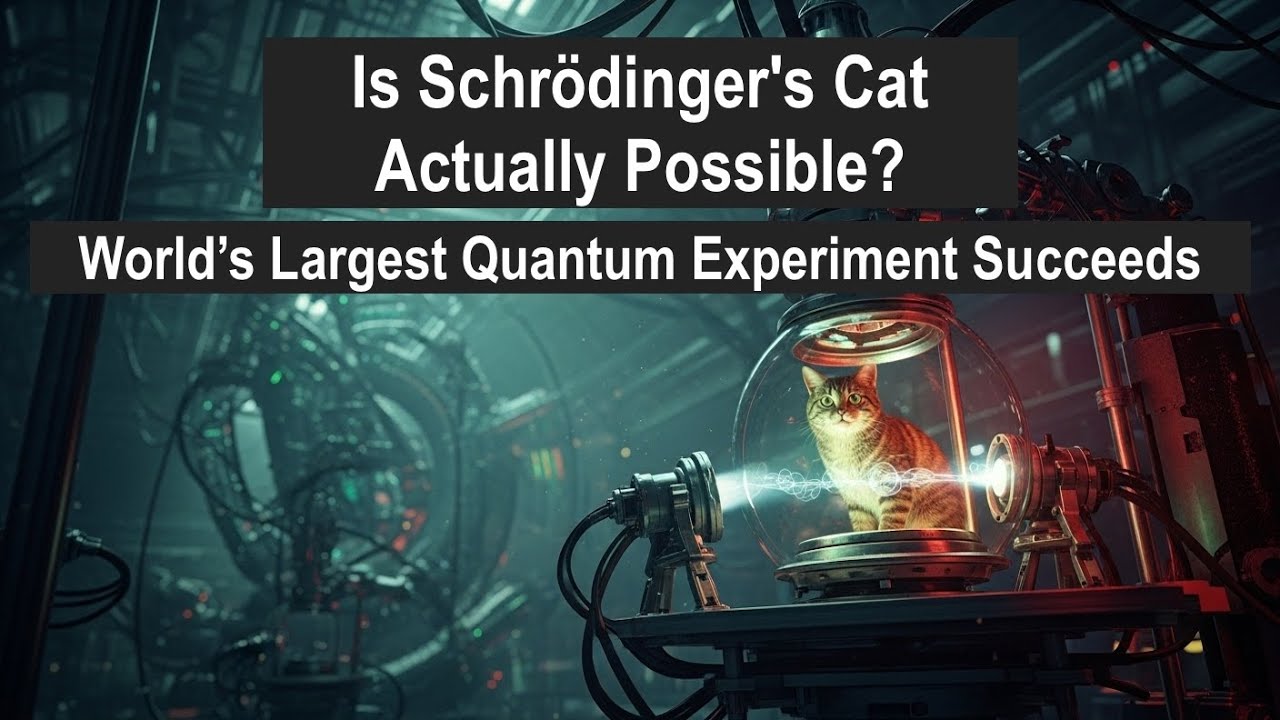
Is Schrödinger's Cat Actually Possible? World’s Largest Quantum Experiment Succeeds
Автор: alpha 137
Загружено: 2026-02-01
Просмотров: 51
Описание:
Probing quantum mechanics with nanoparticle matter-wave interferometry
, https://www.nature.com/articles/s4158...
Imagine a cat sealed in a box, both alive and dead at the same time.This strange image was never meant to describe reality. In 1935, Erwin Schrödinger invented it to criticize quantum mechanics — to show how absurd it seemed to apply the rules of atoms to everyday life. The cat illustrates quantum superposition: the idea that a particle can exist in multiple states at once, until it is observed.
Nearly a century later, that paradox has transformed from a joke into a challenge. Scientists now ask a daring question:How large can a quantum superposition become?
The obstacle is something called decoherence. At the atomic scale, superposition can survive. This fragile state — being in multiple possibilities at once — is the foundation of quantum computing. But larger objects constantly interact with their surroundings. A cat, for instance, collides with billions of air molecules every second. Stray light, heat vibrations, and tiny environmental disturbances continuously “ask” the system what state it’s in. Each interaction acts like a measurement, destroying the superposition and forcing reality to choose a single outcome. That’s why a cat — or your coffee mug — never appears in two states at once. And it’s why decoherence remains the central challenge in building working quantum computers.
So the real question becomes:How big can we make a quantum object before the world forces it to behave classically?
In 2025, a major breakthrough pushed that boundary further than ever. A team led by Markus Arndt and Stefan Gerlich at the University of Vienna, working with collaborators in Germany, created a quantum superposition in a nanoparticle made of more than 7,000 sodium atoms — a tiny speck nearly 8 nanometers wide, yet enormous by quantum standards. Previous experiments had managed molecules of around 2,000 atoms. This was a dramatic leap in size and complexity.
To prove the particle was truly in superposition, the researchers used matter-wave interferometry — the quantum version of the famous double-slit experiment. Just as water waves passing through two openings create an interference pattern of ripples, quantum particles behave like waves. Fire them through two paths, and they interfere with themselves — but only if they truly exist in both paths at once. The Vienna team observed this interference pattern with their massive nanoparticle. It wasn’t behaving like a tiny pebble. It was behaving like a spread-out quantum wave, existing in multiple places simultaneously.
This isn’t just a physics stunt. Scaling up superposition is the key to fault-tolerant quantum computers. The larger and more complex a system we can keep quantum, the closer we get to machines that can outperform classical computers by staggering margins. The 2025 Nobel Prize in Physics, awarded for pioneering work in macroscopic quantum systems in superconducting circuits, reflects this shift: quantum mechanics is no longer confined to theory labs — it’s becoming engineered technology. Companies like Google are racing to tame decoherence and turn delicate quantum states into computational power, with potential breakthroughs in cryptography, materials science, drug discovery, and artificial intelligence.
Schrödinger’s cat was meant to show that quantum mechanics sounded ridiculous. Instead, it has become a symbol of one of the greatest scientific quests of our time. We are not putting cats into superposition — but step by step, from electrons to molecules to nanoparticles, we are learning how to control the boundary between the quantum and classical worlds.
The ghost of Schrödinger’s cat still lingers — not as a warning, but as a guide. What once seemed like an impossible paradox is becoming the foundation of a new technological era, where reality itself can be engineered at the level of possibility.
Probing quantum mechanics with nanoparticle matter-wave interferometry
, https://www.nature.com/articles/s4158...
#quantumphysics #schrodingerscat #quantummechanics #superposition #quantumcomputing #science #quantumtechnology #nobelprize #physics #sciencecommunication
Повторяем попытку...
Доступные форматы для скачивания:
Скачать видео
-
Информация по загрузке: