STOP Buying LED Bulbs That Don’t Last! (Socket Guide & Teardown) 🛠️🕵️♂️
Автор: Rico’s Best Pick
Загружено: 2026-02-19
Просмотров: 39
Описание:
💡 Why Do LED Light Bulbs Burn Out So Fast? The Ultimate Guide to Light Bulbs: From K-Rating to LED Teardowns!
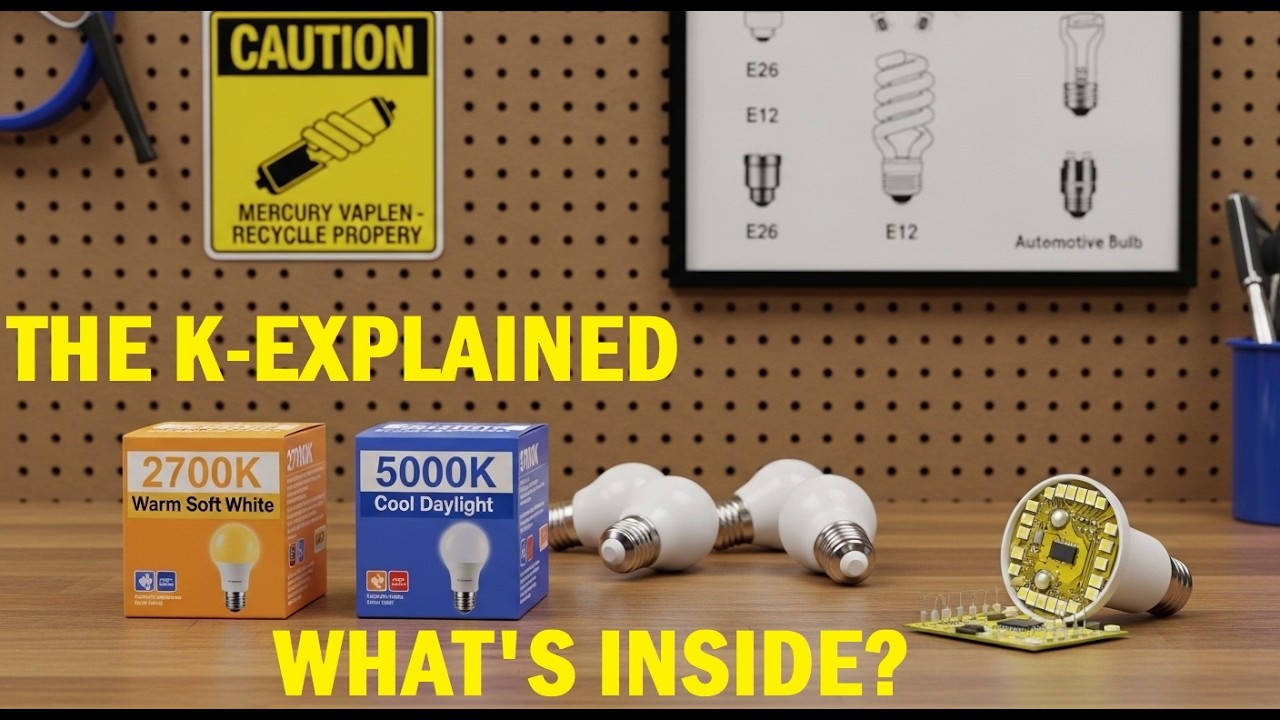
In this ultimate guide to LED, incandescent, and fluorescent lighting, we explain enclosed fixture overheating, Kelvin color temperature (2700K–6500K), dimmable switch compatibility, socket sizes (E26/E12), and real LED teardown results.
Why Don’t LED Light Bulbs Last Long?
LED light bulbs may not last long due to overheating, voltage issues, or incompatibility with fixtures (especially enclosed ones). Loose connections or power surges can also shorten their expected lifespan. To fix this, use bulbs rated for enclosed fixtures, ensure proper wattage, and make sure the socket has a secure, clean connection. Manufacturers may also produce poor-quality designs.
👉Overheating: The #1 killer especially in enclosed fixtures, which trap heat and damage delicate internal components. If they are poor quality, the components burn out faster.
👉Wrong Fixture Type: Using non–enclosed-rated bulbs in enclosed fixtures, or bulbs not designed for dimmers, can cause premature failure. Look for bulbs specifically labeled for enclosed fixtures. You can open the fixture, as shown in the video, to help with heat buildup.
👉Poor Quality: Cheaper bulbs often use lower-quality components, leading to shorter lifespans.
👉My Opinion: When an LED bulb fails, it is often due to the internal circuitry and electronic components (drivers and capacitors) rather than the diode itself. Manufacturers may use lower-quality components, causing them to burn out faster.
We begin by breaking down the different types of bulbs, including incandescent and fluorescent, with a critical safety warning on the mercury vapor risks associated with broken fluorescent tubes.⚠️
You will learn how to master light appearances, from the warm glow of 2700K to the crisp daylight of 6500K, and understand the relationship between brightness, soft light, and harsh light.
We also dive into specialized lighting, including appliance bulbs and samples of automotive socket sizes. As a special bonus, we cut open an LED bulb to reveal the internal diodes and circuitry!
🔍 What You’ll Learn:
✅Color Science: Understanding the Kelvin scale from the warm glow of 2700K to the daylight crispness of 6500K.
✅Dimmable Lighting: A review of dimmable bulb types and compatible switch models.
✅Enclosed Fixtures: How to choose the right LED to prevent overheating in tight spaces.
✅The Wattage Lie: The difference between "Equivalent Watts" and actual electricity consumption.
✅Socket Secrets: A full breakdown of light bulb base sizes, including chandelier and automobile light bulb sockets.
✅Heat Management: A pro tip on using open LED bulbs in existing fixtures to reduce heat and extend bulb life.
✅The Danger Zone: Why breaking a fluorescent bulb is a health hazard (mercury vapor).
⏰ Video Chapters:
00:00 💡 Introduction to Light Bulbs: More than just a glow!
00:04 🧪 Incandescent vs. Fluorescent: The mercury vapor warning.
00:32 🌡️ 2700K to 6500K: Choosing your light appearance (warm vs. cool).
02:15 🧊 Appliance Lighting: Bulbs for fridges, ovens, and dryers.
02:48 ⚡ BONUS: Cutting open an LED bulb (the diode reveal).
05:00 🎛️ Dimmable Switches: Models and how to avoid the "flicker."
05:53 🔋 Energy Math: LED watts vs. actual power consumption.
07:05 🏠 Enclosed Fixtures: When to use LED and how to prevent overheating.
10:18 🔧 Socket Masterclass: Regular, chandelier, and automotive sizes.
11:54 ✨ Conclusion: Real-world displays and the "Open LED" cooling hack.
🛠️ Featured Gear & Terms Mentioned:
✅CCT: Correlated Color Temperature (2700K–6500K), which measures how warm (yellowish) or cool (bluish) the light appears.
✅E26/E12: Standard and chandelier base sizes.
✅Mercury Vapor: ⚠️The toxic gas inside CFL/fluorescent tubes.
✅CFL (Compact Fluorescent Light): An energy-efficient lighting bulb designed to replace incandescent bulbs, using a coiled tube.
✅Socket Sizes: Socket sizes are categorized by type and diameter in millimeters (e.g., E26 = 26mm Edison screw). Common sizes include E12 (candelabra base), E26 (medium/standard base), E10 (miniature screw), and a 2-pin twist-and-lock base (used in automobiles).
✅LED Driver Circuit: The "brains" of the bulb that regulate current to the light-emitting diodes (LEDs).
✅Light-Emitting Diodes (LEDs): Solid-state semiconductor devices that emit light when electric current passes through them.
✅Dimmable Switches: Control brightness using phase-cut (TRIAC) waveform modulation for compatible LED drivers.
✅Wattage: Higher watts mean higher electricity consumption, not brightness.
✅Enclosed Fixture: A lighting unit where the bulb is surrounded glass or plastic, restricting airflow and trapping heat.
✅LED failure analysis: Kelvin temperature, enclosed lighting fixture, rated LED bulbs.
.
.
.
#lightbulbs #lightinghacks #ledlights #diyprojects #energyefficient #electrical #shortstutorial #DIYHome #LEDTeardown #ElectricianTips #EnergySaving #Teardown
Повторяем попытку...
Доступные форматы для скачивания:
Скачать видео
-
Информация по загрузке:



![[ НОВЫЙ 2026 ] Уральские Пельмени -Смейтесь без остановки вместе с комедийной группой №1 в России!](https://imager.clipsaver.ru/XV1sj-rQyLM/max.jpg)