Dutilleux, Henri (1997): The Shadows of Time, five episodes for orchestra — BSO/Ozawa
Автор: Chronochromie
Загружено: 2026-02-21
Просмотров: 177
Описание:
Composer: Henri Paul Julien Dutilleux (22 January 1916 – 22 May 2013)
Orchestra: Boston Symphony Orchestra (founded 1881)
Treble soloists: Jordan Swaim (born 19??); Rachael Plotkin; (born 19??); Joel Esher (born 19??)
Conductor: Seiji Ozawa (1 September 1935 – 6 February 2024)
With the curator's utmost gratitude and appreciation offered in deepest and friendliest affection towards @dlz-q8o.
Copyright 1997 by Schott Musik GmbH & Co. KG, Mainz, Rhineland-Palatinate
Recording of the world première, 10 October 1997
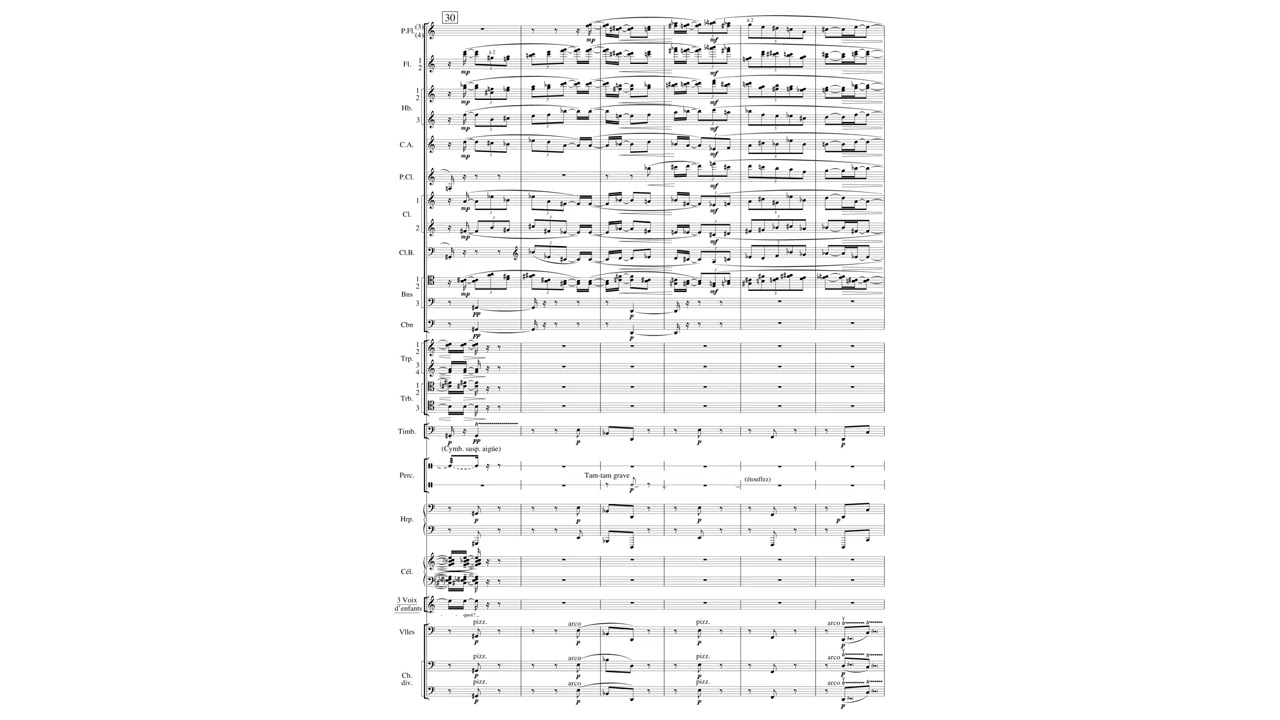
The Shadows of Time, five episodes for orchestra (1997)
Dedicated to Seiji Ozawa
00:00 — Introduction
00:06 — i. Les heures (The Hours). ♩ = 90
03:18 — ii. Ariel maléfique (Malefic Ariel). penser à la ♪ (soit ♪ = 150)
05:51 — iii. Mémoire des ombres (Memory of Shadows). ♪ = 84 environ
10:45 — Interlude. Très lointain (♪ = 84 environ)
13:05 — iv. Vagues de lumière (Waves of Light). ♪ = 80 environ
16:04 — v. Dominante bleue ? (Dominant Blue?). (♩ = 60 environ)
The Shadows of Time is a somber meditation on loss. The catalyst was the half-century anniversary of the end of World War II in 1995 and of the discovery of Anne Frank’s diary, and specifically a memory: the deportation by the Nazis to concentration camps of an entire orphanage of Jewish children. The work unfolds in five “orchestral episodes” with evocative titles. An untitled interlude links the final two episodes. Although only 21 minutes long, the entire piece exudes a concentrated power belying its length, rather like dream time’s ability to subvert the clock’s rational measurement.
Setting the work in motion (“Hours”) is a fatalistic fanfare of brass, punctuated by percussion and strings, tracing a downward fall. These thickly clotted lines of descent recur at several crisis points. A temple block marks the relentless tread of time with banal tenacity. Following an uneasy sustained glissando skid upward in the strings, the note A is urgently repeated high in the trumpets (where the episode began). A brief coda suggests a false resting stop as trumpets bleat with mutes.
“Evil Ariel” pits flickering divided strings against spiraling constellations in the winds for a scherzo of malignant energy, of which Ariel – a deformation of the serviceable spirit from Shakespeare’s The Tempest or one of Milton’s named demons – seems to be a herald. Mood shifts dramatically as the piccolo intones a solo against deceptively childlike timbres from glockenspiel and vibraphone, leading directly into “Memory of Shadows.”
Dutilleux calls this central episode the “heart” of the score, on which is written “to Anne Frank and all the children, innocents of the world (1945-1995).” He recounts a stroke of inspiration when he was searching for a “special color in the instrumentation” to contrast with the brass and wind timbres dominating the beginning and heard “some voices coming from a nursery school close to my studio.” The score specifies only “three voices of a child” – singing alternately in solo and together. Their vocalise turns to repetition of the simple phrases:
“Pourquoi nous? Pourquoi l’étoile?”
(Why us? Why the star [of David]?).
The melody suggests a Near Eastern modality mixed with the spirit of Gregorian chant. The touching directness here contrasts with the menacing moods elsewhere in the score.
Eventually the music sinks into the nether regions of the orchestra. The interlude and “Waves of Light” episode move slowly up from the lower strings into the piquant winds, while the dominance of G-sharp verges on the obsessive. The final episode’s indeterminate title (“Dominant Blue?”) is borne out by the faltering rhythms with which mirroring instrumental choirs continue to obsess over variant phrases from the children’s chanting. The need for consolation is urgent, as signaled by the solo trumpet’s and trombone’s attempts to take lyrical flight. Yet they are false starts, and the unforgiving clockwork of the percussion returns, though in more sublimated form, as the entire orchestra tapers out on a repeated C-sharp.
On one level, The Shadows of Time can even read like a symphony in miniature: with a forceful opening, demonic scherzo à la Berlioz, meditative slow movement, and enigmatic finale. At the same time, its alternation of violent, threatening gestures with textures almost withdrawn in their delicacy suggests a fundamental disquiet and sense of doubt that gives an edge to the composer’s gentle humanism and poetry.
— Thomas May
As per the description of this channel, I do not own anything within this video. The music and performances have been uploaded for exclusively and entirely for the purposes of divulgation and spreading interest in music and the arts.
Повторяем попытку...
Доступные форматы для скачивания:
Скачать видео
-
Информация по загрузке: