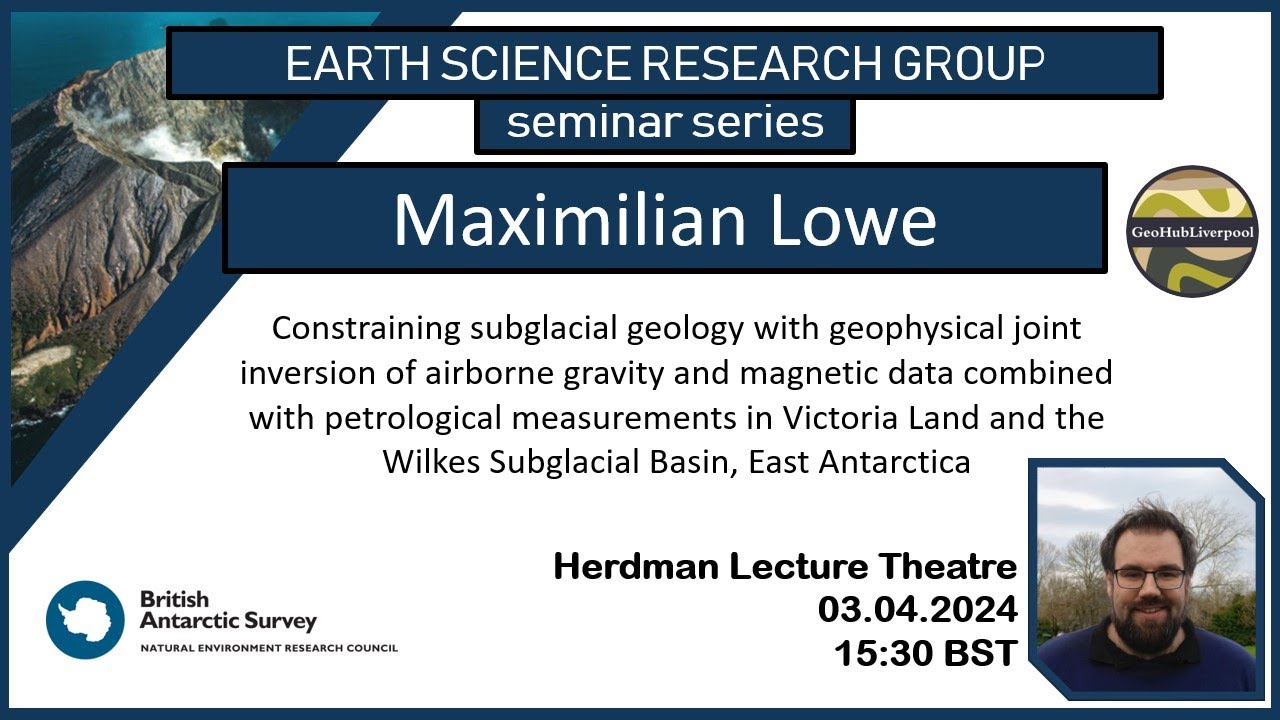
Constraining subglacial geology with geophysical joint inversion in Antarctica. - Maximilian Lowe
Автор: Earth Sciences, University of Liverpool
Загружено: 2024-04-03
Просмотров: 112
Описание:
Constraining subglacial geology with geophysical joint inversion of airborne gravity and magnetic data combined with petrological measurements in Victoria Land and the Wilkes Subglacial Basin, East Antarctica.
Subglacial geology can significantly influence the heat flow at the base of the icesheet and therefore is a crucial interface between the solid earth and the cryosphere. However, bedrock geology from Antarctica remains largely unknown since it is hidden beneath thick ice sheets. Direct geological samples are limited to ice free regions along the coast, high mountain ranges or isolated nunataks, while the origin of geological material transported by glaciers themselves is often ambiguous. Geophysical methods such as gravity and magnetic inverse modelling provide an indirect framework for inferring crustal rock properties in Antarctica. However, due to limited availability of rock samples, validation against direct geological information is challenging.
I present latest result from 3D singular and joint inversions of airborne gravity and magnetic data in northern Victoria Land and the Wilkes Subglacial Basin, East Antarctica. Those results indicate a large intrusive body located in the interior of the Wilkes Subglacial Basin and suggests a tectonically complex area west of the Basin, which I attribute to the transition zone at the margin of the Terre Adélie Craton. The implication of an intrusive bodies to the local heat flow is discussed by examining the present of subglacial lakes in that area.
Furthermore, the importance of inversion resolution to constrain fine scale geological structures is assessed by comparing local high-resolution inversion with regional scale inversion model with a coarser grid resolution. The inverted density and susceptibility distribution are validated against a new rock properties catalogue containing laboratory density and susceptibility measurements on 320 rock samples from northern Victoria Land. The close correspondence between inverted and measured rock properties allows us to predict locations of rock types where currently such information is missing. The utility of measured susceptibility and density relationships for interpreting inversion output provides a strong incentive to incorporate local rock samples into geophysical studies of subglacial geology across Antarctica.
Повторяем попытку...
Доступные форматы для скачивания:
Скачать видео
-
Информация по загрузке: