Lifestyle Modifications for IgA Nephropathy, Immunoglobulin A (IgA) Nephropathy, Glomerulonephritis:
Автор: EndlessMedical.Academy
Загружено: 2026-02-06
Просмотров: 1
Описание:
A 42-year-old man with a history of IgA nephropathy, obesity hypoventilation syndrome, and recent ICU admission for pneumonia now seeks clear guidance as he transitions to the hospital ward. With ongoing kidney dysfunction and multiple chronic illnesses, what critical elements should you discuss with both patient and caregiver to ensure a successful shift in lifestyle habits to slow kidney decline and support long-term disease management?
VIDEO INFO
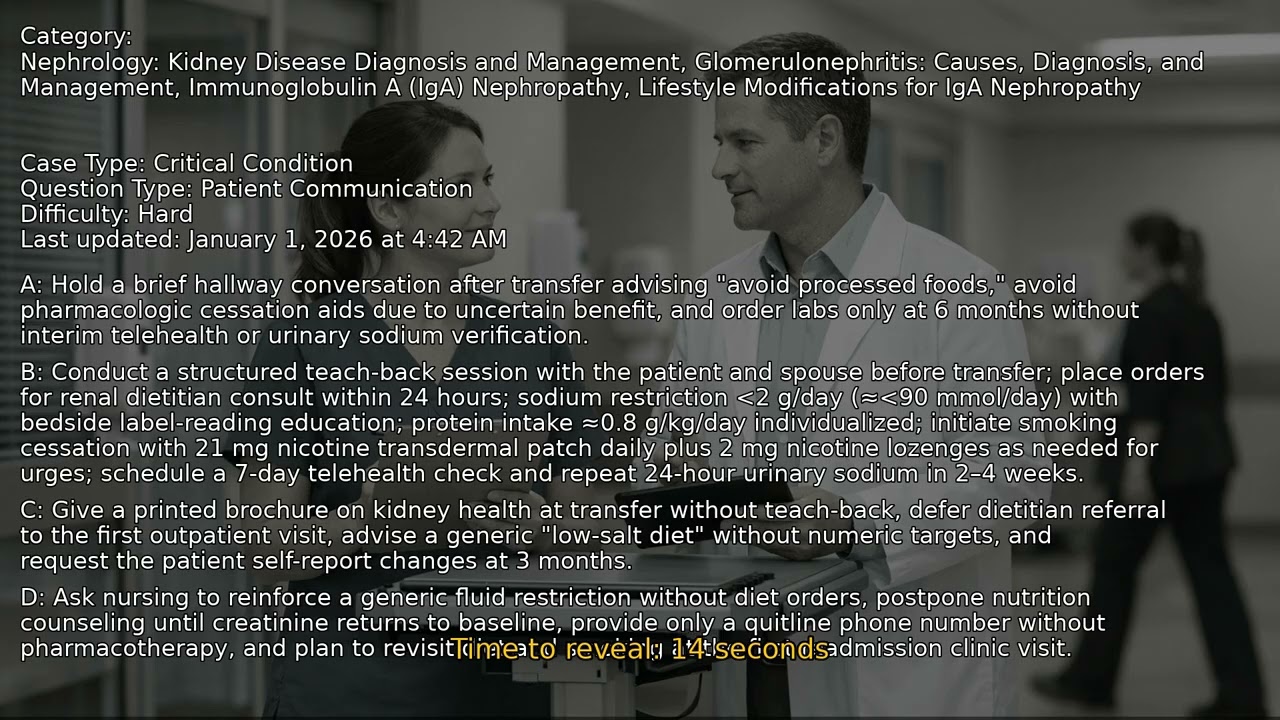
Category: Lifestyle Modifications for IgA Nephropathy, Immunoglobulin A (IgA) Nephropathy, Glomerulonephritis: Causes, Diagnosis, and Management, Nephrology: Kidney Disease Diagnosis and Management
Difficulty: Hard - Advanced level - Challenges experienced practitioners
Question Type: Patient Communication
Case Type: Critical Condition
Explore more ways to learn on this and other topics by going to https://endlessmedical.academy/auth?h...
QUESTION
A 42-year-old man with IgA nephropathy (biopsy 2 years ago: M1 E0 S1 T1 C0), obesity hypoventilation syndrome, and prior infective endocarditis was admitted to the ICU for pneumonia with acute-on-chronic hypercapnic respiratory failure. He was extubated earlier today after successful spontaneous breathing trials and is now alert and interactive on 2 L/min oxygen via nasal cannula....
OPTIONS
A. Conduct a structured teach-back session with the patient and spouse before transfer; place orders for renal dietitian consult within 24 hours; sodium restriction less than 2 g/day ( less than 90 mmol/day) with bedside label-reading education; protein intake 0.8 g/kg/day individualized; initiate smoking cessation ...
B. Give a printed brochure on kidney health at transfer without teach-back, defer dietitian referral to the first outpatient visit, advise a generic low-salt diet without numeric targets, and request the patient self-report changes at 3 months.
C. Ask nursing to reinforce a generic fluid restriction without diet orders, postpone nutrition counseling until creatinine returns to baseline, provide only a quitline phone number without pharmacotherapy, and plan to revisit diet and smoking at the first readmission clinic visit.
D. Hold a brief hallway conversation after transfer advising avoid processed foods, avoid pharmacologic cessation aids due to uncertain benefit, and order labs only at 6 months without interim telehealth or urinary sodium verification.
CORRECT ANSWER
A. Conduct a structured teach-back session with the patient and spouse before transfer; place orders for renal dietitian consult within 24 hours; sodium restriction less than 2 g/day ( less than 90 mmol/day) with bedside label-reading education; protein intake 0.8 g/kg/day individualized; initiate smoking cessation with 21 mg nicotine transdermal patch daily plus 2 mg nicotine lozenges as needed for urges; schedule a 7-day telehealth check and repeat 24-hour urinary sodium in 2-4 weeks.
EXPLANATION
At ICU-to-ward transition in a patient with IgA nephropathy and active tobacco use, the highest-value communication plan is a structured teach-back session that sets numeric lifestyle targets, initiates first-line pharmacologic cessation, and establishes verification and early follow-up. Sodium restriction to less than 2 g/day ( less than 90 mmol/day) with bedside label-reading education and dietitian consult within 24 hours translates evidence into action; pairing this with individualized protein intake around 0.8 g/kg/day aligns with CKD nutrition guidance....
Further reading:
Links to sources are provided for optional further reading only. The questions and explanations are independently authored and do not reproduce or adapt any specific third-party text or content.
---------------------------------------------------
Our cases and questions come from the https://EndlessMedical.Academy quiz engine - multi-model platform. Each question and explanation is forged by consensus between multiple top AI models (i.e. Open AI GPT, Claude, Grok, etc.), with automated web searches for the latest research and verified references. Calculations (e.g. eGFR, dosages) are checked via code execution to eliminate errors, and all references are reviewed by several AIs to minimize hallucinations.
Important note: This material is entirely AI-generated and has not been verified by human experts; despite stringent consensus checks, perfect accuracy cannot be guaranteed. Exercise caution - always corroborate the content with trusted references or qualified professionals, and never apply information from this content to patient care or clinical decisions without independent verification.
Clinicians already rely on AI and online tools - myself included - so treat this content as an additional focused aid, not a replacement for proper medical education. Visit https://endlessmedical.academy for more AI-supported resources and cases.
This material can not be treated as medical advice. May contain errors.
--------------------------------------------------
Повторяем попытку...
Доступные форматы для скачивания:
Скачать видео
-
Информация по загрузке: