Use of TPE in Dementia, Indications for Therapeutic Plasma Exchange, Therapeutic plasma exchange, Cl
Автор: EndlessMedical.Academy
Загружено: 2026-02-06
Просмотров: 0
Описание:
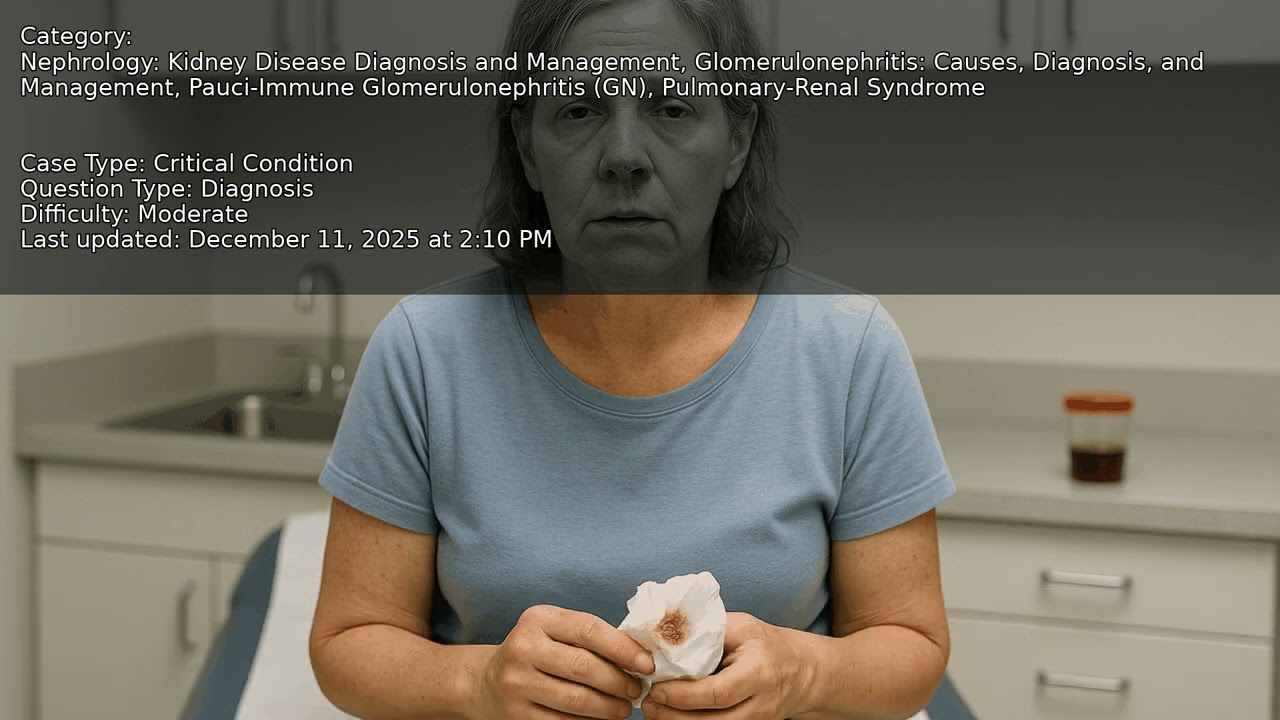
A 37-year-old woman with prior liver cancer resection, selective IgA deficiency, and recent spells of involuntary facial and arm movements presents with memory loss, behavioral changes, and persistent hyponatremia, alongside abnormal MRI and EEG findings. What clinical and epidemiological features should be considered when evaluating such a patient with new-onset neurological symptoms and suspected autoimmune brain involvement?
VIDEO INFO
Category: Use of TPE in Dementia, Indications for Therapeutic Plasma Exchange, Therapeutic plasma exchange, Clinical Pathology
Difficulty: Moderate - Intermediate level - Requires solid foundational knowledge
Question Type: Epidemiology
Case Type: Typical Presentation
Explore more ways to learn on this and other topics by going to https://endlessmedical.academy/auth?h...
QUESTION
A 37-year-old woman with hepatocellular carcinoma under surveillance (segment 6 resection 2 years ago, no recurrence), selective IgA deficiency, secondary hyperparathyroidism treated medically, and a remote inguinal hernia repair presents with 5 weeks of spells described as sudden brief facial grimacing and right arm posturing many times per day, progressive short-term memory loss, emotional lability, and daytime sleepiness....
OPTIONS
A. Population-based data show autoimmune encephalitis has an incidence near 0.8 to 1.0 per 100,000 person-years-comparable to infectious encephalitis-and prompt immunotherapy improves outcomes; plasma exchange is an accepted first-line option in severe cases (typically 1.0-1.5 plasma volumes every o...
B. Autoimmune encephalitis occurs in roughly 10 per 100,000 person-years and most cases require long-term maintenance plasma exchange every month to prevent relapse; degenerative dementias in middle age are commonly treated with outpatient exchange to improve memory.
C. Because autoimmune encephalitis is extraordinarily rare (about 0.08 per 100,000 per year), hospitals should avoid initiating plasma exchange even when clinical criteria and antibodies are present; instead, reserve it for second-relapse disease after 6 months of steroid therapy alone.
D. Alzheimer s disease in the 30s is more common than autoimmune encephalitis, and plasma exchange has guideline support as a disease-modifying therapy in typical Alzheimer s disease; an every-other-month low-volume exchange program is recommended when cholinesterase inhibitors fail.
CORRECT ANSWER
A. Population-based data show autoimmune encephalitis has an incidence near 0.8 to 1.0 per 100,000 person-years-comparable to infectious encephalitis-and prompt immunotherapy improves outcomes; plasma exchange is an accepted first-line option in severe cases (typically 1.0-1.5 plasma volumes every other day for 5 sessions with albumin replacement) but is not standard for degenerative dementias.
EXPLANATION
Population-based data show autoimmune encephalitis has an incidence near 0.8 to 1.0 per 100,000 person-years-comparable to infectious encephalitis-and prompt immunotherapy improves outcomes; plasma exchange is an accepted first-line option in severe cases (typically 1.0-1.5 plasma volumes every other day for 5 sessions with albumin replacement) but is not standard for degenerative dementias. This is accurate and directly relevant to a patient with LGI1-IgG encephalitis presenting with faciobrachial dystonic seizures, mesial temporal MRI changes, hyponatremia, and subacute memory loss....
Further reading:
Links to sources are provided for optional further reading only. The questions and explanations are independently authored and do not reproduce or adapt any specific third-party text or content.
---------------------------------------------------
Our cases and questions come from the https://EndlessMedical.Academy quiz engine - multi-model platform. Each question and explanation is forged by consensus between multiple top AI models (i.e. Open AI GPT, Claude, Grok, etc.), with automated web searches for the latest research and verified references. Calculations (e.g. eGFR, dosages) are checked via code execution to eliminate errors, and all references are reviewed by several AIs to minimize hallucinations.
Important note: This material is entirely AI-generated and has not been verified by human experts; despite stringent consensus checks, perfect accuracy cannot be guaranteed. Exercise caution - always corroborate the content with trusted references or qualified professionals, and never apply information from this content to patient care or clinical decisions without independent verification.
Clinicians already rely on AI and online tools - myself included - so treat this content as an additional focused aid, not a replacement for proper medical education. Visit https://endlessmedical.academy for more AI-supported resources and cases.
This material can not be treated as medical advice. May contain errors.
---------------------------------------------------
Повторяем попытку...
Доступные форматы для скачивания:
Скачать видео
-
Информация по загрузке: