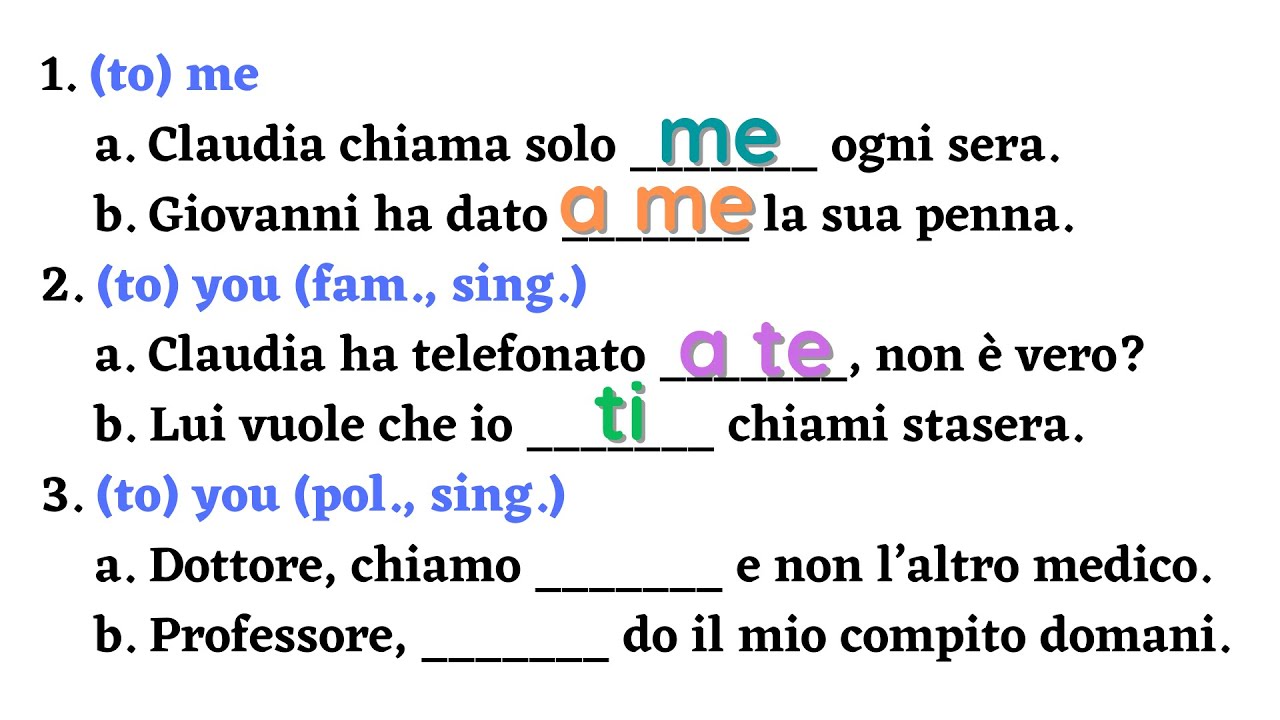
Italian stressed and unstressed pronouns | Direct and indirect object | Learn italian free lessons
Автор: Hyperuran
Загружено: 2021-10-28
Просмотров: 422
Описание:
Italian class, learn italian, italian verbs, learn italian for beginners, stressed, unstressed, tonic, direct, indirect, object, choose, useful, vocabulary, special forms, regular, irregular, A1, A2, B1, grammar class, #learnitalian, aprende italiano, italian grammar, italian language, italian lessons, indicative, subjunctive, learning italian, تعلم الايطالية, a2 italian, italian b1, apprendre italien, aprender italiano, fill in the blanks, how to learn italian, italian language course, italian learning, italian online class free, italian prepositions, italian pronouns.
A pronoun, pronome, is a variable part of the speech. It is a word that takes the place of, or fulfils the function of a noun in certain specific circumstances.
Besides a noun, the pronoun can replace a group of words, an adjective, a phrase, another pronoun.
Pronouns can be classified in six categories:
personali (personal), relativi (relative)
dimostrativi (demonstrative), possessivi (possessive), indefiniti (indefinite), interrogativi (interrogative) ed esclamativi (exclamative).
Personal and relative pronouns have only a pronominal function; the others, depending on the circumstances, can also assume a adjectival function.
• Personal pronouns
They are indispensable. Personal pronoun, pronomi personali, indicate:
the person who speaks, prima persona, first person, singular or plural: io (I), noi (we);
the person who listens, seconda persona, second person, singular or plural: tu (you), voi (you);
the person or the thing the sentence is talking about, terza persona, third person, singular or plural: lui (him), lei (her), egli (him), ella (her), esso (it), essa (it), essi, esse, loro (them).
They can assume the function of:
subject, that is who is doing the action;
object, the element that is the target of an action.
Having the function of a complement, personal pronouns can have two forms:
• atona, unstressed;
• tonica, stressed.
Subject personal pronouns are often understood: the endings of italian verbs always show who the subject is, without the need for a pronoun. The use of pronouns is limited to situations where we need to give special emphasis to the subject.
For example: Andiamo a mangiare! (Let’s eat!) The implied subject is noi.
The object pronoun can represents a direct complement: the one who answers the question chi? (who?), che cosa? (what?)
For example: Francesca mi ha chiamato → Francesca ha chiamato (chi?) me
Francesca ti ha chiamato → Francesca ha chiamato (chi?) te
Francesca lo ha chiamato → Francesca ha chiamato (chi?) lui
Francesca la ha chiamata → Francesca ha chiamato (chi?) lei
Francesca ci ha chiamati → Francesca ha chiamato (chi?) noi
Francesca vi ha chiamati → Francesca ha chiamato (chi?) voi
Francesca li ha chiamati → Francesca ha chiamato (chi?) loro
Francesca le ha chiamate → Francesca ha chiamato (chi?) loro
Important: unstressed personal pronouns are set before the verb; stressed ones are set after the verb.
Important: if the verb is an infinive, a participle or a gerund, an unstressed pronoun can be attached to it.
For example: Mandale un bacio da parte mia. (Give her a kiss by me.) Vederti mi fa star bene. (Seeing you make me feel good.) Parlandogli è diventato tutto più chiaro. (Talking to him made verything cleaner.)
Important: lo e la pronouns become l’ before a vowel starting word.
For example: Hai rotto tu il vaso? No, l’ha rotto Marco.
(Did you break the pot? No, Marco did.)
Object pronouns can represent indirect complements: that is, the ones answering the questions a chi?, con chi?, per chi?, di che cosa?, etc.
For example: Chiara mi ha parlato. → Chiara ha parlato (a chi?) a me.
Chiara ti ha parlato. → Chiara ha parlato (a chi?) a te.
Chiara le ha parlato. → Chiara ha parlato (a chi?) a lei.
Chiara gli ha parlato. → Chiara ha parlato (a chi?) a lui.
Chiara ci ha parlato. → Chiara ha parlato (a chi?) a noi.
Chiara vi ha parlato. → Chiara ha parlato (a chi?) a voi.
Chiara ha loro parlato → Chiara ha parlato (a chi?) a loro.
Anna è andata al cinema (con chi?) con lui.
Questo regalo è (per chi?) per loro.
Important: before a preposition stressed pronouns must be used.
Die Sprache der Natur, Learn italian, Italian grammar, Italian exercises, Learn italian free, Learning Italian, Italian language, Italian lessons, Learn Italian, Speak italian, Learn italian in italian, How to learn italian, Italiano per stranieri, Italienisch lernen, Aprender italiano, Italiano, Imparare, Italiano, Learn, Italian, Aprender, Apprendre l’italien, Italian language.
Повторяем попытку...
Доступные форматы для скачивания:
Скачать видео
-
Информация по загрузке:



![MAKING SENSE OF ITALIAN PRONOUNS [Italian Grammar Explained]](https://image.4k-video.ru/id-video/U4Dj6f4nP4U)


![Italian Direct Pronouns with Passato Prossimo [ENG SUB].](https://image.4k-video.ru/id-video/HVYXYNhcWTQ)

