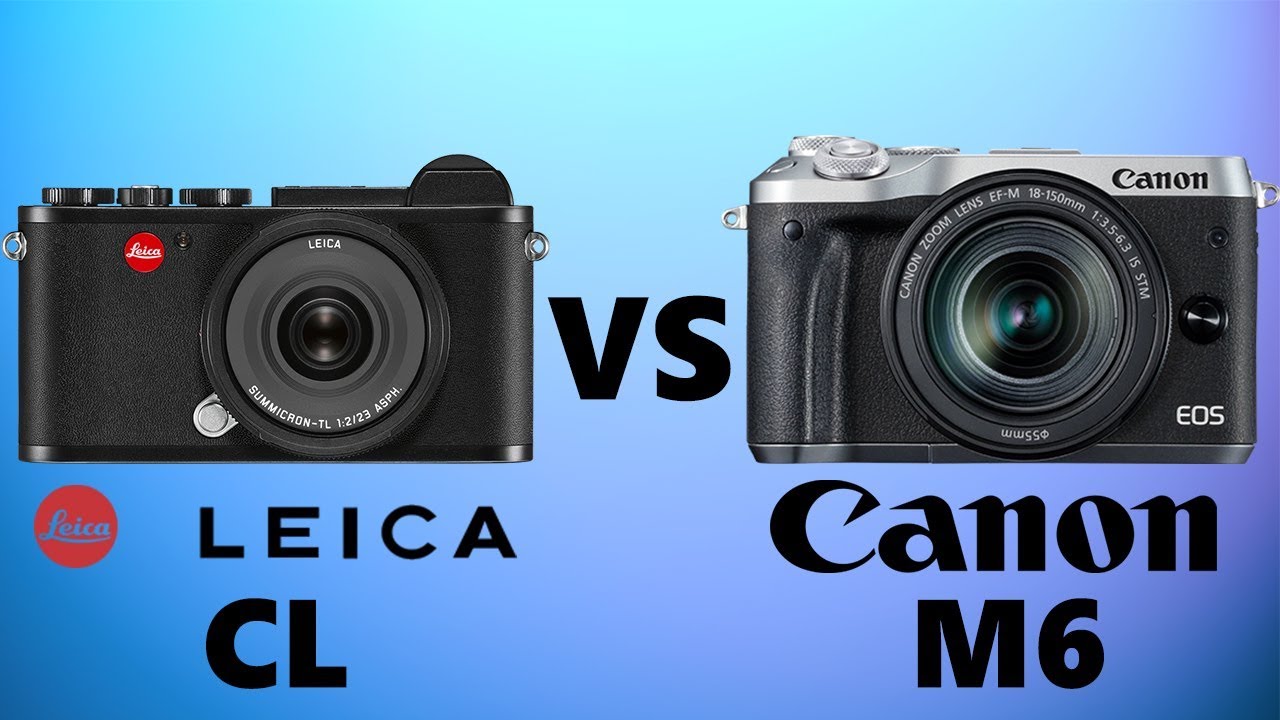
Leica CL vs Canon M6
Автор: World Photo Magazine
Загружено: 2018-01-22
Просмотров: 1001
Описание:
Leica CL vs Canon M6
If you like this video please support me on Patreon! Thank you!
https://www.patreon.com/user?u=9417987
I want to make better videos!
Thanks for watching! Please SUBSCRIBE for more videos.
Check out our Instagram page! / worldphotomagazine
Leica CL
Leica has long been known for their stylish premium cameras and lenses. Their newest APS-C interchangeable lens camera, the Leica CL (not to be confused with the 35mm CL rangefinder from the 1970s), keeps in that tradition. Whereas the Leica TL2, which shares the same 24-megapixel image sensor, employs a thoroughly modern design, the new CL harkens back to a more classic camera design, complete with a built-in viewfinder and more physical controls than the sleek TL2.
Let's take a closer look at the new Leica CL and dig into its design, specifications and features.
Leica CL Key Features and Specs
Compact and lightweight APS-C system camera
24-megapixel APS-C CMOS sensor
ISO 100-50,000
Built-in 2.36M-dot electronic viewfinder
3-inch 1.04M-dot touchscreen
Top status LCD
Utilizes the Leica L-mount (TL and SL lenses)
Can be adapted to use M/R lenses
Maestro II image processor
10 frames per second continuous shooting
33-frame DNG+JPEG buffer, 140 JPEG buffer
4K/30p and 1080/60p video
Built-in Wi-Fi
The CL has a very classic Leica design. The camera, complete with the trademark Leica red dot, is quite compact for an interchangeable lens camera. Speaking of the lenses, the Leica CL has a Leica L-mount bayonet, although it can be used with adapted Leica M/R lenses in addition to the native Leica TL and SL lenses. The camera has dimensions of just over 5 inches wide (131 millimeters), 3 inches high (78 millimeters) and is under 2 inches (45 millimeters) in depth. It weighs 14.2 ounces (403 grams) with the battery installed.
Canon M6
The 24-megapixel APS-C image sensor and DIGIC 7 image processor help deliver good image quality and impressive overall performance, but the Canon EOS M6 has to separate itself from not only its EOS M5 sibling but very good mirrorless cameras from numerous other manufacturers. In terms of blending performance and portability, the EOS M6 does well thanks to its great performance and functionality, but it comes up a little short in a few key areas. Nonetheless, it is an impressive mirrorless camera which can be a great choice for many, especially those already invested in Canon's EOS ecosystem.
Pros:
Enthusiast-oriented compact camera body; Good image quality in most situations; Impressive Dual Pixel CMOS AF; Very good overall performance.
Cons:
Dynamic range and high ISO image quality aren't quite up to par with some of its competition; No 4K video recording; Video features in general are underwhelming; Native EF-M lens selection is limited.
Following up on their enthusiast-oriented mirrorless camera, the EOS M5, Canon's similar and slightly more affordable mirrorless camera, the Canon EOS M6, is actually the successor to the M3. In many ways, the M6 and M5 cameras are the most alike, especially on the inside, but they do differ in several ways. Let’s take a look at what the Canon M6 has to offer.
One of the biggest differences between the M5 and the M6 is that the latter does not have a built-in electronic viewfinder. The M5 was the first Canon mirrorless camera to offer a built-in EVF, but the M6 returns to the series' roots and opts to go without one. Although, like some prior M cameras, you can attach an optional electronic viewfinder accessory to the camera's hot shoe. The M6 is compatible with the Canon EVF-DC1 electronic viewfinder as well as the new EVF-DC2 which uses an OLED display instead of an LCD with the same number of dots (2.36 million), however it does not tilt like the EVF-DC1.
There are a handful of other differences between the M6 camera body and the M5. The Canon M6 employs a 3-inch LCD display rather than the 3.2-inch LCD found on the M5, although they are both tilting touchscreen displays. The tilting display on the M6 can tilt 180° up and 45° down, though the bottom of the screen is partially blocked by the top deck when facing forward.
The Canon M6 pairs a 24.2-megapixel APS-C CMOS sensor which has a 1.6x focal length multiplier (like all APS-C sensors found in Canon cameras) with a DIGIC 7 processor, both of which is shares with the M5. The Canon EOS M6 offers a native ISO range of 100-25,600 and includes an Auto ISO feature (the ISO range in Auto ISO is 100-6400).
Tags:
Leica CL vs Canon M6, Leica CL vs Canon M, Leica CL vs Canon, Leica CL vs, Leica CL, Leica, Leica CL test, Leica CL review, Leica CL unboxing, Leica CL comparison, Canon M6 vs, Canon M6 vs Leica, Canon M6 test, Canon M6 review, Canon M6 unboxing, Canon M6 comparison, Canon M6 vs Canon M5, camera comparison, dslr review, world photo magazine, Leica CL video test, canon m6 video test,
Повторяем попытку...
Доступные форматы для скачивания:
Скачать видео
-
Информация по загрузке:











![KRYM PO 12 LATACH OKUPACJI PUTINA - SZPITALE WOJSKOWE ZAMIAST SANATORIÓW [BOJKE]](https://imager.clipsaver.ru/9wOp5s-3yRU/max.jpg)