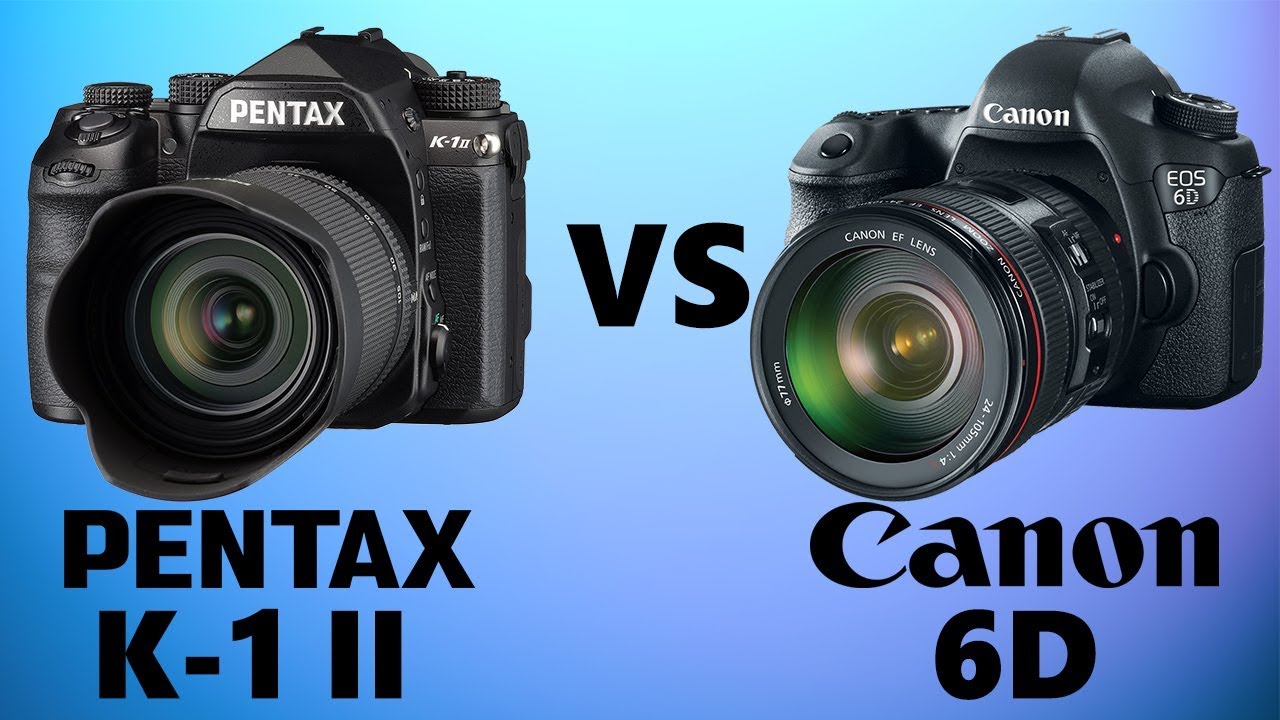
Pentax K-1 II vs Canon 6D II
Автор: World Photo Magazine
Загружено: 2018-08-07
Просмотров: 506
Описание:
Pentax K-1 II vs Canon 6D
If you like this video please support me on Patreon! Thank you!
https://www.patreon.com/user?u=9417987
I want to make better videos!
Thanks for watching! Please SUBSCRIBE for more videos.
Check out our Instagram page! / worldphotomagazine
Pentax K-1 II
A couple of years ago, at the start of 2016, Ricoh finally answered the calls from Pentaxians for a full-frame DSLR with the arrival of the Pentax K-1. We were seriously impressed by the weatherproof, 36-megapixel K-1, which paired great ergonomics with a lengthy laundry list of features, some of them completely unique to this camera.
Two years down the line, the K-1 has now received a followup in the form of the Pentax K-1 II. If you're familiar with the earlier camera, you already know most of what you need to about its successor, as the two are near-identical in most ways. There are changes in just a few key areas.
So what's new? Well, most importantly the Pentax K-1 II now features the same accelerator unit which made its debut in 2016's Pentax K-70, and was also sighted in the 2017 model year Pentax KP. So what, exactly, does this new unit do? Ricoh has played its cards pretty close to its chest thus far, but we can make an educated guess that it's being used to assist the main PRIME IV-branded processor with denoising.
The reason we can draw that conclusion is that the Pentax K-1 II's performance is basically unchanged from that of its predecessor. Full-resolution, full-frame burst capture is still limited to a maximum of 4.4 frames per second, while the 15-megapixel APS-C crop mode has slowed ever so fractionally from 6.5 to 6.4 fps.
But while burst capture speed is unchanged, the K-1 II's maximum ISO sensitivity soars a full two stops beyond what the K-1 could manage. Just as did the sub-frame Pentax KP before it, the K-1 II offers everything from a minimum of ISO 100 to a maximum of ISO 819,200, but it does so with a much larger full-frame sensor, so we'd expect more of the high ISO range to be usable than was the case with the KP.
Canon EOS 6D
With the 20.2-megapixel EOS 6D, Canon has created a smaller, lighter and less expensive full-frame digital SLR for prosumer photographers. In many ways, the well-designed 6D is a mini 5D Mark III for the rest of us. While it doesn't feature as robust a camera build as that step-up model, and its autofocus system is decidedly basic, the Canon 6D is otherwise a fantastic, responsive DSLR that offers the glories of full-frame in a trim but comfy camera body. Plus, you get full-featured, built-in Wi-Fi and GPS to boot.
Pros:
Excellent image quality on par to more expensive full-frame DSLRs (including the 5D Mark III); Responsive all-around performer; Superior HD video-shooting chops; Built-in Wi-Fi with remote control and sharing features, Built-in GPS and geotagging.
Cons:
Lacks a built-in, pop-up flash; No external headphone jack; Rather basic 11-point autofocus system; Mediocre burst speed.
This winter the Canon EOS 6D finally emerged from behind the curtain of rumor and conjecture. The new Canon 6D is another camera -- like the Nikon D600 -- designed to appeal to the photographer who wants to step up to full-frame but has found the $3,000-$3,500 price tag prohibitively expensive. Instead, the Canon 6D body retails for US$2,000, sports a 20.2-megapixel 35mm CMOS sensor that's powered by a DIGIC 5+ processor, has a 3-inch 1.04-million dot LCD, a UHS-I SD card slot, and includes both Wi-Fi and GPS built-in.
To lower the cost, Canon naturally had to change a few of the specs. First, its sensor isn't quite as large as the 36 x 24mm sensors of the 5D Mark II and Mark III. Instead it's 35.8 x 23.9mm. Not a big deal, but not quite full-frame. It's worth noting that this smaller sensor size is nearly identical in size to the sensor in the original 5D. The Canon 6D's sensor also has 2.1 million pixels fewer than the 5D Mark III. With a pixel pitch of 6.55 microns, that could be a boon in the sensitivity department, as the 5D II's pixel pitch was 6.4 microns and the 5D III was 6.25 microns. The Canon 6D also doesn't have that wonderful array of 61 autofocus points like the 5D Mark III.
ISO sensitivity in the Canon 6D is a little higher than the Nikon D600, with regular settings ranging from 100 to 25,600, and extended settings up to 102,400. Autofocus sensitivity in the Canon 6D goes lower than the 5D Mark III, down to -3 EV
Tags:
Pentax K-1 II vs Canon EOS 6D, Pentax K-1 II vs Canon 6D, Pentax K-1 II vs Canon, Pentax K-1 II vs, Pentax K-1 II, Pentax K-1 II test, Pentax K-1 II review, Pentax K-1 II comparison, Pentax K-1 II 4k video test, dslr vs, Canon 6D, Canon 6D vs Pentax, Canon 6D test, Canon 6D review, Canon 6D 4k video test, Canon 6D comparison, camera comparison, dslr review, worldphotomagazine,
Повторяем попытку...
Доступные форматы для скачивания:
Скачать видео
-
Информация по загрузке:


![KRYM PO 12 LATACH OKUPACJI PUTINA - SZPITALE WOJSKOWE ZAMIAST SANATORIÓW [BOJKE]](https://imager.clipsaver.ru/9wOp5s-3yRU/max.jpg)