Three infinitely long wires with linear charge density λ are placed along the x-axis, y-axis
Автор: Physics Behind Everything
Загружено: 2025-03-16
Просмотров: 7162
Описание:
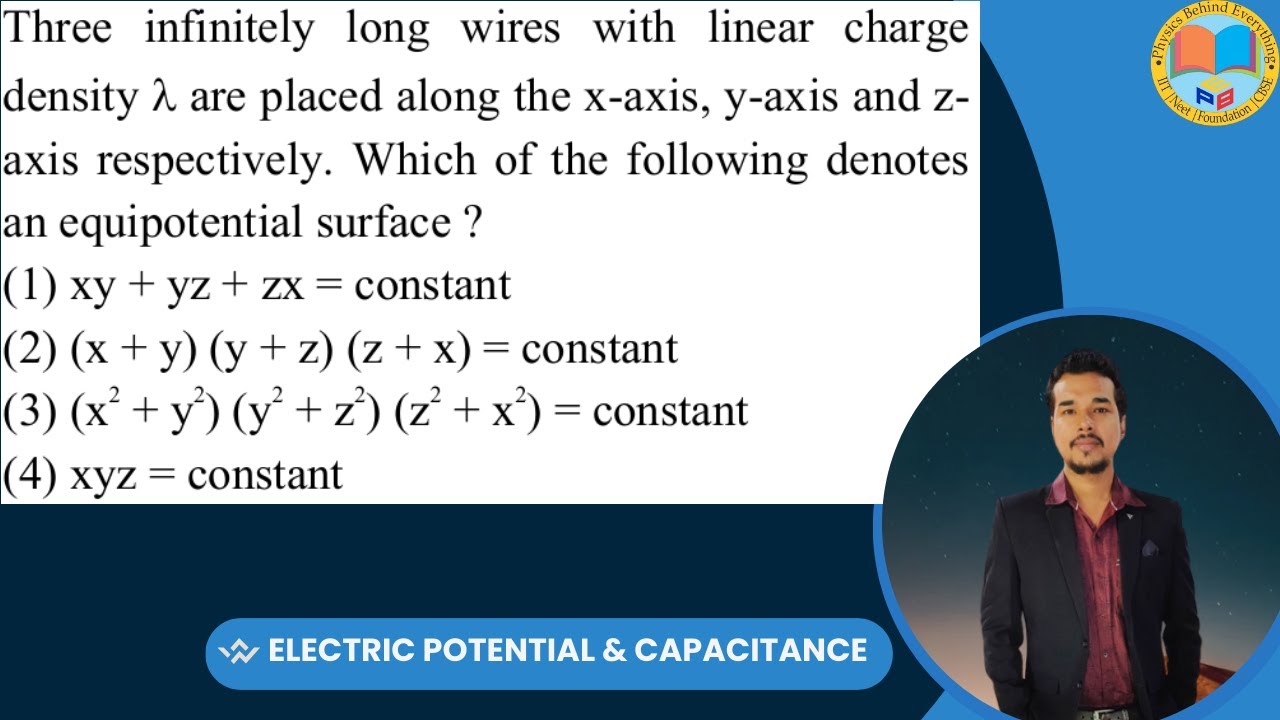
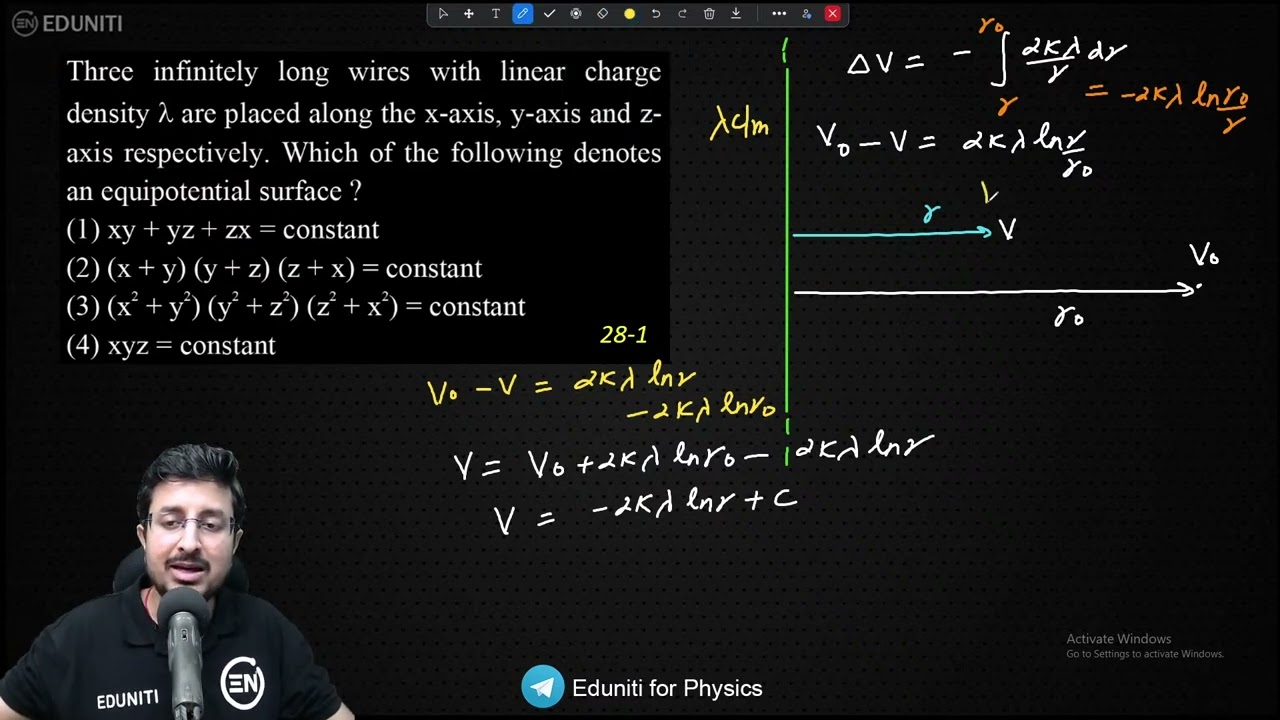
Three infinitely long wires with linear charge density λ are placed along the x-axis, y-axis and z-axis respectively. Which of the following denotes an equipotential surface ?
(1) xy + yz + zx = constant
(2) (x + y) (y + z) (z + x) = constant
(3) (x² + y²) (y² + z²) (z² + x²) = constant
(4) xyz = constant
Potential Video Link : • Electric Potential Due to Infinite Line Ch...
Equipotential Surfaces with Infinite Wires | JEE Mains 2025 PYQ Solved 🔥
📚 Chapter/Topic: Electrostatics | Equipotential Surfaces
🎯 Exam Focus: JEE Mains 2025 | NEET 2025
📖 In This Video:
In this video, I’ve solved a JEE Mains 2025 Previous Year Question (PYQ) based on equipotential surfaces created by infinitely long wires with linear charge density. This problem combines concepts of electrostatics, potential due to infinite wires, and equipotential surfaces, making it a must-watch for all JEE and NEET aspirants. I’ve explained the entire concept in a simple and engaging way, focusing on the theory and avoiding complex calculations.
🔥 Key Highlights:
✅ Detailed explanation of equipotential surfaces and their properties
✅ Understanding the potential due to infinitely long wires placed along the x, y, and z axes
✅ Analyzing the given equations to identify the correct equipotential surface
✅ Step-by-step breakdown of the problem without complex formulas
✅ Tips to approach similar questions in JEE Mains 2025
Theory and Problem Explanation
In this problem, we’re dealing with three infinitely long wires with linear charge density λ placed along the x-axis, y-axis, and z-axis. Here’s a breakdown of the setup and the solution:
Setup Overview:
Three infinitely long wires are placed along the x-axis, y-axis, and z-axis, each with linear charge density λ.
We need to determine which of the given equations represents an equipotential surface in this setup.
Key Concepts:
An equipotential surface is a surface where the electric potential is constant at every point.
For an infinitely long wire, the potential at a distance r from the wire is proportional to ln(r).
The total potential at any point in space due to multiple wires is the sum of the potentials due to each wire.
Connecting the Dots:
The potential due to each wire depends on the distance from that wire.
For the wires along the x, y, and z axes, the distances are given by √(y² + z²), √(x² + z²), and √(x² + y²) respectively.
The total potential at any point (x, y, z) is the sum of the potentials due to the three wires.
An equipotential surface is one where this total potential is constant.
Analyzing the Options:
Option 1: xy + yz + zx = constant
This does not represent an equipotential surface because it does not account for the logarithmic dependence of potential on distance.
Option 2: (x + y)(y + z)(z + x) = constant
This does not represent an equipotential surface because it does not match the form of the potential due to the wires.
Option 3: (x² + y²)(y² + z²)(z² + x²) = constant
This represents an equipotential surface because it accounts for the distances from each wire and matches the form of the potential.
Option 4: xyz = constant
This does not represent an equipotential surface because it does not account for the distances from the wires.
Final Answer:
After analyzing the setup and applying the concepts of equipotential surfaces, the correct option is (3) (x² + y²)(y² + z²)(z² + x²) = constant.
Why This Problem is Important:
This problem tests your understanding of equipotential surfaces and potential due to infinite wires, which are crucial topics for JEE Mains and NEET. By solving this problem, you’ll learn how to handle questions that combine multiple concepts, a common trend in competitive exams.
📜 About This Channel:
Welcome to Physics Behind Everything! 🚀 Here, I create highly engaging and educational content for JEE and NEET aspirants. My goal is to make Physics easy and fun for you. From detailed problem-solving videos to motivational shorts, I’ve got everything you need to ace your exams. Don’t forget to subscribe and hit the bell icon to stay updated!
📌 Important Links:
👉 Follow me on Instagram for daily Physics tips, motivation, and updates: Physics Behind Everything
👉 Watch my full playlist on Electrostatics: [Insert Playlist Link]
🔍 SEO Keywords:
Equipotential Surfaces, Infinite Wires, Electrostatics, JEE Mains 2025 PYQ, NEET 2025 Physics, JEE Mains Problem Solving, Physics Behind Everything, Electrostatics PYQs, JEE Mains 2025 Preparation, NEET 2025 Preparation
#JEEMains2025 #NEET2025 #Physics #EquipotentialSurfaces #InfiniteWires #Electrostatics #CompetitiveExams #PhysicsBehindEverything #ExamPreparation #PYQs
Повторяем попытку...
Доступные форматы для скачивания:
Скачать видео
-
Информация по загрузке:





![Эффект Джанибекова [Veritasium]](https://imager.clipsaver.ru/N9HlQ-XVnFk/max.jpg)