A parallel plate capacitor of capacitance 1 µF is charged to a potential difference of 20 V. The dis
Автор: Physics Behind Everything
Загружено: 2025-03-18
Просмотров: 2157
Описание:
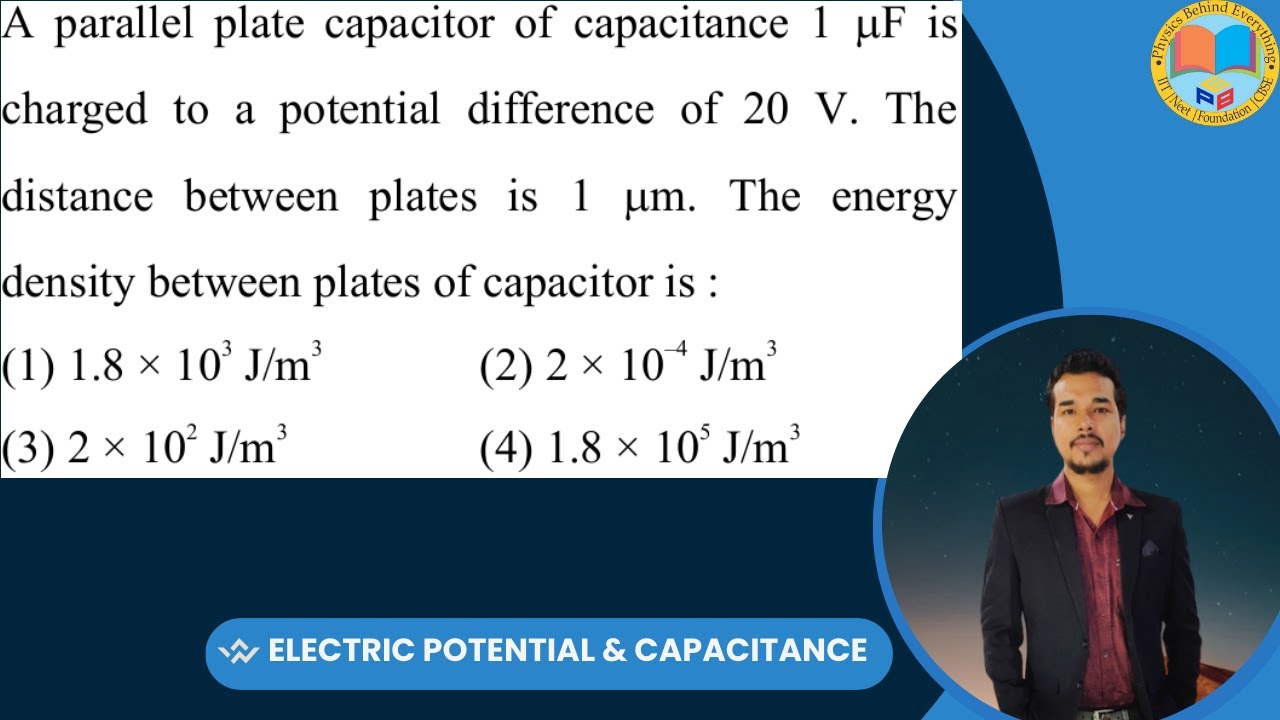
A parallel plate capacitor of capacitance 1 µF is charged to a potential difference of 20 V. The distance between plates is 1 µm. The energy density between plates of capacitor is :
(1) 1.8 × 10³ J/m³ (2) 2 × 10⁻⁴ J/m³
(3) 2 × 10² J/m³ (4) 1.8 × 10⁵ J/m³
📢 JEE Mains 2025 Physics | Energy Density in a Parallel Plate Capacitor ⚡
In this video, I have provided a detailed explanation of a JEE Mains 2025 physics question related to *energy density in a parallel plate capacitor**. Understanding capacitors is crucial for solving electrostatics problems efficiently. Let's dive deep into the concept of **energy storage in a capacitor* and how energy is distributed between the plates! 🚀
🔍 *Concept of Energy Density in a Capacitor*
A *parallel plate capacitor* is an essential electrical component used to store energy in the form of an electric field. The *energy density* refers to the amount of *energy stored per unit volume* between the capacitor plates. This energy is directly linked to the potential difference and the electric field present in the capacitor.
When a capacitor is charged, an *electric field* is created between its plates, which leads to *energy storage* in the form of *electrostatic potential energy**. This energy is distributed throughout the space between the plates, forming a uniform electric field. The **energy density* depends on the charge stored, the plate separation, and the *dielectric medium* between the plates.
🔥 *Key Insights for JEE Mains 2025 Aspirants*
✅ A capacitor stores *electrostatic energy* in the field between its plates.
✅ The energy density represents how much energy is present in a **unit volume**.
✅ This concept is widely applied in **electronics, circuits, and electromagnetic systems**.
✅ Understanding the *relation between capacitance, voltage, and energy density* is crucial for solving electrostatics problems effectively in JEE Mains.
✅ The energy stored in the capacitor can be *used in various electronic devices* like filters, power supplies, and energy storage units.
⚡ *Applications of Capacitors in Real Life*
🔹 *Electronic Circuits* – Capacitors are used in almost every circuit, from mobile phones to computers.
🔹 *Energy Storage* – They help in storing and releasing energy quickly in devices like camera flashes.
🔹 *Signal Processing* – Capacitors filter unwanted signals in audio and communication systems.
🔹 *Power Supply Systems* – Used in UPS and other power backup systems to maintain a stable voltage supply.
💡 *How to Solve Similar Problems in JEE Mains?*
To tackle *capacitor-based problems* effectively:
✅ *Understand the physical meaning* of capacitance and energy density.
✅ *Visualize the electric field distribution* between the capacitor plates.
✅ *Relate the problem to real-world applications* to strengthen conceptual clarity.
✅ *Practice similar JEE Mains previous year questions* for better retention.
📌 *Boost Your JEE Mains 2025 Preparation!*
For more such *detailed explanations**, **shortcut tricks**, and **quick revision techniques**, **subscribe to my channel* and stay updated with the best JEE physics content! 🚀
🔗 *Follow me on Instagram for more updates & tricks:* [Physics Behind Everything](https://www.instagram.com/physics_beh...)
🔴 *Don’t forget to like, share, and comment your answers!*
#JEEPhysics #JEE2025 #Electrostatics #Capacitor #PhysicsTricks #JEEPreparation #EnergyDensity
Повторяем попытку...
Доступные форматы для скачивания:
Скачать видео
-
Информация по загрузке:




![Пожалуй, главное заблуждение об электричестве [Veritasium]](https://imager.clipsaver.ru/6Hv2GLtnf2c/max.jpg)