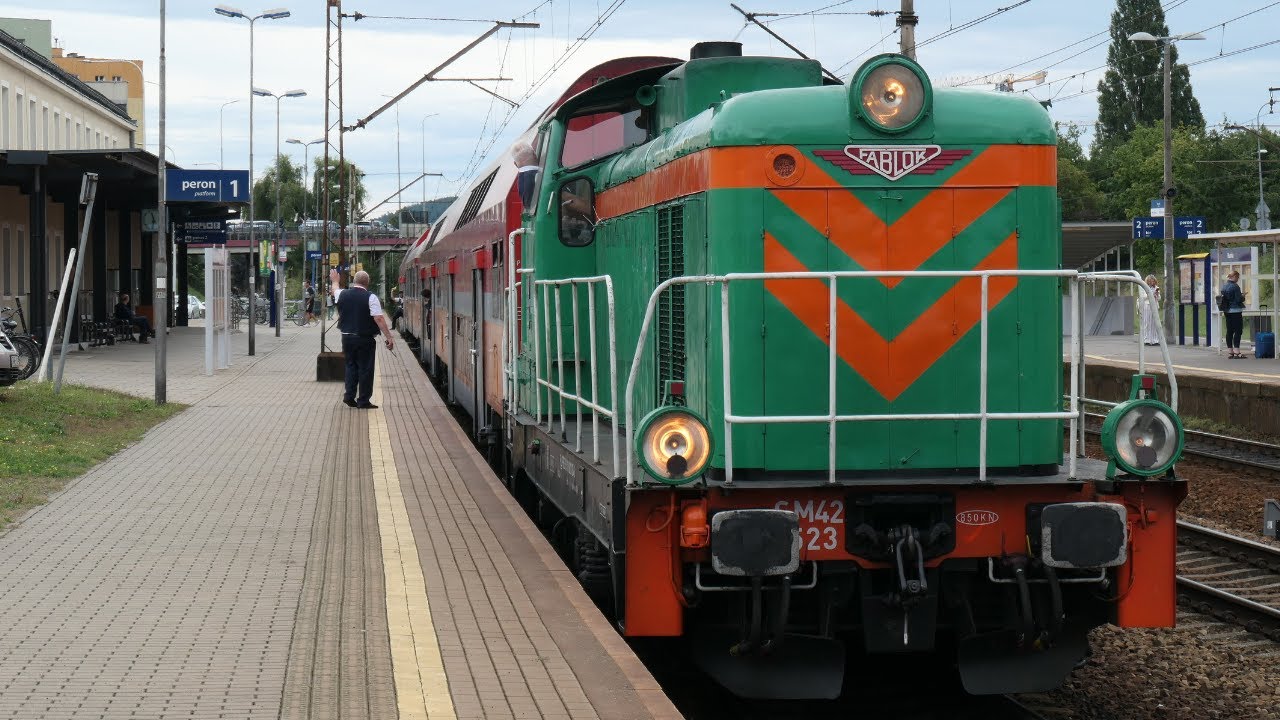
Romania: CFR Railways electric Class 40 locomotive leaves Copsa Mica on a Teius service
Автор: FrontCompVids
Загружено: 2015-11-17
Просмотров: 1258
Описание:
Romania: CFR Railways electric Class 40 locomotive (number 40 0623-5) leaves Copsa Mica station hauling the 1605 Brasov - Teius passenger service.
Recorded 13th May 2012.
Copsa Mica (German: Kleinkopisch; Hungarian: Kiskapus) is a town in Sibiu County, Transylvania, Romania, located north of Sibiu, 33 km east of Blaj, and 12 km southwest of Medias.
The town is best known for its status (in the 1990s) as one of the most polluted in Europe. This was due to the emissions of two factories in the area:
One, open from 1935 to 1993, produced carbon black for dyes; its emissions permeated the area for nearly sixty years, leaving soot on homes, trees, animals, and everything else in the area. The stain from these decades of deposits are still visible.
The other source of the pollution, less visible but with even more serious effects to the health of the town's residents, was Sometra, a smelter whose emissions have contributed to significantly higher incidence of lung disease and impotence, along with a life expectancy nine years below Romania's average.
-+-+-+-+-+-+-+-+-+-+-+-+-+-+-+-+-+-+-+-+
Sibiu is a county (județ) of Romania, in the historical region Transylvania, with the capital city Sibiu.
In Hungarian, it is known as Szeben megye, and in German as Kreis Hermannstadt.
-+-+-+-+-+-+-+-+-+-+-+-+-+-+-+-+-+-+-+-+
Teiuș, German: Dreikirchen, Dornstadt; Hungarian: Tövis) is a town in Alba County, Romania, near the junction between the Stremț/Geoagiului Creek and the Mureș River, with a population of 7,284 inhabitants. The town, declared as such in 1994, is a junction point on the Cluj-Napoca - Sighișoara railway. It has several old churches, the most notable being the 17th century Uniate church and the Roman Catholic church, built for John Hunyadi in 1449 and rebuilt (1701–1704) in a simple Gothic style.
The town administers four villages: Beldiu (Marosbéld), Căpud (Magyarkapud), Coșlariu Nou (Újkoslárd) and Pețelca (Pacalka).
-+-+-+-+-+-+-+-+-+-+-+-+-+-+-+-+-+-+-+-+
Căile Ferate Române (abbreviated as CFR) is the official designation of the state railway carrier of Romania. The railway network of Romania consists of 11,380 km (7,070 mi), of which 3,971 km (2,467 mi) (34.9%) are electrified, and the total track length is 22,247 km (13,824 mi), of which 8,585 km (5,334 mi) (38.5%) are electrified. The network is significantly interconnected with other European railway networks, providing pan-European passenger and freight services. CFR as an entity has been operating since 1880, even though the first railway on current Romanian territory was opened in 1854.
CFR is divided into four autonomous companies:
CFR Călători, responsible for passenger services;
CFR Marfă, responsible for freight transport;
CFR Infrastructură, manages the infrastructure on the Romanian railway network; and Societatea Feroviară de Turism, or SFT, which manages scenic and tourist railways.
CFR Călători, the passenger service division of CFR, operates seven types of passenger train, both on Romania's territory, with rolling stock and locomotives, or internationally, with rolling stock. Also, CFR operates international trains on Romanian territory with its own locomotives. The train types vary in terms of speed and type of rolling stock. In 2010, approximately 58 million passengers have traveled with the company. 10 million travelers have preferred private equity firms in particular on the side lines.
CFR train types are:
Regio (R) -- the trains have assigned numbers from 2000 to 9999
InterRegio (IR) -- the trains have assigned numbers from 200 to 499, 600 to 999, 1000 to 1999 and 10000 to 14999
InterCity (IC) -- numbered from 500 to 599
EuroCity (EC) -- numbered as IC trains from 500 to 599
EuroNight (EN) -- numbered as IC trains from 500 to 599
Special (S) -- tourist trains operated on scenic routes with vintage rolling stock, numbered from S1 to S9
Aside from the seven main train types, CFR also operates night trains, which can be of any status (usually Rapid, InterCity or EuroNight). Freight trains, operated by CFR Marfă, have a different numbering system.
-+-+-+-+-+-+-+-+-+-+-+-+-+-+-+-+-+-+-+-+
@FrontCompVids - Follow us on Twitter!
More FrontCompVids clips are regularly added to so don't forget to Like and Subscribe!
Click / frontcompvids for more details :-)
Повторяем попытку...

Доступные форматы для скачивания:
Скачать видео
-
Информация по загрузке:


![T:ANE [BG] Karlovo-Plovdiv with military train](https://imager.clipsaver.ru/uOwK0fPavbE/max.jpg)