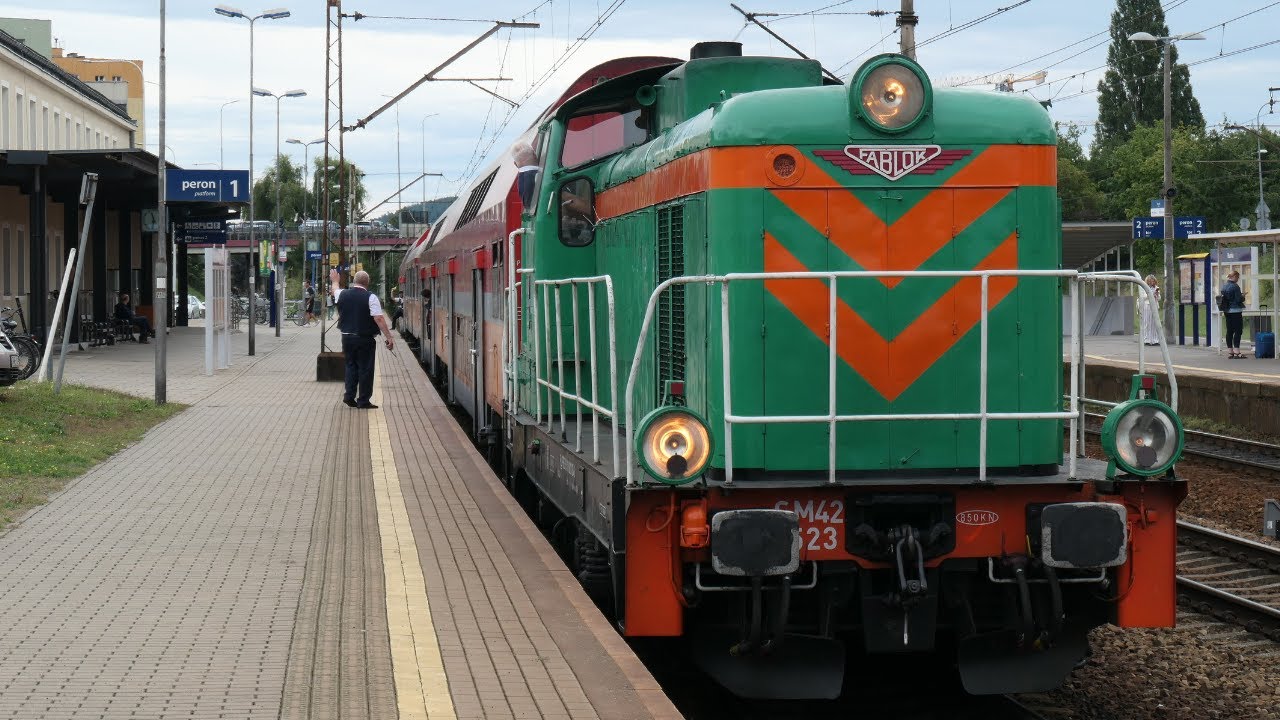
Poland: Polregio SM42-523 at Sopot & Rumia working a Chojnice - Hel passenger train
Автор: FrontCompVids
Загружено: 2026-01-03
Просмотров: 211
Описание:
Poland: Polregio SM42-523 is seen at Sopot and Rumia working train R55255, the 0804 Chojnice to Hel.
Both clips recorded 26 August 2025.
Clip 1 - An onboard clip showing SM42-523 leaving Sopot.
Clip 2 (1:10) - SM42-523 leaves Rumia towards Hel.
SM42 is the PKP class for a Polish shunter diesel locomotive for shunting and light freight traffic, built by Fablok in Chrzanów (manufacturer's designation is Ls800E, designer's designation 6D).
The SM42 was the first Polish-designed heavier diesel-electric locomotive and was the most numerous one in its country of origin.
The main buyer of Ls800 locomotives, which had priority in orders, were the Polish State Railways, which received 1157 locomotives. They were used for shunting, local freight traffic and local passenger traffic in warm months. 622 were made for the Polish industry, some in Ls800P variant with single steering only (they were designated by their users as Ls800 or SM42, with numbers above 2000).
A variant of type 6D/SM42 locomotive was a type 101D locomotive, equipped with a steam generator for carriage heating. 268 locomotives of this variant were built and classified as SP42.
In the years 1975-1977, 40 locomotives were converted to SU42 ("diesel universal") class, with the addition of 500 V electric train supply for heating of passenger carriages. Due to the withdrawal of such carriages, in 2000 the electric supply systems were removed and these locomotives were reclassified back to SM42. In the years 1999-2000, 40 SP42 locomotives were equipped with standard 3 kV electric train supply and classified as SU42 too.
In the 2000s, a number of companies started offering comprehensive modernisations of the locomotive, involving the replacement of the prime mover, generator and air compressors, upgraded driver's cab (that better isolates against the engine vibrations the original locomotive was famous for) and various changes to the body. Some of the companies that offer the rebuilds are:
Newag – 6Dg, 18D, 6Dl (with 3 kV electric train heating; equivalent to SU42 functionality)
Pesa – 6Dk
Tabor Dębica [pl] – 6Dh-1
H. Cegielski – SU4220
-+-+-+-+-+-+-+-+-+-+-+-+-+-+-+-+-+-+-+-+
Polregio (formerly Przewozy Regionalne) is a train operator in Poland, responsible for local and interregional passenger transportation. Each day it runs approximately 3,000 regional trains. In 2002 it carried 215 million passengers.
The company was founded in 2001 from the splitup of the PKP Passenger Transport Sector of the once-unitary Polskie Koleje Państwowe national rail operator into several companies to meet European Union requirements.
-+-+-+-+-+-+-+-+-+-+-+-+-+-+-+-+-+-+-+-+
Sopot is a seaside resort city in the Pomeranian Voivodeship on the southern coast of the Baltic Sea in northern Poland. It has the status of county – the smallest city in Poland to have that status. Sopot lies between the larger cities of Gdańsk to the southeast and Gdynia to the northwest. The three cities together form the Tricity metropolitan area.
Sopot is a major health-spa and resort destination. It has the longest wooden pier in Europe, at 511.5 metres, stretching out into the Bay of Gdańsk. The city is also famous for the Sopot International Song Festival, the largest such event in Europe after the Eurovision Song Contest. Among its other attractions is a fountain of bromide spring water, known as the "inhalation mushroom".
The city's name is thought to derive from an old Lechitic word, sopot, meaning "stream" or "spring". The same root occurs in a number of other Lechitic toponyms; it is probably onomatopeic, imitating the murmur (Šepot) of running water.
The name is first recorded as Sopoth in 1283 and Sopot in 1291. The Germanized form Zoppot is derived from the original Polish name. In the 19th century and in the interwar years the German name was re-Polonized as Sopoty (a plural form). "Sopot" was made the official Polish name when the town returned under Polish rule in 1945.
-+-+-+-+-+-+-+-+-+-+-+-+-+-+-+-+-+-+-+-+
Rumia (German: Rahmel) is a town in northern Poland, in the Wejherowo County in Pomeranian Voivodeship. It is a part of the Kashubian Tricity (Rumia, Reda, Wejherowo) and a suburb part of the metropolitan area of the Tricity. It is situated in Kashubia in the historic region of Pomerania. It is connected by well-developed railway and highway connections to the Tricity, an urban agglomeration of almost 1 million inhabitants on the coast of Gdańsk Bay.
-+-+-+-+-+-+-+-+-+-+-+-+-+-+-+-+-+-+-+-+
@FrontCompVids - Follow us on Twitter!
More FrontCompVids clips are regularly added to so don't forget to Like and Subscribe!
Click / frontcompvids for more details :-)
Повторяем попытку...
Доступные форматы для скачивания:
Скачать видео
-
Информация по загрузке: