Micro-Palaeontology: Intro, Def, size, branches and types of microfossils
Автор: PC Geo Kimberlite
Загружено: 2021-04-01
Просмотров: 3264
Описание:
MICROPALAEONTOLOGY
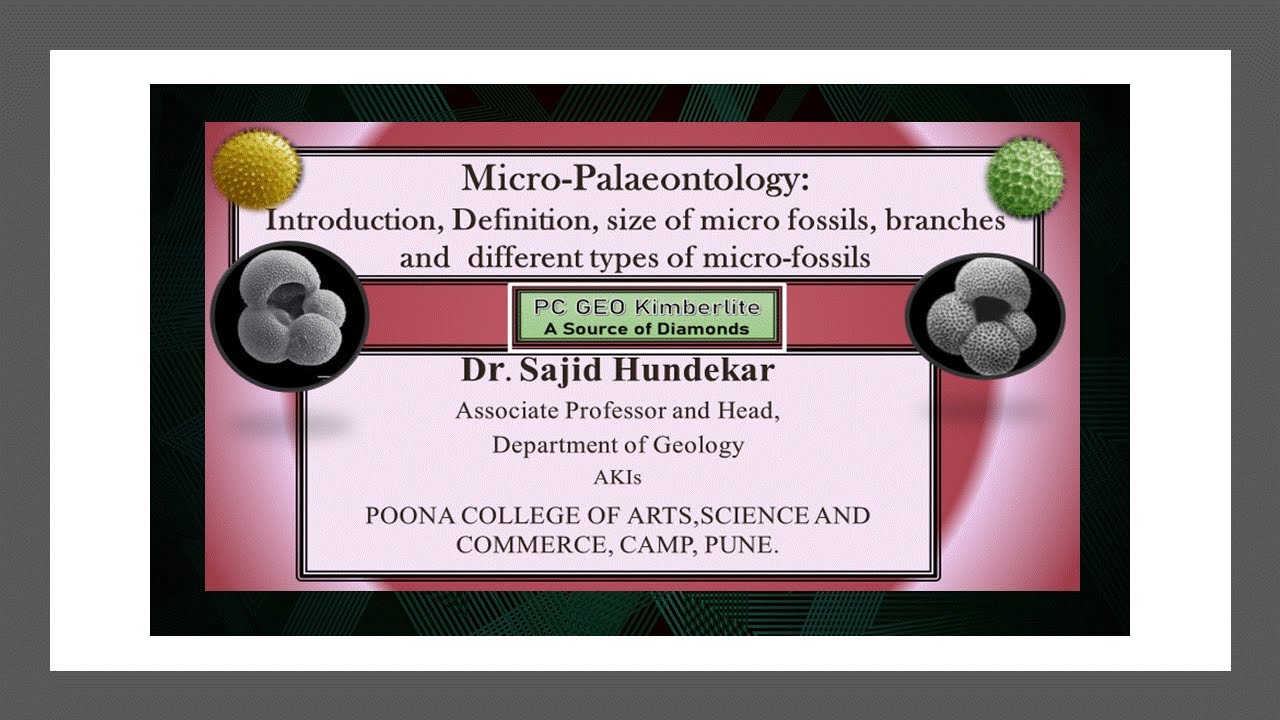
Palaeontology palaios-ancient ontology-biology may be the science which deals with the systematic Study of past life, but the life of past is represented by fossils alone MICROPALAEONTOLOGY:- Introduction,Definition Micro-palaeontology is a special branch of Palaeontology which deals with study of remains of micro-organisms, detached micro parts of certain animals and plants preserved in the form of microfossils. 1 The size of these fossils requires a special method of collection, separation, preparation, and examination. 2 Unlike macrofossils they occur in great number and hence can be treated statistically with reference to their distribution in the sediments. 3Because of their small size and abundant occurrence, they have practical value in biostratigraphy and applied geological investigations Economic geology. SIZE OF MIROFOSSILS :- Microfossils are essentially microscopic in size. COMPOSITION OF MICROFOSSILS:- These minute organisms have varied chemistry. Foraminifera, ostracods and calpionellids are calcareous. The diatoms and radiolaria are composed of silica while conodonts are phosphatic. BRANCHES OF MICROPALAEONTOLOGY:- Micro-palaeontology- the study of microfossils is divided into the following branches.
1-MICROPALAEOBOTANY:- deals with the study of microfossils of plants like algae, fungi, bacteria, diatoms, cocoliths nano fossils. 2-MICROPALAEO ZOOLOGY:- deals with the study of microfossils animals like foraminifera, ostracoda, radiolarians etc. Divided into two:- a.Vertebrate micropalaeontology. b)Invertebrate micropalaeontology. 3-PALYNOLOGY:- study of spores and pollens of the plant. 4-NANOFOSSILS:- unidentifiable microfossils of plants and animals. Palynology is a new field of micropalaeontology developed in recent years in which electron microscopes are used for high magnification. CALCAREOUS NANOFOSSILS:- These constitute a heterogenous group of objects i.e unidentifiable microfossils of plants and animals that ranges in size from ¼ m to 20m. DIFFERENT TYPES OF MICROFOSSILS:- The important type of microfossils are briefly described below. 1-ACRITARCHS :- Organic-walled unicellular, planktonic hollow-shelled micro-organisms hollow vesicles of uncertain affinities are known as acritarchs. 2-TASMANITIDS :- Spheroidal to ovoidal, disclike, biconvex group of unicellular fossils organisms ranging in colour from yellow to reddish brown to black with size range of 100-600mm. 3-SPORES :- A propagative, reproductive, single or few-called body of nano-flowering plants that consists of gametophytes enclosed in a waxy, nano-cellular spors coat is known as spore. 4-POLLENS :- A pollen is a malticellular male germinent body of true flowering plants. its main function is to reach female gametophyte and fertilize it. Pollens are 5-200mm. 5-SEEDS, SEED COAT, WOOD FRAGMENTS AND PALYNODEBRIS:- Seed, the fertilized ovules of plants containing germinating body or embryo enclosed in integument known as seedcoat, are after preserved in the sediments along with polynodebris. 6-SILICOFLAGELLATES:- Unicellular, marina plant planktons belong to division chrysophyta usually are 20-100mm in diameter with golden brown photosynthetic pigments, many pseudopodia, 7-DIATOMS:- Occur both in freshwater, lake deposits and marine diatomiter. They are autotrophic unicellular algae with photo synthetic golden brown pigments. 8-COCCOLITHS:- These are a heterogeneous group of scale like objects ranging from 0.25mm to 200mm called calcareous nanofossils, and mostly include coccoliths. 9-DINOFLAGELLATES:- 20-150mm in size, unicellular usually considered as plants. Occur in two forms planktic motile stage and planktic or benthic cysts stage. 10- TINTINNIDS AND CALPIONELLIDS:- Tintinnid cell is either cylindr:cal or bell shaped produced into a shell and a stalk for its attachment other ciliophor with calcareous forms is known as calpionellids. 11- RADIOLARIANS:- Marine protozoans belong to phylum sarcodina of kingdom protista. Unicellular radiolarians Have a size range of 100-1000mm. 12- CONODONTS:- Most controversial phosphatic tooth like fossil objects called conodonts usually occur in marine rock. Usually translucent amber brown, grayish to blackish in colour and range from 0.1 to 5mm in length. 13- SPONGE SPICULES:- Small skeletal elements called spicules made up of silica or calcium carbonate calcite or aragonite are scattered in mesoglea of forifer a sponges. 14- FORAMINIFERAS:- Unicellular less than1mm is diameter to about 100mm. 15- OSTRACODES:- Bivalved, crustaceans, bean shaped, oval or kidney shaped.
#Micro-Palaeontology
#Intro,
#Definition,
#size,
#branches
#types of microfossils,
#palaeontology,
#paleontology,
#foraminiferas,
Повторяем попытку...
Доступные форматы для скачивания:
Скачать видео
-
Информация по загрузке:


![Эффект Джанибекова [Veritasium]](https://imager.clipsaver.ru/N9HlQ-XVnFk/max.jpg)