How Quaker Cemeteries Are Different
Автор: QuakerSpeak
Загружено: 2015-06-04
Просмотров: 33569
Описание:
How is a Quaker cemetery different? Early Quakers believed that ornate gravestones communicated the dominion of the upper classes, even in death. Earlham College professor Thomas Hamm takes us through the history of Quaker cemeteries.
Quaker Speak is a weekly video series. Subscribe: http://QuakerSpeak.com/subscribe
Filmed and Edited by Jon Watts
www.JonWatts.com
Music from this episode:
www.JonWattsMusic.com
___
Go Deeper with Friends Journal:
http://FriendsJournal.org
Lobby with Quakers on Capitol Hill:
http://www.fcnl.org
Work for peace with justice with AFSC:
http://www.afsc.org/friends
Learn about the rich diversity of Quakers worldwide:
http://www.fwccamericas.org/
Directed by Jon Watts
http://www.JonWatts.com
___
Photos:
https://umdarchives.wordpress.com/201...
http://freepages.genealogy.rootsweb.a...
http://en.wikipedia.org/wiki/Gildencr...
http://dovernjhistory.org/files/pages...
http://www.waterfordhistory.org/histo...
http://freepages.genealogy.rootsweb.a...
http://commons.wikimedia.org/wiki/Fil...
http://commons.wikimedia.org/wiki/Fil...
http://www.gwyneddmeeting.org/history...
Transcript:
Since the beginning of the Quaker movement, one of the ways that Friends have distinguished themselves is in their practices connected with death and burial, and Quaker burying grounds, Quaker cemeteries—although cemetery is a word that Friends probably didn’t use until at least the 19th century—are unusual. They are an illustration of how Friends tried to distinguish themselves from the rest of the world.
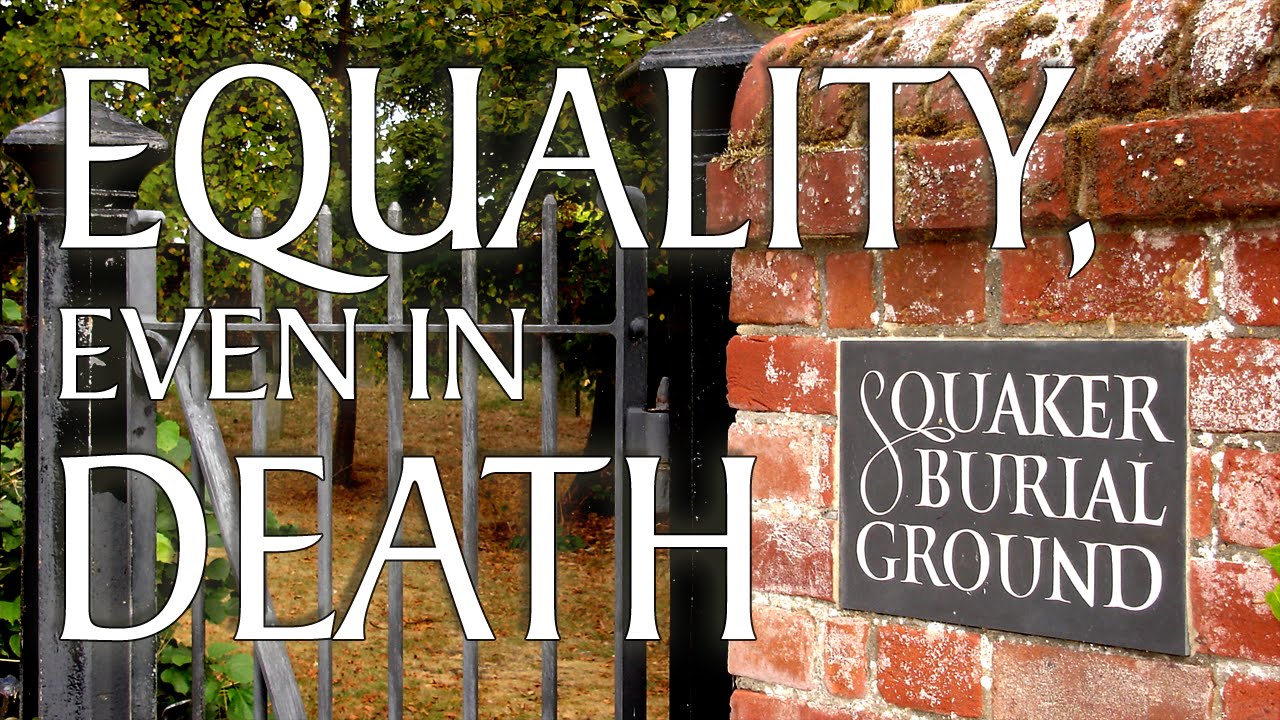
Equality, Even in Death: Why Quaker Cemeteries are Different
Friends believed that, as it was inappropriate to try to elevate some people above others in life, it was equally inappropriate to do that in death. Thus, Friends banned tombstones from their burying grounds because they thought that all that tombstones did was to distinguish some people from others.
Equality, Even in Death
When Quakers attended church in their parishes in 17th century England, in those churches they would’ve been surrounded by memorials. In some cases grandiose tombs, that even in death were intended to communicate that the upper classes—the people who had sat in the front-most pews by life—still exercised dominion, even in death, by the way that they had buried themselves.
Friends felt it appropriate, required of them, that even in death that they bear testimony against such practices that served to puff up human vanity.
Early Quaker Burial Grounds
So in a Quaker burying ground in the 17th and 18th centuries, most likely when you approached it you would have seen a simple, unbroken spans of Earth. Usually consisting entirely of unmarked graves. There were always some Friends who found that unacceptable. They certainly didn’t want grandiose monuments that spoke to how some families were superior to others, but they could see nothing wrong with a simple stone that helped them remember where a loved one was buried.
Modern Quaker Cemeteries
By the middle of the 19th century, Friends finally decided that under certain circumstances, marking graves could be appropriate, and so Friends moved towards a new testimony on tombstones.
Tombstones would be allowed, but they had to be simple. The name of the deceased, the date of death and the age, or maybe the date of birth. No ornamentation, no epitaphs, no decoration of any kind, and usually strict limits on height and width.
If you go, for example, to London Grove Meeting, Chester county, Pennsylvania, a Meeting that goes back to the 18th century, and look at the burying ground, there’s maybe one marker before 1850. But if you go to, say, Gwynedd or Chichester or Old Caln, you’ll find the burying ground full of simple, rough stones, going back into the 18th century.
___
The views expressed in this video are of the speakers and do not necessarily reflect the views of Friends Journal or its collaborators.
Повторяем попытку...
Доступные форматы для скачивания:
Скачать видео
-
Информация по загрузке: