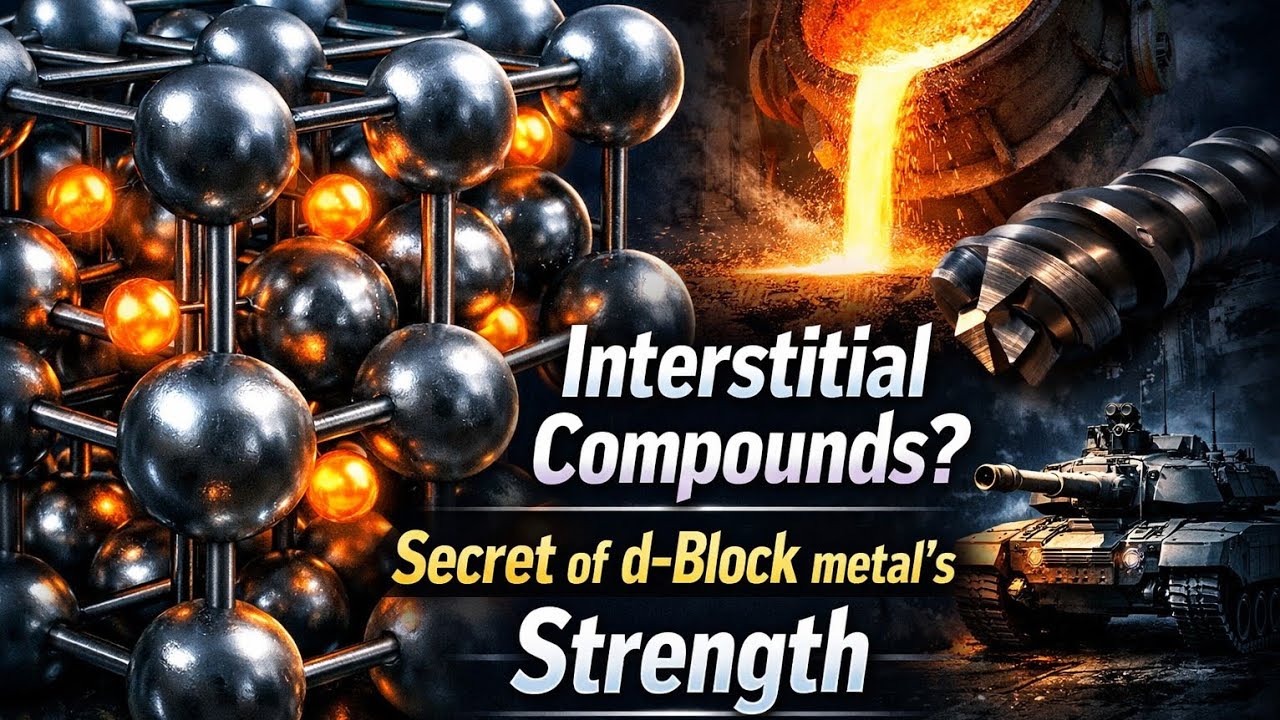
Why Cu+ is Unstable? 🧪 The Mystery of Copper Disproportionation & Redox Reactions🔥
Автор: Subatomic Duo
Загружено: 2026-02-19
Просмотров: 19
Описание:
⚡ Mastering Copper Chemistry: Oxidation States, Disproportionation & Medium Effects 🧪
Welcome to Subatomic Duo ! In this comprehensive lecture, we dive deep into the d-block chemistry of Copper (Cu). We don't just memorize reactions here—we track the movement of every single electron to understand why these transformations happen.
Whether you are preparing for IIT-JEE, NEET, or University exams, this video is your definitive guide to Copper’s redox behavior and its essential compounds.
Chapters:
0:00 - Introduction of Copper as an Element and it's oxidation states
04:03 - Introduction of Cu+ ( Color, electronic configuration)
07:54 - Stability Paradox ( Why Cu²+ is more stable in aqueous solution) [ Key Concept ] 🔥🔥🔥
10:34 - Thermodynamics of Cu+ ( Born Haber cycle of Cu+ )
18:00 - Thermodynamics of Cu²+ ( Born Haber cycle of Cu²+ )
22:40 - Thermodynamics of Disproportionation Reaction or Why Cu²+ is hightly stable in an aqueous solution and concept of " "hydration Energy "( Key Concept) 🔥🔥🔥
28:17 - How to stabilize Cu+ in Aqueous solution.
32:10 - How to destabilize Cu²+ in aqueous solution ( Concept of Lattice energy) 🔥🔥
39:35 - Comproportionation Reaction
42:55 - Why CuF does not exist?
47:21 - Why CuI does not exist?
49:50 - Stabilization of Cu+ in non aqueous solvents
51:15 - Reaction of Cu+ with Cyanide ion ( Formation of potassium tetracyano copper complex )
53:58 - Stabilization of Cu+ by complexation
55:15 - Complexation of Copper Sulfate with KCN
01:01:05 - Cyanogen gas ( Chemical warfare agent or Blood Agent ) 🔥🔥
01:02:40 - Cellular Respiration 🔥
01:05:00 - Effect of Cyanogen gas on human body
01:06:11 - First and second hottest flames
01:08:50 - Behaviour of Cu+ in Neutral Water/ Acidic Solution
01:09:51 - Behaviour of Cu+ in Basic Solution ( Formation of cuprous oxide Lattice)
01:12:31 - Basic introduction of Cu²+ ion , explanation of color
01:15:11 - Behaviour of cu²+ in Neutral Water
01:17:00 - Behaviour of Cu²+ in Acidic Solution ( Sulphuric Acid )
01:18:37 - Behaviour of Cu²+ with Hydrochloride acid.
01:21:07 - Behaviour of Cu²+ in Basic Solution
01:24:57 - Reaction of Copper (II) Hydroxide with Ammonia or Formation of tetraamminecopper(II) ion
01:29:45 - Reaction Of Copper With Hydrochloride Acid 🔥🔥
01:34:17 - Reaction of Copper with dilute Nitric Acid
01:38:47 - Reaction of Copper with Conc. Nitric Acid
01:39:57 - Reaction of Copper (II) Oxide with Hydrochloric Acid
01:40:47 - Reaction of Copper (I) Oxide with Hydrochloric Acid
🔍 Key Concepts Covered:
1. The Cu(I) vs Cu(II) Stability Paradox
Why is Cu²+ (3d⁹) more stable in an aqueous solution than Cu+ (3d¹⁰)? We break down the competition between Second Ionization Enthalpy and Hydration Enthalpy.
2. Disproportionation of Cu(I)
We analyze the spontaneous self redox reaction that occurs in water:
2Cu+ ➡️ 2Cu²+ + Cu (s)
The Electron Move:
One Cu+ ion loses an electron (Oxidation) to become Cu²+ while another Cu+ ion accepts that electron (Reduction) to become metallic Cu⁰.
Stability: Why does this happen in acidic/neutral media but change in the presence of specific ligands?
3. Behavior in Different Media:
🔥Acidic Medium/Neutral Medium: Stability of Cu²+ and the immediate disproportionation of Cu+.
🔥 Basic Medium: Formation of Cu(OH)2 (pale blue ppt) and its dehydration to CuO (black).
🔥 Ammoniacal Medium: The formation of the deep blue [Cu(NH3)4]²+complex.
4. Crucial Reactions of Copper Compounds
Reaction with HNO3 (Dilute vs. Conc.): Tracking the change in Nitrogen's oxidation state from +5 to +2 or +4 ( NO or NO2 )
🔥We also cover the most important reactions of copper and its compounds, including:
Reactions of CuSO₄, CuCl₂, Cu₂O, CuO
📚 Join " Subatomic Duo" Community:
If you want to master chemistry through logic rather than rote learning, Subscribe and hit the bell icon! We make the invisible movement of electrons visible.
If you're preparing for board exams or competitive entrance tests, this video breaks down complex concepts with clear explanations, examples, and balanced equations.
👍 Like the video if it helped!
🔔 Subscribe for more inorganic chemistry lectures on transition metals (Fe, Cr, Mn, Co, Ni, Cu, Zn & more)
💬 Comment your doubts below – I'll try to reply!
#OxidationStatesOfCopper #CopperChemistry #Disproportionation #CuI #CuII #TransitionMetals #InorganicChemistry #JEEChemistry #NEETChemistry #Class12Chemistry #dBlockElements #CopperCompounds #RedoxReactions #cuet #cuetpreparation #cuet2026 #cuetexam
#Chemistry #TheElectron #IITJEE #NEET2026 #CopperChemistry #InorganicChemistry #RedoxReactions #JEEMains #NEETPreparation #dBlockElements
#CopperChemistry #Disproportionation #JEE2026 #NEET2026 #InorganicChemistry
Повторяем попытку...

Доступные форматы для скачивания:
Скачать видео
-
Информация по загрузке:






![Почему взрываются батарейки и аккумуляторы? [Veritasium]](https://imager.clipsaver.ru/a3-3R9zwyGY/max.jpg)