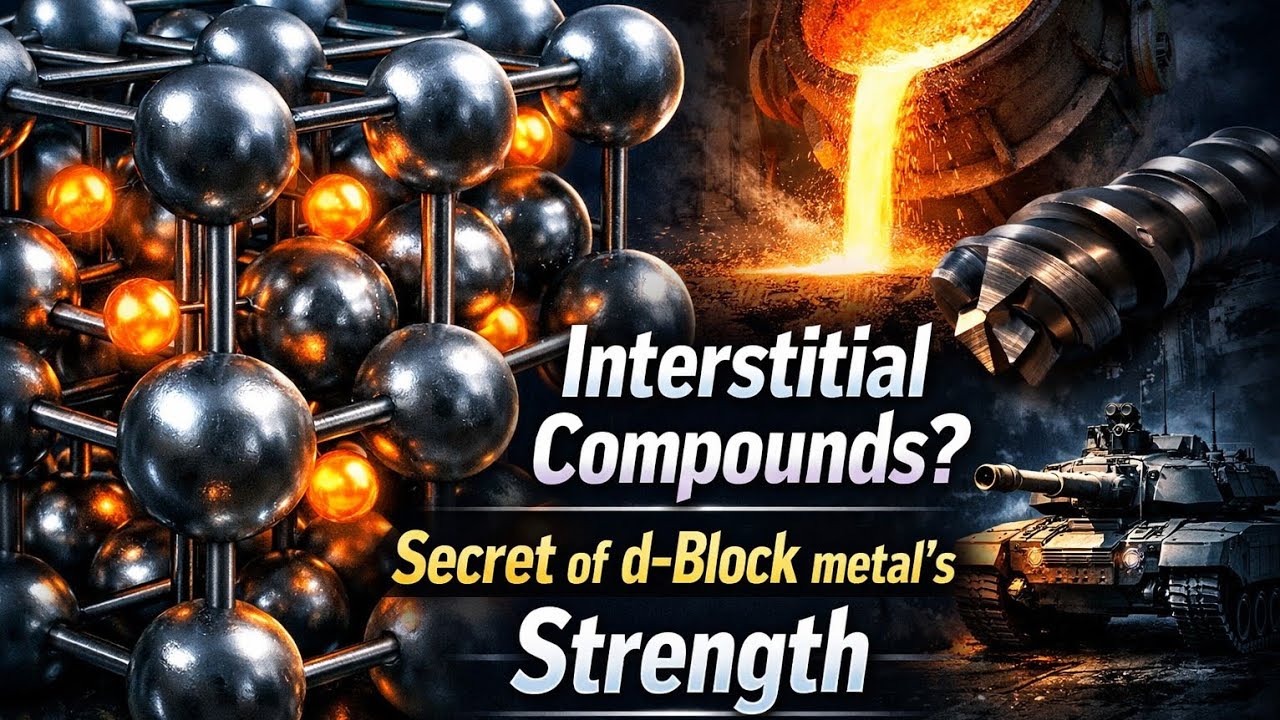
Interstitial Compounds: Electronic Mechanism Non-Stoichiometry| d-Block Elements | IIT-JEE NEET CUET
Автор: Subatomic Duo
Загружено: 2026-02-23
Просмотров: 8
Описание:
Master the Chemistry of d-Block Elements: Interstitial Compounds
In this comprehensive lecture, we deconstruct the formation, bonding, and industrial significance of Interstitial Compounds. Designed specifically for JEE (Main & Advanced) and NEET aspirants, this session goes beyond the textbook to explain the "why" behind the physical properties of transition metal hydrides, carbides, and nitrides.
Chapters:
00:00 - Topic Overview
01:00 - Metallic Lattices and formation of Interstitial compounds
02:05 - Understanding Voids
03:40 - Tetrahedral Voids
06:00 - Octahedral Voids
09:33 - Definition of Interstitial compounds
10:15 - Understanding BCC (Body centered cubic)
15:00 - Understanding FCC ( Face centered cubic )
17:15 - Understanding HCP (Hexagonal Close Packing)
18:08 - Electronic Mechanism within interstitial compounds
23:50 - Physical and Chemical properties of Interstitial compounds ( Hardness)
25:40 - Melting Point
27:09 - Conductivity
28:29 - Chemical Inertness of Interstitial compounds
29:29 - Why interstitial compounds are neither Malleable nor ductile?
31:09 - Non-stoichiometric nature of Interstitial compounds
34:00 - Example of Interstitial compounds
36:00 - importance of Interstitial compounds (Steel formation)
36:10 - Hard cutting tools, Drill bits , Saw blades
36:52 - Bullet Proof Jackets and in Nuclear Reactor
What This Lecture Covers:
🔥 Structural Geometry: A deep dive into how small atoms (H, C, N, B) occupy the Octahedral and Tetrahedral voids within the transition metal lattice.
🔥 The Electronic Track Record: Detailed explanation of the (n-1)d and p-orbital interactions that lead to enhanced rigidity without sacrificing metallic conductivity.
🔥 #Non_Stoichiometry Decoded: Why compounds like TiH_{1.7} and VH_{0.56} do not follow traditional valence rules and how to calculate their composition for JEE-level problems.
🔥 Material Science Applications: Understanding the "Pinning Mechanism" in Steel (Fe-C system) and the extreme hardness of Rhenium Diboride (ReB2).
Key Highlights for JEE Aspirants:
🔥 #Hardness & Melting Points: Why interstitial filling leads to a dramatic increase in lattice energy.
🔥 Chemical #Inertness: How the occupation of surface voids renders transition metals resistant to corrosion.
🔥 #Conductivity Analysis: Why these compounds remain metallic conductors despite the inclusion of non-metals.
About "Subatomic Duo":
Dedicated to providing high-accuracy, mechanism-based Chemistry lectures. We focus on tracking every single electron to ensure you don't just memorize, but understand the science.
#interstitialcompounds #subatomicduo
#Chemistry #JEEAdvanced #NEET2026 #dBlockElements #InorganicChemistry #TheElectron #IITJEE #MaterialScience
Teacher's Suggestion for the Pinned Comment:
"Challenge Question: Why does the density of a transition metal increase upon the formation of an interstitial compound, even though the lattice expands slightly? Post your electronic explanation below!"
Повторяем попытку...
Доступные форматы для скачивания:
Скачать видео
-
Информация по загрузке:











![Почему реактивный двигатель не плавится? [Veritasium]](https://imager.clipsaver.ru/F6UB0V2Fct4/max.jpg)