Where or when - Rodgers & hart - Ukulele chord-melody w. pdf
Автор: art levine
Загружено: 2026-01-10
Просмотров: 38
Описание:
Where or when - Rodgers & Hart (1937), from the Broadway musical “Babes in Arms.” Like so many standards, this one has lent itself to a huge range of interpretations, especially as regards tempo and the inclusion of the verse. For me, the natural habitat of “Where or when” is at the slower, ballad end, where the quasi-mystical lyric can really come into its own. Tea leaves, ouija boards, seances in the afternoon, have we lived before, did we meet in a past life?
As suggested, a lot of performers don’t necessarily see things my way, but some do, so dive in. The first recording was by Ruby Newman & his Rainbow Room Orchestra, Ray Heatherton singing. Another early one: Hal Kemp (v. Bob Allen). A few more: Barbara Cook (always worth listening to), Ginette Fertel, Lena Horne, Dick Haymes, Ella Fitzgerald, Dean Martin, Diana Krall, Dion and the Belmonts, Carly Simon, Julie London, Artie Shaw, Art Tatum, Sonny Rollins, Frank Sinatra, Clifford Brown. Youtube has a recreated “original cast” version of “Babes in Arms” put out by New World Records, vocal by Gregg Edelman.
Any maybe my favorite. Benny Goodman recorded it a couple of times, once with his trio, and once with his sextet and a 21-year old singer named Peggy Lee. One critic’s comment: “The finest version of that song, and among the earliest - the pared-down recording that Peggy Lee and the Benny Goodman Sextet made in a New York studio on Christmas Eve 1941, barely two weeks after America entered the Second World War - speaks to the quavering uncertainty of the historical moment and remains, for me, the most poignant jazz record ever made.” - Benjamin Schwarz, “The End of Jazz,” The Atlantic, November 2012.
Uke key: C. The verse starts in A minor, and is unusual in having a first and second ending. The repeated B in the melody, harmonized as A minor 9, gives the whole thing a dreamy quality, clearly related to the mysterious lyric. This continues into the chorus (form: AABA 10+10+8+10), where a repeated A at “It seems we stood and talked like this” is harmonized as 4000 - C major 7 with a 6 on top, a lovely chord which doesn’t get used too often. The line itself is a lsow ascent up to the C, ending on the E at “where or when.” The bridge starts from the E, and is built on ii-V of C, then A-, then C again. The return of A is altered to create a long stepwise ascent to the A on octave above the start: “And so it seems that we have met before, and laughed before, and loved before, but who know where or when.”
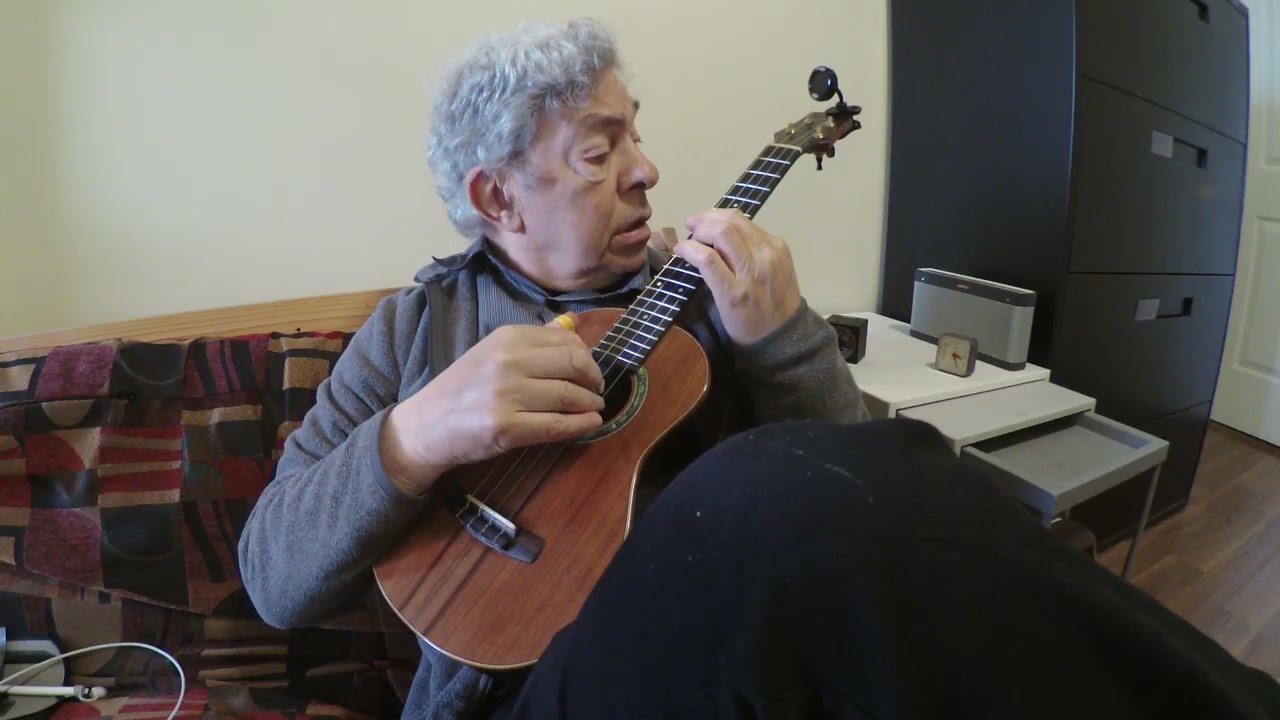
Uke: lyric tenor by Pat Megowan.
pdf
https://drive.google.com/file/d/1TAmFzudhI...
Повторяем попытку...
Доступные форматы для скачивания:
Скачать видео
-
Информация по загрузке: