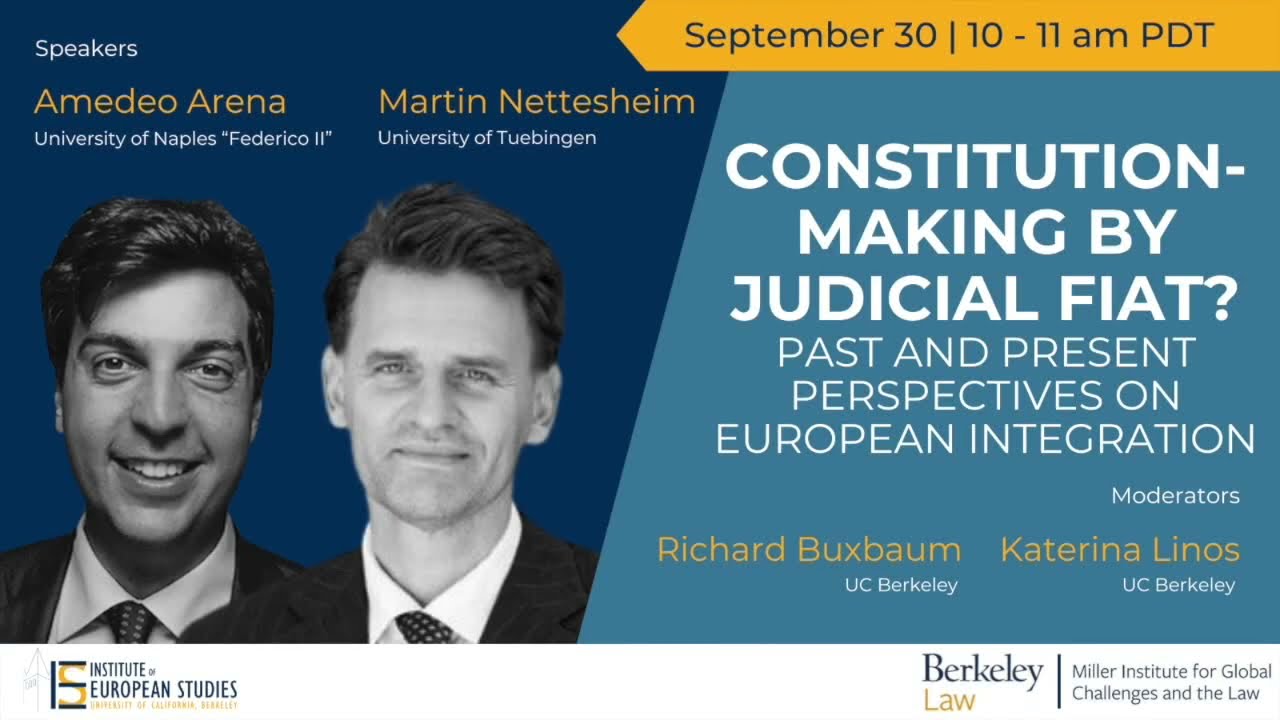
Constitution-making by Judicial Fiat? Past and Present Perspectives on European Integration
Автор: Institute of European Studies, UC Berkeley
Загружено: 2022-10-15
Просмотров: 123
Описание:
0:00 Katerina Linos
3:01 Amedeo Arena
16:14 Martin Nettesheim
28:27 Richard Buxbaum
Speakers: Amedeo Arena, Full Professor at the Faculty of Law, University of Naples “Federico II”, Senior Fellow, Institute of European Studies; Martin Nettesheim, Professor of Law, University of Tuebingen, Senior Fellow, Institute of European Studies
Moderators: Katerina Linos, Irving G. and Eleanor D. Tragen Professor of Law, Co-Faculty Director, Miller Institute for Global Challenges and the Law; Richard Buxbaum, Jackson H. Ralston Professor of International Law (Emeritus), UC Berkeley Sponsors: Institute of European Studies, Miller Institute for Global Challenges and the Law
Amedeo Arena, The making of Europe’s Supremacy Clause. While in the US the supremacy of federal law vis-à-vis State law was clearly set out in the US Constitution of 1787, in Europe that principle was introduced by the European Court of Justice’s ruling in Costa v. ENEL of 1964. This talk focuses on the ‘making of’ that groundbreaking decision, placing it in the context of Italy’s nationalization of the electricity sector at the height of the Cold War.
Martin Nettesheim, The European Court of Justice and Europe's self-description. The EU Court of Justice ascribes a constitution to the EU that is supported by "European values" and has a "constitutional identity". Is this form of judicial lawmaking legitimate? How does it fit into the history of European integration? What does it imply for the interpretation of provisions such as Art. 2 TEU, Art. 10 TEU or Art. 19 TEU?
Повторяем попытку...
Доступные форматы для скачивания:
Скачать видео
-
Информация по загрузке: