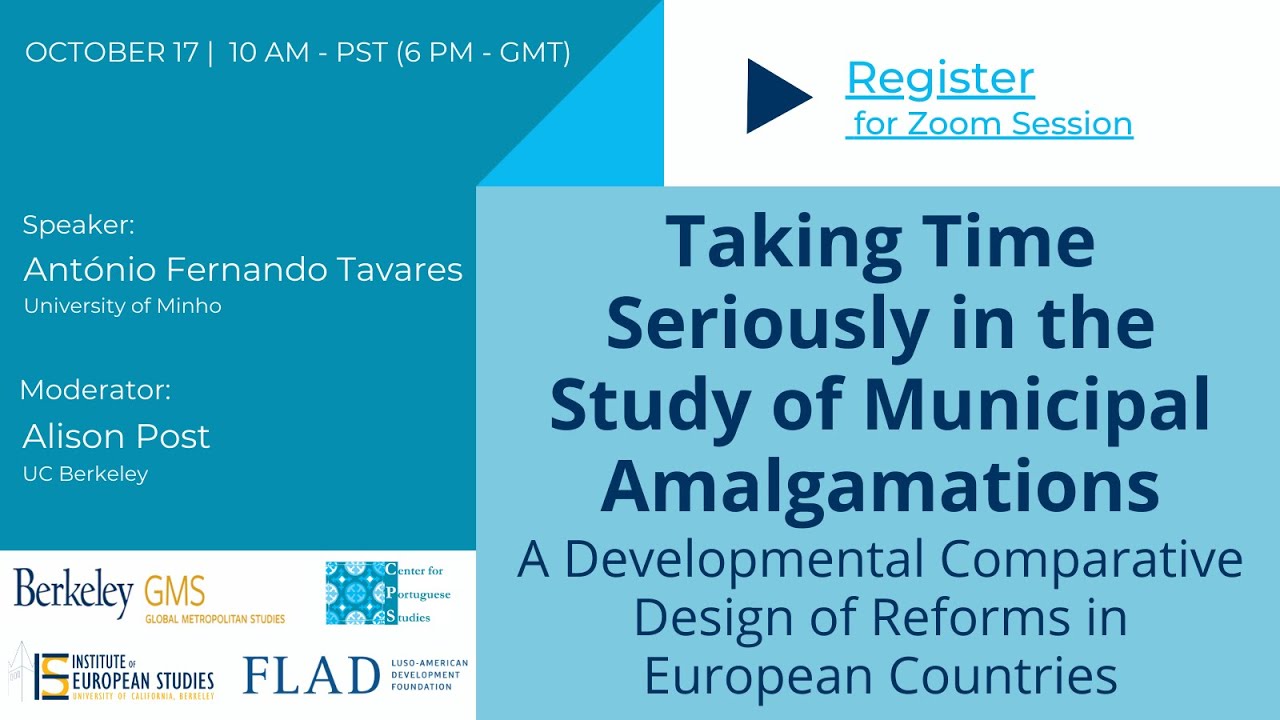
Taking Time Seriously in the Study of Municipal Amalgamations
Автор: Institute of European Studies, UC Berkeley
Загружено: 2022-10-21
Просмотров: 124
Описание:
Taking Time Seriously in the Study of Municipal Amalgamations: A Developmental Comparative Design of Reforms in European Countries
Speaker: António Fernando Tavares, Associate Professor, School of Economics and Management of the University of Minho
Moderator: Alison Post, Travers Family Associate Professor, UC Berkeley Department of Political Science
Sponsors: Institute of European Studies, Center of Global Metropolitan Studies, Center for Portuguese Studies
Prior comparative analyses of 70 years of amalgamation reforms in Europe have been bounded by both time and space. Beginning the analysis of amalgamation reforms in the post-World War II years, the conventional explanation in the literature argues that amalgamation reforms occurred when countries engaged in decentralization reforms to develop Welfare State functions. Prof. António F. Tavares argues this conventional explanation ignores both historical events that took place before WWII and cross-country diffusion processes over the last 70 years.
The presentation employs a Comparative Historical Analysis approach to 1) identify historical patterns of amalgamation reforms in Europe and to 2) provide a macro-causal explanation to make sense of continuities and discontinuities in these reforms. Prof. Tavares unpacks four key elements of time required to investigate municipal amalgamations in a comparative manner: a) the historical time of adoption (enactment); b) the sequencing of reforms across countries; c) the tempo of the reforms (fast or radical vs. slow or incremental); and d) the duration of the reform (implementation).
In this search for a macro-causal explanation for amalgamation reforms Prof. Tavares highlights the different historical time of amalgamation reforms, with some taking place almost two centuries ago (Portugal, 1835), others early after WWII (e.g. Sweden, 1948-52), others much later (e.g., Greece, 1999; Georgia 2002-2006), more than once (e.g., Denmark, 1960s and 2004-05), or never (Spain). Next, he employs the elements of physical time – sequencing, tempo and duration – to uncover the complex causal processes and patterns that generated these territorial reforms.
Повторяем попытку...
Доступные форматы для скачивания:
Скачать видео
-
Информация по загрузке: