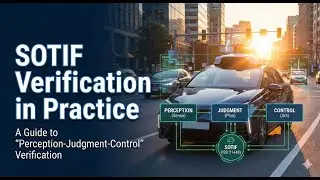
SOTIF Verification in Practice: A Guide to "Perception-Judgment-Control" Verification
Автор: AutoSysEng TV: System Architecture & Safety
Загружено: 2026-01-28
Просмотров: 5
Описание:
In this episode, we explore Clause 10 of the SOTIF (Safety of the Intended Functionality) standard: ISO 21448. While traditional functional safety (ISO 26262) focuses on hardware failures, SOTIF addresses the risks arising from performance limitations and environmental conditions—even when every component is working perfectly.
We break down the systematic process of verifying "Known Scenarios" (Area 2) to ensure the system responds safely to real-world complexities. From sensor perception limits like sun glare to the logic behind Minimum Risk Conditions (MRC), we analyze how engineers bridge the gap between simulation and the messy reality of the road.
What you will learn:
The fundamental difference between ISO 26262 and SOTIF.
How to identify and verify performance limitations in sensing and logic.
The impact of system integration on safety (e.g., bumper paint and signal loss).
Strategies for AI trust and accelerated testing for autonomous systems.
Timestamps:
00:00 - Introduction: Why Perfectly Functional Cars Can Be Unsafe
00:41 - Understanding SOTIF (ISO 21448) Core Concepts
01:32 - Mapping Dangerous Scenarios: The SOTIF Compass
02:07 - Phase 1: Sensing Limits (Perception Performance & Environment)
03:10 - Phase 2: Logic & Decision Making (The Car’s "Brain")
03:33 - Minimum Risk Condition (MRC): The Emergency Escape Plan
04:02 - Phase 3: System Integration & Real-World Variables
04:34 - The Bumper Paint Case: How Tiny Details Impact Radar
05:12 - Phase 4: Validating AI & Accelerated Testing Strategies
06:05 - Conclusion: Reducing Residual Risk to Build Trust
#SOTIF #ISO21448 #AutonomousDriving #FunctionalSafety #SystemsEngineering #Clause10 #ADAS #SelfDrivingCars #ISO26262 #AutomotiveEngineering
Повторяем попытку...

Доступные форматы для скачивания:
Скачать видео
-
Информация по загрузке: