Art History ( Lesson 73/3): Conceptuel art/: Daniel Buren,Hans Haacke,Kosuth,Hatoum,Boltanski:
Автор: Art Pencil Drawing
Загружено: 2025-07-29
Просмотров: 63
Описание:
Art History ( Lesson 73/3): Conceptuel art/: Daniel Buren,Hans Haacke,Joseph Kosuth,Mona Hatoum,Christian Boltanski:
In Conceptual art, the idea or concept behind the work is as important as the work itself. Marcel Duchamp made the first examples of Conceptual art before World War I, but it only became recognised as a distinct art form in the 1960s.
Origins
The term "concept art" was first used in 1961 by the American anti-art activist Henry Flynt to describe his performance art. The term was extended to "Conceptual art" by the American artist Sol LeWitt in his 1967 article "Paragraphs on Conceptual Art" for Artforum magazine. This article recognized that a generation of artists was creating a new form of art and popularized the term.
Media:
Conceptual art revolutionized the way we appreciate art. To Conceptual artists, a work of art was primarily for intellectual - not aesthetic - stimulation and was no longer a beautiful, hand-crafted object. It did not have to take the traditional form of painting or sculpture, but might be a photograph, a film, or an instailation.
It could be made from found objects, or produced by the artist's assistant.
Some Conceptual artists, such as Joseph Beuys, created performance art to make statements about the pain of human existence or man's relationship with nature. Others turned to Land art, making artworks directly in the landscape (see p.551).
Conceptual art was a reaction against Abstract Expressionism, which dominated the art world in the 1950s Whereas Abstract Expressionists sought to express their emotions and experiences in large, heroic paintings, the Conceptualists were often cool and cerebral. Piero Manzoni, one of the first Conceptual artists, began his series of Achromes in 1957. In these works he soaked the canvases in kaolin, a white clay, to produce a
"white surface that is simply a white surface and nothing else".
Daniel Buren:
Buren is a French conceptual artist who is sometimes classified as an abstract minimalist. He came to fame in the 1960s, by painting stripes across urban environments in unauthorized, bandit-style acts. The stripes are based on a popular French awning fabric - they are always 8.7cm wide, and white is always alternated with another colour. At his first solo exhibition, Buren blocked the entrance of the gallery with stripes. In 1986, he created a controversial sculptural installation, entitled Les Deux Plateaux, in the great courtyard of the Palais Royal.
Hans Haacke:
The German conceptual artist, Hans Haacke, creates incisive, forthright political art that exposes power and privilege. His early work focused on natural processes. Rain Tower (1962), Condensation Cube (1963-65) and Grass Cube (1967) allowed for interactions between animals, plants, water, and wind. He also made forays into Land art.
In the 1970s, Haacke's work became overtly political. His targets included governments, multinational corporations, property developers, and museums.
Joseph Kosuth:
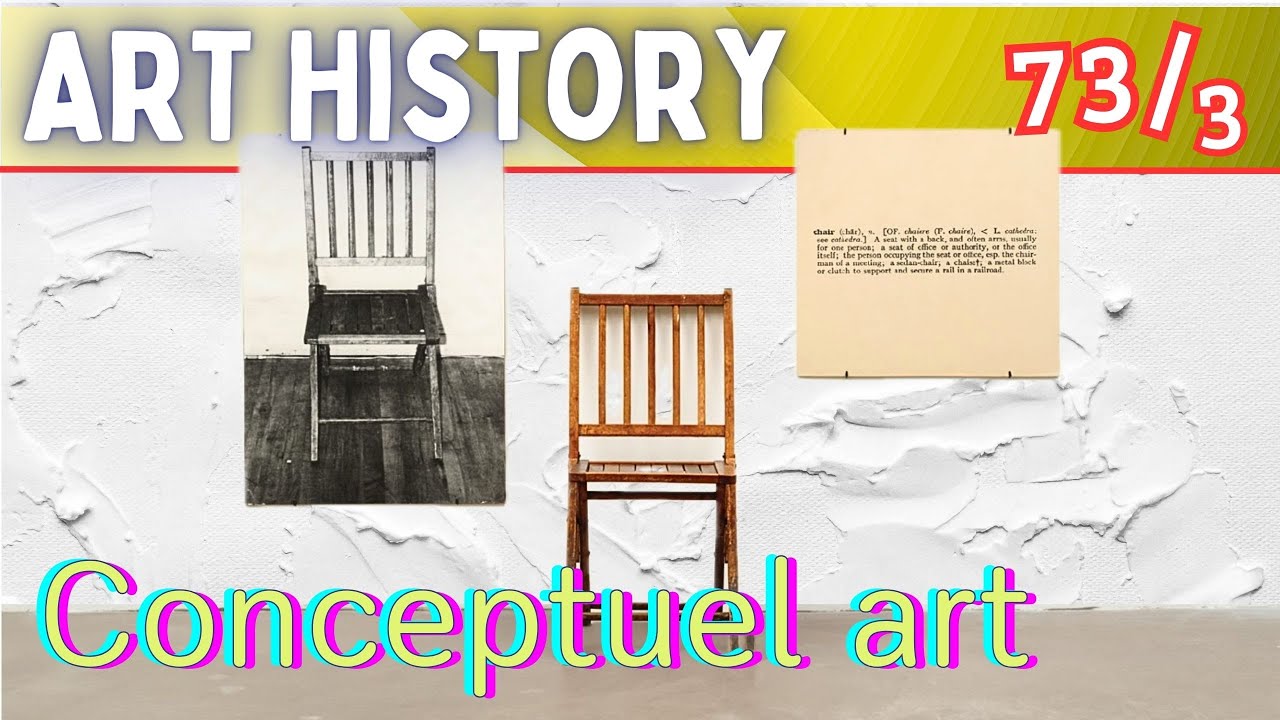
Joseph Kosuth creates conceptual art, inspired by philosophy and linguistics. Precocious and provocative, he had produced some of his most celebrated works by the age of 20. Kosuth summed up his ideas in the 1969 essay Art after Philosophy, writing, "Being an artist now means to question the nature of art... If you make paintings you are already accepting (not questioning) the nature of art. Kosuth's preferred medium was language. Words displaced images, while intellectual stimulation replaced the contemplation of aesthetic objects.
This idea was exemplified in First Investigations (1966), a series that included photostats of the dictionary definitions of "water", "idea",
"meaning", and other words.
Mona Hatoum:
The Palestinian-born artist Mona Hatoum has worked mainly in London and Berlin.
She works in many media, producing performance and installation pieces, video art, photography, and sculpture.
Her work is unsettling - the familiar becomes grotesque, and the grotesque familiar. A necklace looks as if it is made from large, decorative, brown beads, but turns out to be an eerie combination of wood, leather, and human hair.
Christian Boltanski:
Boltanski is a French artist whose artworks and installations have huge emotional power, often inspiring meditation and reverence. Boltanski left school aged 12, and started painting in 1958. In 1967, he began to explore his own personal history, assembling documents and photographs from his family albums.
In Three Drawers (1970), he made plasticine sculptures of a child's possessions, which remind us of the inconsequential treasures we cherished as children.
Boltanski's other great subject is death, and in particular the Holocaust. In Chases School (1986-87), he created an altar-like construction by placing framed photographs of Jewish schoolchildren on top of tin boxes. In 1988, in his Reserve series, he lined a whole room with musty, hand-me-down clothes - stimulating the sense of smell as well as sight.
Повторяем попытку...
Доступные форматы для скачивания:
Скачать видео
-
Информация по загрузке:


